



Binance.US has cleared the first procedural step toward offering perpetual futures to U.S. customers. The documents it filed alongside that step describe a longer runway than the announcement suggests.
In a 19 November statement , the exchange said the Commodity Futures Trading Commission had deemed its applications to register as a designated contract market (DCM) and a derivatives clearing organization (DCO) “materially complete,” and that the DCM application was now posted on the regulator’s website.
The commission’s filings database shows what that finding covers. BAM Derivatives LLC’s contract market application carries a status of “Pending” and a filing date of 19 November 2026. The exhibit list includes a 70-page exchange rulebook that names two products, a perpetual bitcoin contract sized at one hundredth of a coin and a perpetual ether contract sized at one tenth of an ether, and a core-principles mapping that runs to dozens of pages.
The clearing side is older and less far along. BAM Clearing LLC’s DCO application entered the register on 21 September, sixty days before the exchange’s announcement, and still reads “Pending Registration.” Its own summary of proposed clearing activities, filed as Exhibit A-3, states that clearing operations are expected to begin in March 2027.
Both filings are public. Neither has been granted. That gap is the story for anyone reading the announcement as a launch date.
What “materially complete” covers, and what it leaves open
The phrase comes from the commission’s own designation procedure. Under 17 CFR 38.3 , staff review a DCM application against the core principles in section 5(d) of the Commodity Exchange Act, and the Commission’s Division of Market Oversight holds delegated authority to tell an applicant that its submission is materially incomplete. A material-completeness finding is the inverse of that notice: the file is judged sufficient to enter substantive review.
Binance.US said as much in its own release. “A materially complete determination means the CFTC has confirmed the application contains the information needed to proceed with its substantive review,” the company wrote. “It is not an approval of the application.”
The same section sets the clock. Section 38.3 states that the Commission will review the application “pursuant to the 180-day timeframe and procedures specified in section 6(a) of the Act.” Counting from the 19 November filing date, 180 days runs to 18 May 2027, and the Commission may approve, deny, or designate the applicant subject to conditions within that window.
Katerina DiCostanzo, general manager for DCM and DCO at Binance.US, framed the finding as process rather than outcome. “Reaching material completeness is the product of a rigorous, collaborative process with CFTC staff, and we are grateful for their engagement,” she said in the release.
The contract terms the rulebook actually commits to
Because the DCM exhibit is published, the proposed instruments can be read directly rather than inferred from a press release. Rule 11.3 defines a perpetual bitcoin contract with a notional of 0.01 BTC, a minimum price increment of one cent, a position limit of 2,000,000 contracts and a reportable level of 25 contracts. Rule 11.4 applies the same limits to a contract of 0.1 ETH.
Three features of that specification are worth translating into dollars at current prices. CoinGecko quoted bitcoin at $59,030.00 and ether at $1,620.39 at 22:26 UTC on 20 November. One bitcoin contract therefore carries about $590 of notional value and one ether contract about $162.
The 2,000,000-contract ceiling is the more consequential number. In bitcoin terms it equals 20,000 coins, or roughly $1.18 billion at the same quote. In ether terms it equals 200,000 coins, about $324 million. The reportable level of 25 contracts, by contrast, is 0.25 BTC, or roughly $14,758, which tells you the surveillance threshold was written for retail-size accounts rather than block trades.
Settlement mechanics also differ from the offshore product most traders know. Rule 11.2 sets continuous listing with no expiry and no final settlement date, and Rule 11.3 requires settlement at least once each business day at 5 p.m. New York time. Funding is calculated for standard eight-hour intervals ending at 12:00 a.m., 8:00 a.m. and 4:00 p.m. Central time under Rule 6.2, with the transfer amount equal to the funding rate multiplied by the contract’s fair market price and trading unit. Longs pay shorts when the rate is positive, the reverse when it is negative.
Two absences in the same document matter more than any single term. Chapter 6 covers clearing and settlement, and the next chapter is printed as “Chapter 7: [RESERVED]” before the rulebook moves on to discipline and enforcement. There is no chapter on margin requirements in the exchange rulebook at all. The definitions section instead points to the clearinghouse, defined as BAM Clearing LLC, for that framework.
A clearinghouse that is still a pending line in the register
The CFTC publishes a register of derivatives clearing organizations with a status and a one-line description of permitted activity for each entry. Read on 20 November, it lists 60 organizations. Thirty hold registered status. Nine, including BAM Clearing, are pending registration. The rest are dormant, exempt or vacated.
BAM Clearing has been in the pending column since 21 September. Its application package includes a proposed clearing rulebook, a regulatory compliance chart and a summary of clearing activities, and that summary is explicit about sequencing. Clearing begins only after the DCO is registered by the Commission, the affiliated exchange obtains authority to operate as a DCM and list the initial contracts, systems and production-readiness testing is complete, clearing-member and settlement-bank arrangements are in place, and the contracts satisfy their own filing or approval requirements.
The company’s own target sits behind those conditions. “The Applicant currently anticipates launching clearing services in March 2027, although the precise commencement date will depend upon regulatory approval and completion of operational readiness activities,” the exhibit reads. The initial scope is narrow: two cash-settled, dollar-denominated perpetual contracts, BTCUSD_PERP and ETHUSD_PERP, with no swaps, no bilaterally negotiated trades, no clearing for unaffiliated venues and no direct customer access. Every customer position would sit behind a clearing member registered as a futures commission merchant.
That last point separates the U.S. product from the venue it borrows its name from. Offshore perpetuals let a trader post collateral directly against a position and get liquidated by an automated engine. The BAM structure interposes an FCM between the trader and the clearer, which is the standard onshore chain and the reason U.S. perps have historically arrived later and cost more to operate.
Two of thirty registered clearers may take margin
The register’s description column is where the practical question lives. Of the 30 registered clearinghouses, 2 carry a remark permitting them to clear margined futures: TLD Clearing, Inc., doing business as Backpack Clearing, registered 13 November 2026, and NADEX, doing business as Crypto.com Derivatives North America, registered in February 2004. The other 28 are described as permitted to clear fully collateralized futures, options on futures and swaps.
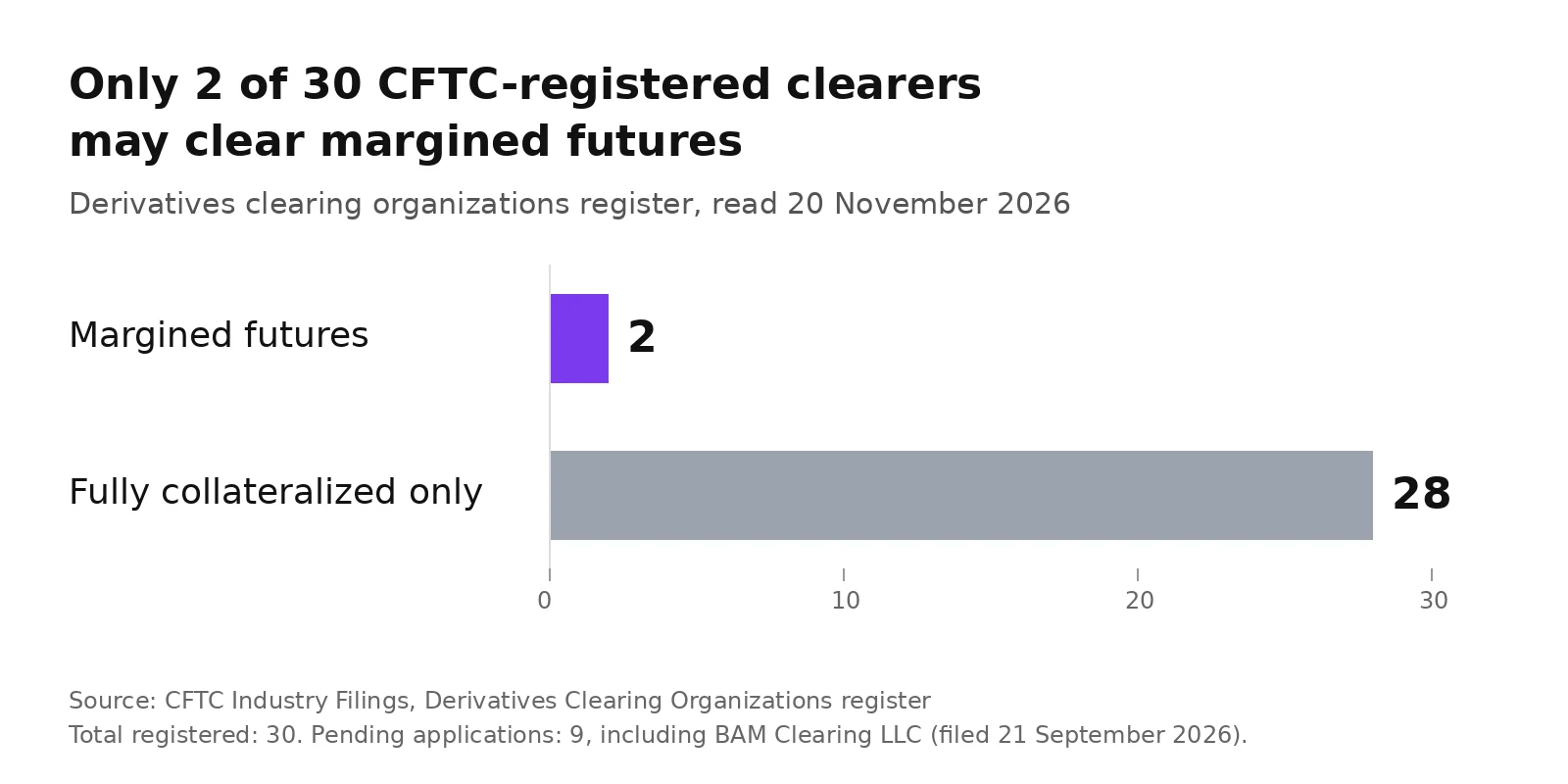
The distinction is not cosmetic. A fully collateralized clearer requires the position to be funded in full before it exists. A margined clearer accepts a fraction of contract value and collects variation margin as the position moves, which is the mechanism that produces leverage and liquidation. Backpack’s approval on 13 November, and the exchange designation that followed, made it the first new entrant to win that wording in more than two decades, as covered in our report on the clearing permission .
Nothing in the Binance.US release or in the published DCM exhibit states which permission BAM Clearing has requested. The Exhibit A-3 language assumes margin exists: it lists “Margin, Variation Margin settlement, Funding Amounts” among the obligations a clearing member owes the clearer. But the remark line that would confirm the permission only appears when the Commission issues an order, and that order has not been published.
Two caveats belong next to any count taken from that table. The remarks are staff summaries, not the operative text of each registration order, so silence in the column is not proof that a clearer cannot take margin under another authority. And the register is a snapshot: it changed twice in the week before this article, with Backpack’s entry on 13 November and the DCM designation that followed.
Why March 2027 sits before the clock runs out
Put the two timelines side by side and the scheduling problem becomes visible. The DCM application was filed on 19 November. Section 6(a) gives the Commission 180 days, which expires on 18 May 2027 unless the agency acts sooner. The clearing launch target in the company’s own DCO exhibit is March 2027, roughly two months before that statutory window closes.
For the March date to hold, three separate decisions have to land early: a DCO registration order from the Commission, a DCM designation order, and clearance of the initial contract filings. The exhibit acknowledges the dependency in plain terms, listing each as a precondition. A company target date is a plan, not a commitment the regulator has accepted, and the commission is not obliged to act before its deadline.
There is a second reason the clearing permission matters for the launch date. If BAM Clearing is registered with the fully collateralized wording that 28 of 30 clearers carry, the product that goes live would require full funding of each position. That is a functional instrument, but it is not the leveraged perpetual that offshore venues sell, and it would not compete on the same terms with the products U.S. traders already access through offshore accounts.
The competitive queue Binance.US is joining
The exchange is arriving late to a build-out that accelerated this autumn. Coinbase Clearing registered on 28 September, tZERO’s clearing arm on 16 October, XV Clearing on 29 October and Sporttrade’s clearer on 16 October, all with the fully collateralized wording. Backpack’s group went further, pairing a margined clearer with an exchange designation in the same week.
Binance.US brings a different asset: a consumer brand with a U.S. history that most of those entrants lack, and a stated ambition to rebuild share after the 2023 enforcement cycle. As we reported when the exchange outlined its comeback plan in July , management has pointed to a 20% market-share target. Derivatives are the part of that plan with the largest revenue pool and the highest regulatory barrier.
Chief executive Stephen Gregory tied the filing to customer demand rather than to a product roadmap. “Our customers have asked for access to regulated crypto derivatives, including perps, on a platform they already trust,” he said in the release. The company also stated that it “does not yet offer derivatives products” and that none would be offered “unless and until the CFTC grants the required registrations.”
Market conditions have not made the wait cheaper. Bitcoin is down 14.4% over seven days and ether 16.9%, according to CoinGecko quotes at the same timestamp, a drawdown that has thinned the volumes any new venue would be launching into. Perpetual futures remain the largest pool of crypto trading activity by turnover, which is precisely why the onshore permission has been slow to arrive.
What would have to appear before a contract trades
Three public artefacts would mark real progress, and none exists yet. The first is a Commission order registering BAM Clearing as a DCO, which would replace the pending line and carry the permitted scope in its text. The second is a designation order for BAM Derivatives as a contract market. The third is a product filing for BTCUSD_PERP and ETHUSD_PERP.
That third step has its own procedure. Under Part 40 of the Commission’s regulations, a designated contract market lists a new product either by requesting approval or by certifying that the contract complies with the Act and the core principles, with the certification taking effect after the review period unless the Commission stays it. The BAM Clearing exhibit anticipates exactly this sequence, stating that the initial contracts must satisfy “all applicable regulatory filing, certification, or approval requirements” before clearing begins.
Until those appear, the 19 November finding is a statement about paperwork quality. It tells readers that the CFTC’s staff found no missing information serious enough to stop the review. It does not tell them when a U.S. perpetual future will trade, at what leverage, or through which clearing member, and the company’s own filings put the earliest plausible clearing date in March 2027.
For the traders who have been watching this file since the 2023 lawsuit, the useful signal is narrower than the headline. The rulebook is now public, which means the contract size, the settlement hour and the funding interval are knowable in advance. The leverage is not, because the number that would set it lives in a clearinghouse rulebook whose registration is still pending.
The post Binance.US Perps Cleared the CFTC’s First Gate. Its Own Filing Points to March 2027 appeared first on BlockchainReporter .