



Bitcoin is trading near $61,500, about 51% below the October 2025 peak that 21Shares uses as its reference point, and the asset manager has now published the case it wants allocators to weigh for next year. Its Investment Outlook 2027 , published on 19 November and written by research author Eliézer Ndinga, sets out ten predictions: a new bitcoin all-time high next year, 15 of the 21 G20 members operating under a digital asset rulebook, more than 100 million monthly active stablecoin addresses, tokenised real-world asset trading at $15 trillion and a privacy sector worth more than $100 billion.
The framing is macro first. The report opens with an AI investment boom still running, an unresolved Middle East war, the first stirrings of a Eurozone debt crisis, inflation above target and rates rising, and credit spreads widening as capital gets more expensive. Against that backdrop it argues digital assets have begun a “K-shaped recovery” in which some sectors found new price discovery on fundamentals while the largest ones kept falling.
That is the part worth testing. A ten-call outlook published halfway through a 50% drawdown is either an early map or a well-formatted hope, and the difference sits in the arithmetic behind each prediction.
A New High That Depends on a Two-Point-Two Multiple
The headline call is the one that travelled fastest. “We expect a new bitcoin all-time high in 2027, though not this cycle’s top,” the report states in its key takeaways, and the reasoning runs through cycle history rather than through flows.
Low-to-peak gains across the last three cycles shrank from 114x to 21x to 8x, and in each case bitcoin traded at least 2.2 times higher twelve months after the cycle low. Applied to the June 2026 low of $59,000, that multiple produces $129,800. Against the October 2025 peak of roughly $126,000, the target clears the old high by about 3%. From today’s $61,511, it implies 111% upside.
Read that way, the call is less dramatic than the coverage suggests and more fragile. A 3% overshoot is inside normal intraday noise for bitcoin, which means the prediction lives or dies on whether the June low holds as the cycle low, not on whether the rally is strong. At $129,800 the network would carry about $2.61 trillion of market value on a circulating supply of 20.11 million coins, roughly double today’s $1.24 trillion.
The report is candid about the sample size. “Three prior cycles is a small sample, and past performance is not a reliable indicator of future results,” it says, adding that bitcoin has already fallen more than 50% and can do so again. It also anchors the “not the top” half of the call on the 2028 halving and the roughly 18-month lag between each of the last three halvings and the cycle peak.
The Demand Side of the Equation
What separates this outlook from a chart pattern is the absorption data underneath it. ETFs, corporations and sovereigns have taken in 1.75 million BTC since 2024, about 3.4 times the supply mined over the same period, worth roughly $145 billion at current prices. That implies about 515,000 coins mined since early 2024, a figure the report leaves implicit but which follows from its own multiple.
The bear-market number is the more striking one. Since the October 2025 top, those same buyers added 180,000 BTC against 122,000 mined, a ratio of 1.48 to 1 while the price halved. The report attributes the counter-cyclical bid to wirehouses and 401(k) plans widening the investor base, and it is the single claim that most directly contradicts the “no bid” narrative that usually accompanies a 50% drawdown.
Whether that bid is price-insensitive is a separate question the report does not settle. Corporate treasuries buy with balance sheets that can shrink, and ETF flows have already turned. The absorption series is a stock of holdings, not a promise of monthly demand.
Fifteen of Twenty-One G20 Rulebooks
The second call is regulatory and, unusually for this genre, it enumerates the mechanism. Regimes are already live in the EU under MiCA, plus Japan, Canada, Brazil and Turkey; the UK and Australia arrive in 2027; the report expects the US and South Korea to bring the count to 15 of 21 G20 members by the end of next year.
The US path it describes does not run through the CLARITY Act, which failed to reach consensus in September. Instead the report lists what is already moving: the GENIUS stablecoin law going live in January, a five-year runway for tokenised stocks from the SEC with a token safe harbour expected in 2027, CFTC rulemaking on perpetual futures and prediction markets, a federal digital asset tax framework that cleared committee 38 to 5, and confirmation from the Fed, OCC and FDIC that eligible tokenised securities receive the same bank capital treatment as their traditional equivalents.
The report labels the count explicitly as “a 21shares view, not passed legislation,” and the South Korea example shows why. A single dispute over whether banks or technology firms may issue won-backed stablecoins has been enough to stall that market, and the same kind of procedural fight can move a G20 member out of the count without any change in the underlying demand.
Stablecoins and the Tokenisation Ledger
On stablecoins, the base is measurable. Monthly active addresses reached 76.4 million in September 2026 and monthly card spend through digital asset neobank programmes reached $1.22 billion, against a forecast of more than 100 million addresses and $25 billion in annual card spend in 2027. The report flags its own weakness here, noting that addresses are not people and that RedotPay’s figures are self-reported and not verifiable onchain.
The tokenisation numbers are larger and harder. Trading of tokenised real-world assets is put at $6.3 trillion in 2026 rising to $15 trillion in 2027 across spot and perpetual futures, with quarterly volume already up from $0.12 trillion in the first quarter to $2.6 trillion in the third. The report says the path requires roughly 21% compounding growth per quarter.
That rate deserves a check. From a $6.3 trillion annual base, $15 trillion is 138% growth, and 21% per quarter reaches it in about 4.6 quarters, which fits a 2027 endpoint. Measured from the third-quarter run rate of $2.6 trillion instead, the same 21% would need closer to nine quarters. The difference matters because it decides whether $15 trillion is a 2027 number or a 2028 one, and the report does not reconcile the two bases. The same section expects real-world assets and fintech distribution to reach 15% of DeFi gross revenue from about 8% today, a shift already visible in products such as HSBC’s tokenised money market fund on Ethereum .
Privacy Is the Only Sector Above Its Old Peak
The privacy call is the most interesting and the most exposed. Privacy assets grew from $4 billion at the end of 2024 to about $31 billion, roughly 1% of the $2.6 trillion market excluding stablecoins, and the report expects more than $100 billion in market capitalisation in 2027. Reaching $130 billion would mean capturing 5% of today’s market. From $31 billion, the $100 billion target is a 223% gain.
Since the October 2025 top, ZEC and XMR are up 467% and 52% while BTC and ETH are down 32% and 43%, which makes privacy the only sector trading above its prior peak. The report reads that as evidence of demand from investor safety concerns, with CertiK recording 72 violent attacks on digital asset holders in 2025 and 52 in the first half of 2026, and from institutions that need discretion onchain. Canton, backed by more than 30 institutions, is said to process over $8 trillion in tokenised assets a month.
It also reads it as a warning, and the warning is already being paid for. Zcash trades at $813 after a 13.8% drop in 24 hours and a 37% decline over 30 days, a correction that has done nothing to the 467% figure but plenty to anyone who bought the top of it. The full picture of that move, including the ETF flow that preceded it, sits in our Zcash price coverage .
The Chart Behind the Drawdown
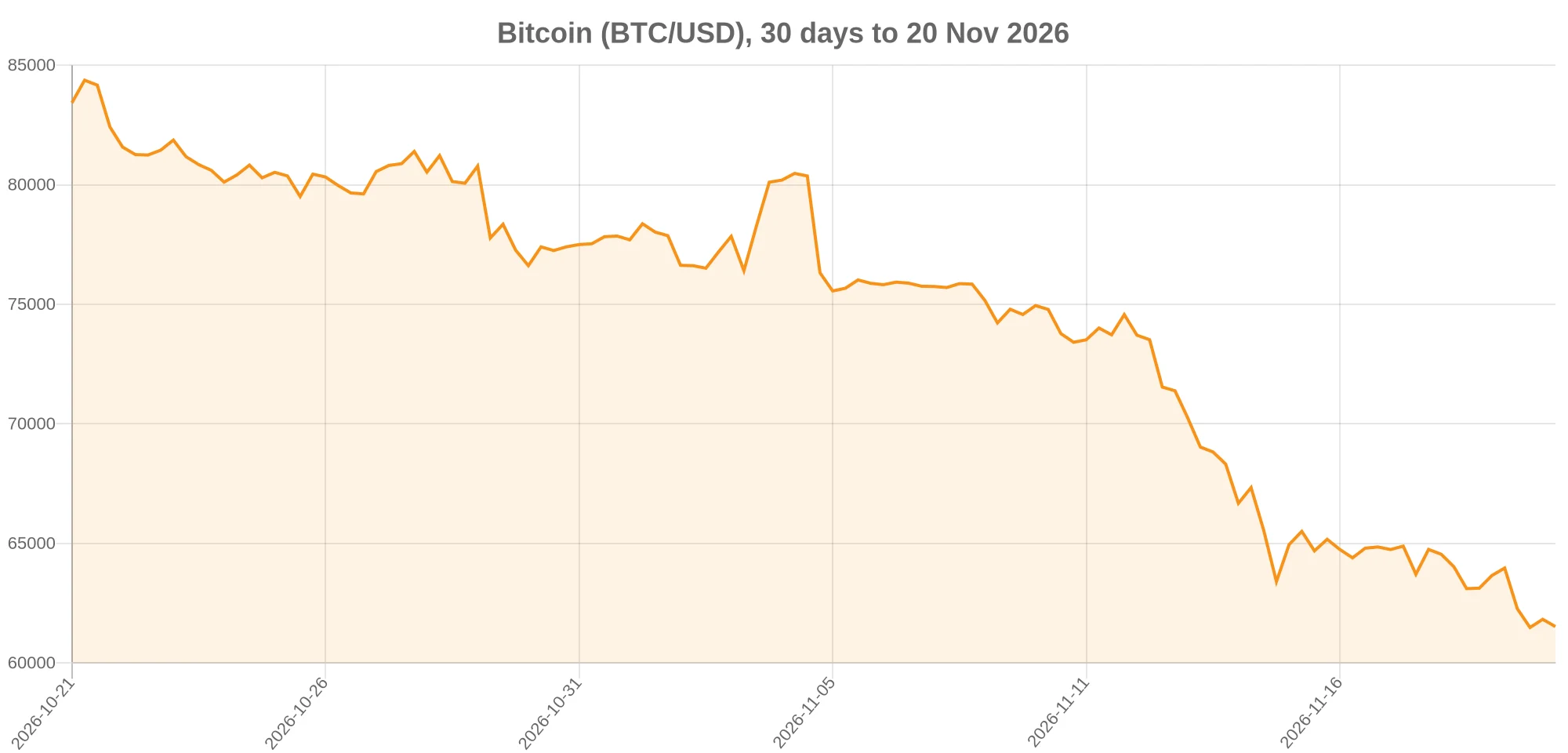
The thirty-day record makes the setup concrete. Bitcoin peaked at $84,766 on 21 October and bottomed at $61,465 on 20 November, a 27.4% decline inside a single month, with the last week accounting for 11.1% of it. Dominance sits at 58.85%, so the money leaving the asset class has not been rotating into altcoins at scale.
For the purpose of testing the 21Shares call, one level matters more than the rest. The report’s cycle argument is built on the June 2026 low of $59,000, and the current price is 4% above it. A sustained break below that low would not merely extend the drawdown, it would remove the base of the 2.2x calculation and leave the 2027 call without an anchor. The invalidation condition is therefore structural rather than tactical, and it is the single most useful number in the whole report for anyone allocating on the back of it.
Options, Prediction Markets and 50,000 BTC Behind Hidden Keys
Three of the remaining calls rest on venue economics rather than price. Onchain options are estimated at about $30 billion of volume in 2026, with quarterly volume up from $2.1 billion in the fourth quarter of 2025 to $8.8 billion in the third quarter of 2026, against a forecast above $100 billion next year and a traditional market of roughly $4 trillion a day. The October 2025 unwind, with more than $19 billion liquidated in 24 hours, is the reference case for why a product with a capped loss attracts users who will not touch perpetual futures.
Prediction markets are the most mature and the most concentrated. Sports pushed the category past $500 billion in 2026, monthly volume on Kalshi and Polymarket roughly doubled from $26 billion to $53 billion between May and July, and annual volume could still pass $1 trillion. That requires an average of $83 billion a month, a run rate the report says needs a higher baseline rather than event spikes, especially with sports at 79% of July volume and the CFTC defending federal oversight against state gambling challenges.
The quantum prediction is the one allocators should read twice. The report projects total exchange-held exposure reaching 7.5 million BTC by the end of 2027 and expects providers to move at least 50,000 BTC to addresses that hide public keys. Its 5% ratio implies a custodian base of roughly 1 million BTC, close to 5% of the circulating supply. As the report notes, no such machine exists, IonQ’s estimate puts a hypothetical 2028-era machine at 26 days to crack a key, and “the deeper fix sits with Bitcoin’s protocol, where proposals such as BIP-360 are under discussion.”
What the Outlook Does Not Answer
Four gaps are worth naming. There is no ether price target anywhere in the ten calls, despite the report noting ETH is 43% below its peak, which leaves the second-largest asset covered only as a relative underperformer. The G20 count has an end-2027 deadline but no sequencing, so a single stalled member collapses the number. The bitcoin call is presented as a cycle inference rather than a valuation, which means no level of adoption or flow can confirm it early. And the tokenisation base switches between an annual total and a quarterly run rate without reconciliation.
What the report does do is close the loop on risk. “Prices remain volatile, regulation will arrive unevenly, and several predictions depend on users staying once incentives fade,” it says, describing its own ten calls as views to test rather than forecasts to relay. For a market that has spent a month proving how quickly a 50% drawdown can arrive, that is the right register.
Data: CoinMarketCap , CoinGecko . Prices are spot at 12:37 UTC on 20 November 2026.
Frequently Asked Questions
It expects a new all-time high in 2027, but not the cycle top. The call applies a 2.2x multiple to the June 2026 low of $59,000, which produces about $129,800, roughly 3% above the October 2025 peak of $126,000 and 111% above today’s $61,511.
21Shares expects 15 of the 21 G20 members to operate under a digital asset rulebook by the end of 2027, with France, Germany and Italy counted inside the EU. The firm labels the figure a view, not passed legislation.
More than $100 billion of market capitalisation in 2027, up from about $31 billion today, which works out to a 223% gain. ZEC and XMR are up 467% and 52% since the October 2025 top while BTC and ETH are down 32% and 43%.
No. The report describes each call as a view based on data to October 2026 and states it is not a forecast of returns. The $130,000 figure that circulated in coverage is an arithmetic result of the 2.2x cycle multiple, not a target printed in the document.
The ten predictions above are 21Shares research views, not investment advice. This article is for information only.
This article is for information only and is not investment advice. Crypto assets are volatile and you can lose your money.
The post 21Shares Lays Out Ten Predictions for 2027, From a New Bitcoin High to a $15 Trillion Tokenised Market appeared first on BlockchainReporter .