




Binance has a new court order, a $6.5 billion headline number and a price chart that barely noticed. The order is a $6.5 billion worldwide freezing injunction from the Abu Dhabi Global Market Courts, granted on 18 November against defendants the court has not named. The number is 102.5% of the roughly $6.34 billion in assets Binance says the breach affected. The chart is BNB at $583.04 in CoinGecko’s 00:36 UTC snapshot on 19 November, down 2.35% over 24 hours while bitcoin fell 2.77%.
That split is the story for anyone holding the exchange’s token. A freezing order changes the legal route a recovery can take. It does not put a dollar back on Binance’s balance sheet, it does not create a claim on recovered assets for BNB holders, and it did not give the tape a reason to reprice.
A Worldwide Order Against People Nobody Has Named
Binance announced the order in its own blog post on 18 November , describing it as a step taken “to support the recovery of assets connected to the incident.” The most useful sentence in that post explains why a court was needed at all: “In some cases, issuers, exchanges or other partners request a formal court order before frozen assets will be released, transferred or returned.”
The procedural detail came from the statement Binance gave reporters, as The Block reported . Justice William Stone SBS KC issued the injunction against unidentified people accused of carrying out the attack. Alongside the worldwide freezing order, the court granted proprietary injunctions and delivery-up orders over specific stolen assets, and some interim orders apply to named parties that had already frozen funds. Binance does not allege wrongdoing by those parties.
Two features of the order are genuinely unusual. Binance said its lawyers identified about 26,000 wallet addresses holding stolen assets, and that the list will be kept live and updated as the money moves. The orders can also be served through the blockchain rather than only through conventional service, which is what allows the injunction to reach parties whose identity is unknown but whose addresses are visible.
What the public record does not contain matters just as much. Binance has not published the order itself, no defendant is named, no return date is disclosed, and no portion of the $6.5 billion is identified as located and recoverable. The one regulator document on the file, the ADGM Financial Services Regulatory Authority’s 30 October statement, is deliberately narrow: the authority is “engaging closely with Binance and monitoring the incident,” and “protecting the interests of clients and supporting the integrity and orderly functioning of markets remain the FSRA’s key priorities.”
The $6.5 Billion Is 102.5% of the Loss and 0% of the Recovery
Put the confirmed figures side by side and the difference between a legal ceiling and a cash balance becomes obvious. The $6.5 billion is the amount the injunction covers. It is not an amount anybody has counted, frozen or returned.
| Measure | Amount | Share of $6.34B affected |
|---|---|---|
| Assets affected, 29 October (Binance figure) | $6.34B | 100% |
| Frozen or intercepted by 18 November | $2.85B | 45.0% |
| Court-authorized for seizure or restraint by DOJ, 12 November | $1.2B | 18.9% |
| Ceiling of the ADGM worldwide freezing order | $6.5B | 102.5% |
| Still not frozen at the last disclosed count | $3.49B | 55.0% |
Three cautions sit under that table. The $1.2 billion is part of the $2.7 billion the US Department of Justice says was frozen across government and private-sector efforts, not an addition to it, so those rows cannot be added together. BlockchainReporter reported on 13 November that the department had won court authority over that slice of the haul while announcing a separate operation against the FaceStealer social-engineering campaign. The $2.85 billion is Binance’s own count of funds frozen or intercepted, disclosed through the statement to reporters rather than through an audited filing. And $6.5 billion divided by 26,000 addresses is roughly $250,000 per address, an average that says nothing about whether any single wallet still holds anything.
Scale the order against the token instead of the loss. BNB’s market capitalisation was $76.68 billion in the same CoinGecko snapshot, on a circulating supply of 131.51 million tokens. The $6.5 billion ceiling equals 8.5% of that market value; the $2.85 billion already frozen equals 3.7%. Neither figure is money the exchange owes its users, because Binance says it absorbed the loss itself: “users are protected,” the 18 November post states, and “Binance will not stop at reimbursing users.”
BNB’s Chart Did Not Need a Court Order to Fall
BNB closed at $759.08 on 29 October, the day of the breach, and at $697.11 the next session, an 8.2% drop in one day. It then spent two weeks in a $680 to $720 band before breaking down with the rest of the market: $656.28 on 13 November, $630.70 on 14 November and $581.47 on 15 November. From the 29 October close to today’s $583.04, the token is down 23.2%. It is 0.3% above the 15 November low.
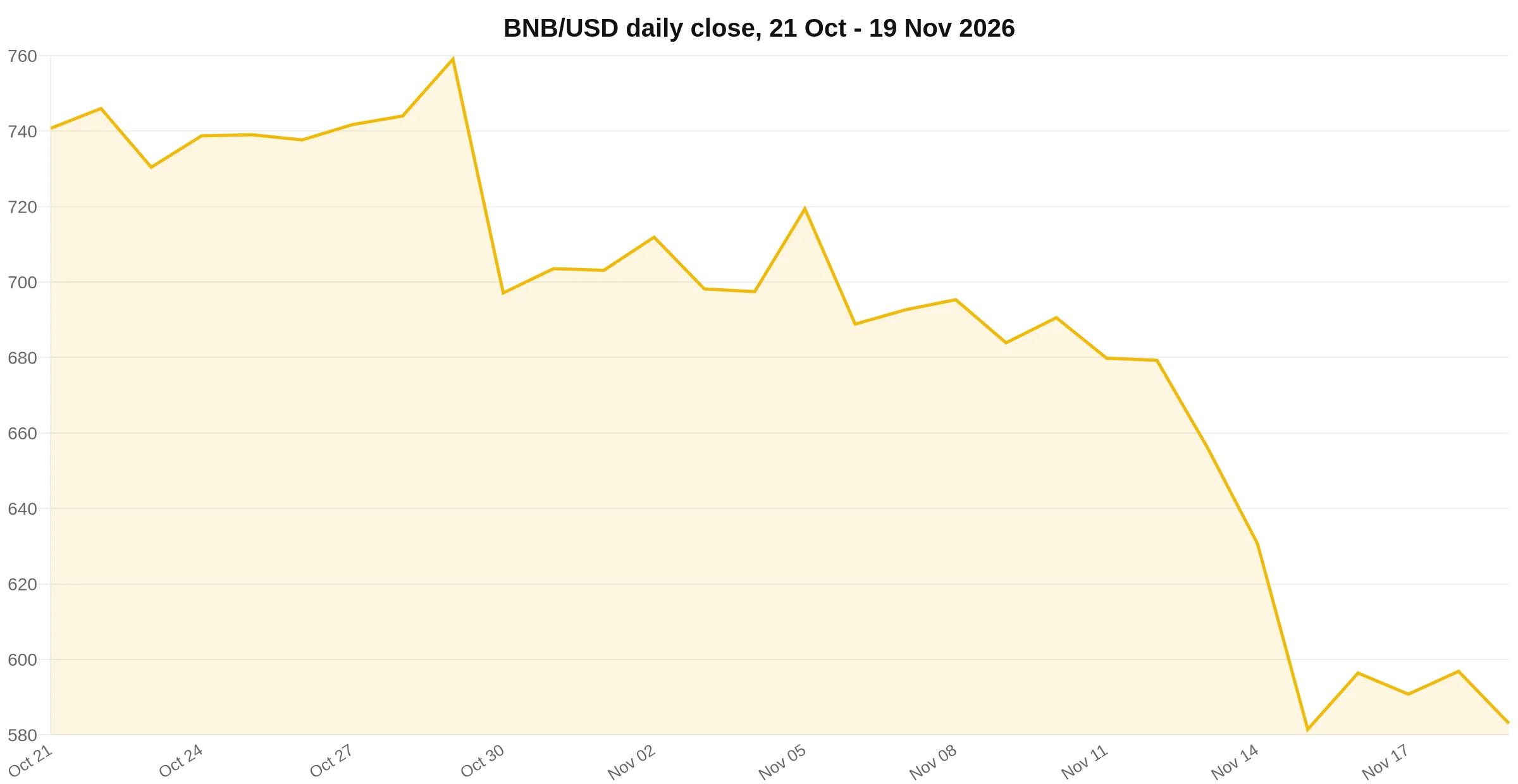
The relative numbers are the ones a holder should keep. Over thirty days BNB is down 20.3% against bitcoin’s 23.0%; over seven days it is down 14.2% against 14.8%. The exchange token has lost less than the market it trades against, which is the opposite of what a company-specific legal shock usually produces.
The order became public in the 18:00 UTC hour on 18 November. BNB closed that session at $596.85, and the token has since given back 2.3% to $583.04, inside a 24-hour range of $575.36 to $595.12. Bitcoin’s 24-hour decline in the same snapshot is 2.8%. That is not a re-rating in either direction. A two-session window cannot separate the effect of a court filing from a market that has shed 14.8% in a week, and this article does not claim it does. What the window can establish is narrower and still useful: no large idiosyncratic reaction followed, in a token whose issuer had just announced an injunction its own lawyers describe as one of the largest publicly known freezing orders.
The levels that follow from that data are few. Support sits at $575.36, the 24-hour low, with the 15 November close of $581.47 just above it; losing that level would remove the base built over 16 to 18 November and re-open the 13 to 15 November slide. Resistance sits at $595.12, the 24-hour high, and then $596.85, the 18 November close and the top of the range since. BNB/BTC trades at 0.00925, and that ratio, not the dollar price, is the cleaner read on whether the recovery story is supporting the token at all.
What a Freezing Order Does That a Stop-Loss Cannot
A worldwide freezing injunction is a court order addressed to defendants. Inside the Abu Dhabi Global Market it operates through the court’s contempt power. Outside it, the order has to be recognised or enforced by a court where the assets actually sit, which is why the practical question is not how large the ceiling is but how many jurisdictions will act on it.
Serving an order through a blockchain is a service mechanic, not a seizure mechanic. It tells the world, and any intermediary watching the addresses, that a court has restrained the funds. What actually immobilises a coin is the issuer or custodian applying its own freeze function, and Binance’s post is explicit that many of those counterparties wanted a court order before they would move: the order “assists in creating that pathway” for assets that are already frozen to be released, transferred or returned.
Read that sentence carefully and the order’s real function narrows. It is a key to the $2.85 billion already sitting in frozen accounts, not a net for the $3.49 billion still moving. The Justice Department described the traffic in its 12 November release : “TraderTraitor actors continue to launder such assets through various cryptocurrency bridges, mixers, and exchanges,” with the FBI issuing a cyber alert urging virtual asset service providers to block transactions tied to the addresses involved.
There is a second, quieter effect. A living list of 26,000 addresses that courts and counterparties can act on compresses the time between “we see the funds” and “someone with custody will freeze them.” That is process, not price. But it is the part of this week’s filing that could matter to the next recovery update.
The Case for Treating 18 November as a Small Date
The sceptical reading starts with the parties. Courts grant freezing orders against unidentified defendants routinely in fraud cases, precisely because the victims do not know who took the money. The order binds people who may never appear, and its value depends on third parties choosing to respect it. Binance’s own account says the counterparties asked for the order; it does not say they have now released anything.
Then there is the language. Gibson Dunn’s M. Kendall Day called the injunction “one of, if not the, largest publicly known freezing orders ever made,” which is a statement by the exchange’s lawyer about a ceiling, not a finding by the court about recoverable value. The court has not ruled that $6.5 billion exists, is traceable or will be returned.
Finally, the balance-sheet point. Binance says it absorbed the impact and that users are protected, and the exchange has already reported replenishing the stolen balances. If the loss has been covered, then a recovery, however large, is a recovery to the company, not a distribution to token holders. Nothing in the 18 November filing changes BNB’s supply, its burn mechanics or its claim on exchange revenue.
The fair counterweight is that “small date” is not “no date.” An order that can be served on-chain, backed by a list that updates as funds move, gives issuers and exchanges a document they said they needed. Whether that converts into released balances is now an operational question with a paper trail, and operational questions eventually produce numbers.
What Would Change the Read
Four signals will settle whether this was a procedural milestone or a turning point. First, any confirmation from an issuer or exchange that frozen balances have been released to Binance under the order. Second, the next recovery update from the company, which has published them at intervals since 29 October. Third, named defendants or enforcement filings in jurisdictions outside Abu Dhabi, which is where the order either travels or stops. Fourth, evidence that the 26,000-address list is being acted on by venues that are not party to the case.
On the tape, the signal is the ratio rather than the headline. BNB has outperformed bitcoin over seven and thirty days while absorbing a $6.5 billion legal headline. If that relative strength holds through the next recovery disclosure, the market is treating the breach as contained. If BNB/BTC breaks below 0.0090 while bitcoin is stable, the containment story is losing its only market evidence, and the $575.36 low becomes the level that decides the next leg.
Disclosure: This article does not represent investment advice. The content and materials featured on this page are for educational purposes only.
Data: CoinGecko (BNB) , CoinGecko (BTC) , Binance blog , US Department of Justice , ADGM FSRA , The Block .
The post Binance Wins a $6.5 Billion Freezing Order, and BNB Barely Moves appeared first on BlockchainReporter .