



Optimizely’s content delivery network served a cryptocurrency address swapper and a card skimmer to visitors of 178 organisations for about sixteen hours on 16 November, and the BTC, ETH and LTC addresses that collected the crypto had been emptied by 05:39 UTC the next morning. The on-chain haul was roughly $7,000.
The affected list mixes crypto businesses with household names. It includes the hardware wallet maker Ledger, the brokers OANDA, IG, Interactive Investor and TMS Brokers, and the payments firm Coinpass, alongside CNN, the BBC, Fox News, Zoom, Salesforce, GitLab, HSBC, KLM, Air France and IKEA.
The technical record comes from StepSecurity’s forensic write-up , published on 17 November and updated at 07:30 UTC, which traced the loader, the payload and the attacker’s wallets. Optimizely’s own incident notice , posted to its status page at 01:02 UTC the same day, confirms the breach in the vendor’s words: “an unauthorized party exploited a vulnerability in Experimentation and used it to add malicious JavaScript to some customer projects.”
What the injected snippet did to a wallet address
Every Optimizely Web customer loads a JavaScript file from Optimizely’s CDN, usually at a path built from the project ID. That file carries the vendor’s own code, the customer’s experiments and an optional field labelled Project JavaScript, which runs on every page of the site. The attacker wrote a loader into that field, so the malicious code arrived from cdn.optimizely.com, signed with Optimizely’s certificate.
Security researcher Scott Helme found the code in 188 of the 1,611 Optimizely snippets he checked, and published the full list of organisations behind them. Sites that serve the snippet from their own domain were hit too, because the content still came from the same project.
The payload is a single file of about 30 KB with three independent blocks. The first is the clipper. It holds replacement addresses for ETH, TRX, BTC, TON, SOL, LTC, BCH and DOGE, and it swaps only an address that passes the chain’s own checksum, so the substitute is valid and the victim’s wallet will accept it. It also waits for context: nearby text must contain a payment word such as wallet, deposit or send.
Where it can substitute, it substitutes widely. StepSecurity’s review found rewrites in page text, form inputs, link and image attributes, copy events, the clipboard API, navigator.share, the URL and body of fetch and XHR requests, and inside Function.prototype.call and apply, so a wallet-shaped string is replaced before it reaches any function.
The practical consequence sits in the clipboard. Copy an address from an affected page and the paste can already be the attacker’s. StepSecurity’s instruction is blunt: check the address on the wallet or hardware-wallet screen against the one you meant to use, not against what you copied.
The other two blocks are quieter. After a first swap on a visible element, the script loads html2canvas, captures the page as a JPEG and posts it to the payload server with the page URL, up to 8,000 characters of document.cookie and up to 20 of the original addresses. Separately, a card skimmer added at 13:43 UTC wraps fetch and XHR, checks a card number against the Luhn test and a known brand prefix, and beacons it with the expiry and CVV to a card endpoint. It cannot read fields inside a cross-origin payment iframe.
Eight chains targeted, four that took nothing
Broad targeting and narrow collection are not the same thing. StepSecurity checked the attacker’s addresses on public explorers at 07:30 UTC on 17 November and found receipts on four chains and nothing at all on the other four.
| Chain | Received | Swept |
| BTC | 0.0853 BTC | 17 Nov, 05:39 UTC |
| LTC | 17.02 LTC | 17 Nov, 04:11 UTC |
| ETH | 0.0745 ETH | 17 Nov, 05:23 UTC |
| TRON | 662.9 USDT, 184 TRX | USDT on 16 Nov, 13:03 UTC |
| TON, SOL, BCH, DOGE | 0 | No transactions |
The ETH address had received 0.0192 ETH on 12 November and a 1 gwei transfer on 15 November, both before the payload domain existed. The TRON account was created in March and kept receiving transfers on the morning of 17 November. StepSecurity reads that as infrastructure built for a longer run, not a weekend experiment.
The haul, priced this morning
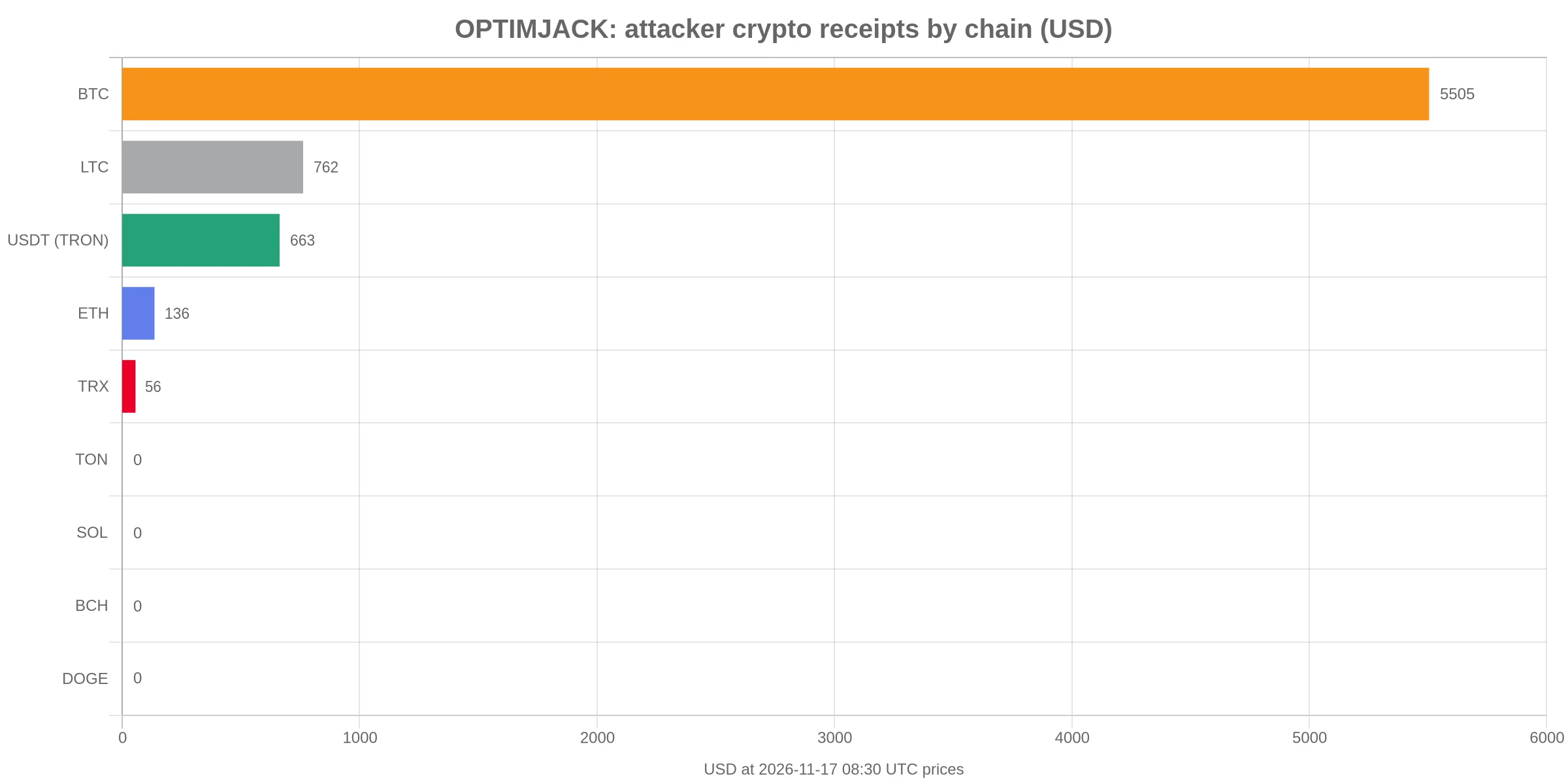
At 08:30 UTC on 17 November, with BTC at $64,541, ETH at $1,828.55, LTC at $44.75 and TRX at $0.3055, the four funded addresses hold what they received at a combined value of about $7,122. Bitcoin accounts for $5,505 of that, or 85.2% of the non-stablecoin total. Litecoin adds $762, ETH $136, TRX $56 and the stablecoin leg $663.
Helme put the take at $7,040 as of 19:25 UTC on 16 November. The difference between his figure and this morning’s valuation is price drift on a stack that has not grown, because the wallets were swept rather than topped up. Divided across the 178 organisations in Helme’s list, the crypto loss works out to about $40 per affected site.
Why 178 websites produced $40 each
The gating explains most of it. A swap needs a checksum-valid address, a payment word nearby, and a visitor who is actually moving funds at that moment. Crypto and trading is the sixth-largest sector in the list with six organisations, behind banking and finance at 32, technology and SaaS at 23, retail at 20, streaming at 12 and news and media at 10. The other groups are airlines and travel at 9, telecoms at 7 and insurance at 6.
Most of those visitors never touched a wallet address, and the cookie and screenshot block only fires after a first swap. The clipper is a filter, and the filter needed a specific kind of traffic on a specific kind of page.
The countercase matters more than the total. An on-chain figure is the only part of this incident that can be counted, which makes it the worst possible measure of the damage. “The money is a small part of the damage,” StepSecurity writes. “Stolen cookies, card data and any iOS compromise leave no trace on-chain.” Card data captured on a checkout page, session cookies scraped from a page that had just swapped an address, and a phone that loaded an exploit chain do not show up in a block explorer.
The iOS branch is the part with no crypto angle at all. On iPhone, iPad and iPod user agents the script adds two boot scripts from .icu hosts, and on iOS 18.6 or earlier it loads a hidden iframe that pulls an exploit page. Helme’s analysis identifies Coruna for iOS 13 to 17 and DarkSword for iOS 18.x, and reports that pages on iOS 18.6 or earlier reload every 60 seconds to retry. StepSecurity says it did not retrieve or analyse those files itself.
A consent banner does not stop this
The defence gap is structural, and it is the reason a marketing tag became a wallet risk. “The site’s own code is clean,” StepSecurity notes. “The change is in a vendor-hosted file, so code review and repository scanning never see it.”
Two standard controls behave worse than teams expect. Subresource Integrity cannot easily pin a snippet that changes whenever a team publishes an experiment. Content Security Policy does work, with one exception worth writing down: a host allowlist in script-src blocks the download and a connect-src allowlist blocks the exfiltration, but a policy built on strict-dynamic with a nonce does not, because it trusts whatever a trusted script adds.
A consent banner is not a control here either. In the scan StepSecurity cites from GitLab, the consent manager itself is what loaded the Optimizely bundle. It decides when the script runs, not what the script contains.
For site owners on Optimizely, the remediation is manual. Read the Project JavaScript field of every project. Searching the served snippet for the payload domain is not enough, because one loader variant hides the URL in base64 and another carries the payload inline with an eval fallback. The vendor’s fix removes the injected code, but it does not tell an operator which of their own projects was modified, when, or through which account.
What to check before you send
If you pasted an address copied from one of the affected sites between about 04:00 and 21:00 UTC on 16 November, verify the destination on the signing device before approving anything, and compare it to the address you intended rather than the one in your clipboard. A hardware wallet helps only when the screen is actually read.
Card details entered on an affected checkout in that window should be treated as exposed and the card replaced. iPhones and iPads on iOS 18.6 or earlier that visited those sites are candidates for forensic triage rather than a routine update.
The incident also sits in a familiar line of work. The Luxor Commander hijack showed how a tampered update path turns into diverted Bitcoin payouts, and the Trezor Safe 5 implants showed the same lesson in hardware. The pattern is consistent: the trusted intermediary is the target, and the loss shows up later than the compromise.
What Optimizely has not explained
Three questions remain open. The first is mechanism. Optimizely has said the flaw lay in its account signup flow, according to StepSecurity’s update, but it has not explained how a signup flaw produced write access across unrelated customer projects, and Helme has asked the same question.
The second is attribution. Nobody has claimed the campaign publicly, the payload domain 1688360[.]cc was registered at 05:23 UTC on 16 November and put on registry hold at 00:37 UTC on 17 November, and it no longer resolves. Two of the iOS-stage .icu hostnames still resolve to a Google Cloud address in Hong Kong, while the three registered on 16 November no longer answer.
The third is completeness. Helme found one snippet still infected at 21:52 UTC on 16 November, after the mass clean-up had run, and Optimizely’s status page still listed the incident as monitoring at 07:30 UTC on 17 November. Until the vendor publishes which projects were modified, an affected operator cannot rule out a return.
Frequently Asked Questions
Ledger, OANDA, Coinpass, IG, Interactive Investor and TMS Brokers sit in the crypto and trading group of six organisations in Helme’s list. The largest group was banking and finance with 32, followed by technology and SaaS with 23 and retail with 20.
The clipper rewrites an address only when the surrounding text contains a payment word and the address passes the chain checksum. A visitor who never copied or typed an address received no swap, and the cookie and screenshot exfiltration ran only after a first swap on the page.
No firmware compromise has been reported. The injected code ran in the browser, so the risk was a substituted address rather than a compromised device. A hardware wallet defeats the swap only when the recipient address is read on the device screen before approval.
Disclosure: This article does not represent investment advice. The content and materials featured on this page are for educational purposes only.
The post Optimizely Script Hijack Reached 178 Sites and Eight Crypto Chains for $7,040 appeared first on BlockchainReporter .