




Binance Pay opened a consumer credit line on 16 November 2026. The product, Binance Pay Later , lets eligible users in Argentina and Mexico pay through Binance Card or QR Pay without selling the BTC, ETH or BNB already sitting in their accounts. Binance described it as “a new crypto-backed spending feature that allows eligible users to make purchases through Binance Card or QR Pay without selling their crypto holdings.”
The terms are narrow and specific. The spending limit is capped at 1,000 USDC and at 50% of the value of eligible collateral. The borrowed currency is USDC, not the asset pledged. Interest is 0% until the first day of the following calendar month, and interest charges apply to overdue amounts. Binance says the feature is live “initially” in two markets “with more markets to follow,” which leaves the rollout calendar open.
That combination makes Pay Later a secured lending product wearing a payments interface. The collateral is locked at the moment of purchase rather than at enrolment, the loan is drawn against it in stablecoin, and the position carries three published thresholds that determine when a user is warned and when the collateral is sold. Those thresholds, not the cashback rate, are the part of the design a borrower has to understand before spending anything.
What actually gets locked when a user taps Pay Later
Enrolling does not lock any asset. The collateral and loan-to-value documentation states the rule directly: “Collateral is only locked when you make a transaction using Pay Later.” Spend 100 USDC at the 50% initial LTV and roughly 200 USDC of eligible assets is held.
Collateral is drawn first from the Spot Account and then from the Flexible Earn account if the user has enabled it as a funding source. The Spot Account is the primary source and cannot be disabled. Assets already locked cannot be removed from the collateral list, at least one eligible asset must stay selected, and changes to collateral settings apply only to future transactions rather than to an existing draw. Binance’s FAQ also states plainly that the platform will not switch a user to Pay Later automatically; the mode has to be selected manually, and switching back to the ordinary Card Available Balance is also manual.
Two mechanical details matter more than they look. The loan is denominated in USDC, so a purchase made in another currency can involve a conversion under the Card or Pay flow. And the collateral is held inside the Spot Account, which means it stops doing whatever else the user wanted it to do while the draw is outstanding.
Three LTV thresholds decide whether the collateral survives
Pay Later measures risk as a loan-to-value ratio: loan value divided by collateral value, priced on Binance’s index price for the locked assets. Loan value includes principal, interest and applicable fees, so the ratio creeps upward if an outstanding balance sits unpaid even when no new purchase is made.
Binance publishes the three thresholds applied to the product. Initial LTV is 50%. Margin Call LTV is 75%, the level at which the user is notified that the position is approaching liquidation. Liquidation LTV is 90%, the level at which the system may sell collateral to repay the balance. Because LTV includes accrued interest, a position can drift toward the margin call without any move in the underlying asset.
Collateral release follows the same arithmetic in reverse. Repay in full and all collateral is released. Repay partially and collateral comes back only if the resulting LTV is below 50%, and only until the ratio is restored to that level. If the post-repayment LTV is still above 50%, nothing is released and the collateral stays locked in the Spot Account.
What 1,000 USDC of credit requires in BTC, ETH or BNB today
At a 50% initial LTV, reaching the 1,000 USDC ceiling requires at least 2,000 USDC of eligible collateral value. At the prices quoted by CoinGecko at about 15:50 UTC on 16 November 2026, with bitcoin at $64,511, ether at $1,818.11 and BNB at $587.10, that works out to about 0.0310 BTC, 1.10 ETH or 3.41 BNB for a borrower drawing the full limit.
The thresholds then translate into price levels that are identical in percentage terms across all three assets, because the ratio does not care which coin is pledged. From a 50% starting ratio, a 33.3% fall in collateral value takes the position to 75%, the margin call line. A 44.4% fall takes it to 90%, the liquidation line. On the figures above that is bitcoin at roughly $43,007 for the warning and $35,839 for liquidation, ether at about $1,212 and $1,010, and BNB at about $391 and $326.
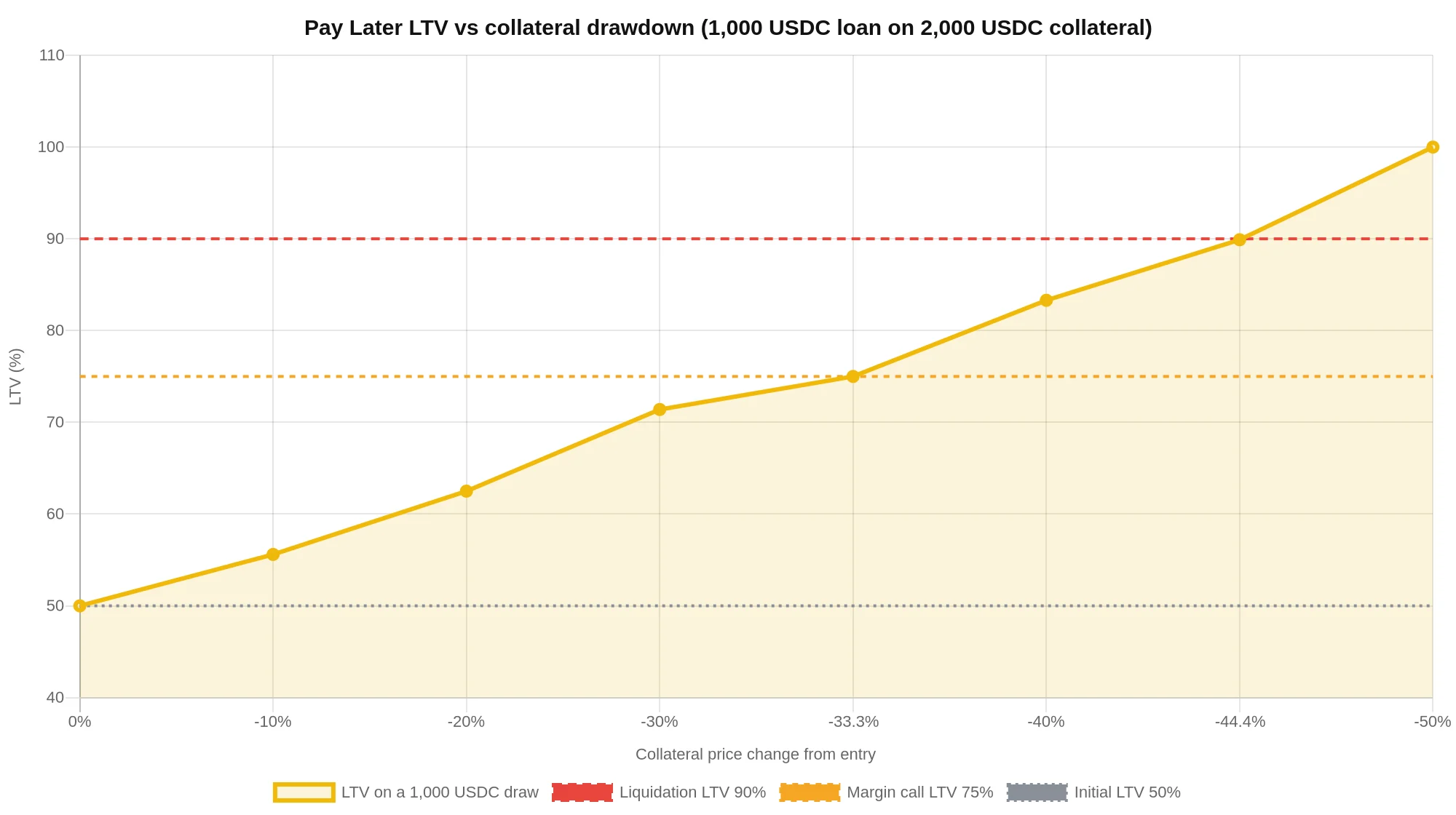
Those levels are arithmetic, not forecasts, and they describe a position that is left untouched. Two adjustments shorten the distance. Interest and fees added to the balance push LTV up without any price move, and a borrower who repays part of the balance without clearing it may find collateral still locked because the ratio has not fallen back below 50%. A user who spends close to the 1,000 USDC cap with the minimum 2,000 USDC of collateral is running a thin buffer against a 33.3% drawdown in a market where bitcoin is on course for a sixth consecutive weekly loss.
Why a card product is still a credit product
The payments framing obscures the balance sheet. Binance lends USDC against crypto, sets a loan-to-value ratio at origination, monitors the ratio against an index price, notifies the borrower at 75%, and may liquidate at 90%. That is the structure of a margin loan, and it sits inside a consumer card flow that many users will treat as a debit product.
The comparison inside the market is not a card. It is collateralised borrowing. When Ledger launched a bitcoin-backed loan through Morpho , the mechanics were onchain and the liquidation rules were visible in a public protocol. Here the liquidation engine is Binance’s own, and the announcement does not describe the order type, the venue or the slippage treatment used when collateral is sold. Nor does it publish the interest rate that applies once the grace period ends, only that interest charges apply to overdue amounts.
The two launch markets carry their own unresolved questions. Binance’s announcement frames availability around eligibility, identity verification, local requirements and its own risk controls, and includes the standard caveat that products “may not be available in your region.” It does not name a licence, a local entity, a regulator or a consumer-credit disclosure regime for either Argentina or Mexico, and it does not say why those two markets were chosen first. The product documentation reviewed for this article says nothing about tax treatment of a liquidation, about credit-bureau reporting, or about what happens to a position if an account is restricted while collateral is locked.
The parts of the terms a borrower should read twice
The 3% cashback is the most visible number in the marketing and the least important in the risk model. It is capped by “applicable reward terms” that the announcement does not reproduce, and it accrues on eligible Card purchases rather than on the credit itself. The interest-free window is more valuable and more conditional than it appears: a purchase made on 16 November falls due on 1 December, which is 14 days of free credit, while a purchase made on the first of a month gets 31 days. The window is a calendar artefact, not a fixed term.
Binance also reserves the right to change the terms unilaterally. The announcement carries the standard clause that the exchange “reserves the right in its sole discretion to amend or change or cancel this announcement at any time and for any reasons without prior notice.” For a credit product with a published liquidation threshold, that clause is the one that determines how much weight the current numbers deserve.
The broader pattern is that collateral has become a feature of consumer payments, not just of institutional settlement. Binance spent the past two months widening what counts as collateral on its exchange, from tokenised stocks to bStocks margin access. Pay Later extends the same logic to a card swipe, with the difference that the borrower is now a retail user spending against a position that can be liquidated while they sleep.
Frequently Asked Questions
Binance Pay Later is a crypto-backed spending feature from Binance Pay that lets eligible users pay through Binance Card or QR Pay while borrowing USDC against BTC, ETH or BNB held in their account, instead of selling those assets.
The spending limit is up to 1,000 USDC per user and up to 50% of the value of eligible collateral. Reaching the 1,000 USDC cap therefore requires at least 2,000 USDC of eligible collateral at the 50% initial LTV.
Loan-to-value rises as collateral value falls. Binance sets the margin call LTV at 75%, when the borrower is notified, and the liquidation LTV at 90%, when collateral may be sold to repay the balance. From a 50% starting ratio, those levels correspond to collateral drawdowns of about 33.3% and 44.4%.
Interest is 0% only until the first day of the following calendar month. Repaying by that due date avoids interest; overdue amounts accrue interest charges, and accrued interest also raises the loan-to-value ratio.
Binance says the feature is initially available to eligible users in Argentina and Mexico, with more markets to follow. Eligibility depends on account status, identity verification, local requirements and Binance’s risk controls, and the announcement notes that products may not be available in every region.
No. Binance states that it will not switch a payment method to Pay Later automatically. Users select Pay Later manually in Binance Card or Binance Pay, and switch back to the ordinary available balance manually as well.
This article is for informational purposes only and does not constitute financial or investment advice. Binance’s stated terms are those published on 16 November 2026 and may be amended; readers should confirm current terms before borrowing.
The post Binance Pay Later: 1,000 USDC Against BTC, ETH or BNB, Liquidated at 90% LTV appeared first on BlockchainReporter .