




Binance closed its door to MEXC on November 10. The exchange published a notice that day stating it will not process transactions involving MEXC, MEXC Global and eleven other listed names, and that any funds arriving from those entities “will be temporarily withheld and subject to compliance review.” On the same date the U.S. Treasury order behind the move became a binding federal rule in the Federal Register at 91 FR 72420, with an effective date of December 10, 2026 . Binance, which is not a U.S. financial institution and therefore not covered by that order, began enforcing it thirty days early.
That gap is the substance of the story. A special measure under section 9714(a) of the Combating Russian Money Laundering Act constrains banks, brokers and money transmitters regulated inside the United States. It says nothing about an offshore exchange. Binance’s notice cites no statute, offers no appeal route and does not explain how it decided who belongs on its list. It converted a regulatory finding into a commercial rule, and in doing so published a set of names longer than the one the government wrote.
The Federal Register Replaced the Placeholder With a Date
When FinCEN issued the order on November 6 , the document still carried a bracketed blank where the publication date belonged, so the thirty-day clock had nothing to count from and users could not tell when a transfer would start failing. Four days later the Federal Register settled it. Document 2026-22962, published on November 10, now states a fixed start of December 10, 2026, and the agency’s own summary confirms the finding reaches subsidiaries, branches, offices and successor entities of the exchange wherever they operate outside the United States.
The evidentiary core did not change between the two versions. Treasury’s release on the action states that between May 2021 and May 2026 MEXC Global moved at least $16 billion connected to sanctions evasion, cybercrime and other illicit finance. Nearly $1.5 billion of that is tied to Russian sanctions evasion, including $232 million in direct transactions with entities designated by the U.S., the EU and the UK. The release also puts the venue’s scale on the record: founded in 2018, more than $1 billion in daily transactions as of September 2026, roughly $5 billion in reserves, more than 50 currencies and 3,000 tokens, and a place among the 20 largest convertible virtual currency exchangers.
Treasury Secretary Scott Bessent described the choice in blunt terms. “Financial institutions cannot have it both ways: Either you support the Iranian regime, or you have access to the U.S. financial system,” he said in the release. “Treasury will continue to sever the Iranian regime’s economic lifelines and thwart its desperate attempts to circumvent U.S. sanctions using digital assets.”
Thirteen Entries, Three of Which Differ by a Single Letter
Binance did not copy Treasury’s six corporate vehicles and stop there. Its notice lists thirteen entries:
- MEXC Global Limited
- MEXC Estonia OÜ
- GIDA Technology AG
- MXC Global Ltd
- MEXC Global Foundation Ltd
- MEXC Singapore Pte Ltd
- MEXC (Comoros) Ltd
- MEXC
- MEXC Global
- MEX Global Ltd
- MX Global LTD
- MEX Exchange (former name)
- MEXC affiliates
Read as written, the thirteen entries break into six legal entities that also appear in the Treasury order, one additional corporate vehicle in MEXC (Comoros) Ltd, two brand names a customer would recognise and type rather than companies that can hold a bank account, one former name so that transfers routed under the exchange’s older identity fail as well, one catch-all, and two strings that differ from MXC Global Ltd by a single letter.
That last group is the practical problem. MEXC affiliates has no definition, no jurisdiction and no registration number attached to it in the notice, so its scope is whatever Binance decides it is. MEX Global Ltd and MX Global LTD sit one character away from a company that is named in the order, and nothing in the document says whether they are the same entity, a variant spelling, or unrelated firms caught by a name match. For a withdrawal already in flight, that ambiguity decides whether the funds arrive or get held, and the person waiting on them cannot check the answer before sending.
What a Blocked Transfer Looks Like From the User Side
The operational instructions are unusually plain. “Accordingly, please do not directly or indirectly send to, receive from, or otherwise engage in transactions through Binance involving these entities,” the notice reads, before spelling out both directions. “Any requests to send funds from a Binance Account to any of the above entities will be declined.” Outbound is a wall: the transaction does not leave.
Inbound runs through a gate instead of a wall. Deposits from the listed entities “will be temporarily withheld and subject to compliance review and users may potentially be subject to further restriction in accordance with Binance Terms of Use, including offboarding.” Three words in that sentence carry the exposure. “Temporarily” has no stated ceiling, so a withheld deposit has no published release date. “Compliance review” has no stated criteria, so the user cannot prepare evidence for a test nobody has described. “Offboarding” means the account itself can be closed, which turns a single incoming transfer into a platform-level outcome.
The direction of the risk is what makes this different from a sanctions list applied to a bank wire. A Binance user who has never opened a MEXC account, never held a MEXC balance and has no relationship with the exchange can still trigger a review if a counterparty routes through it. The notice says so directly: the prohibition covers indirect transactions too. In practice that pushes diligence onto the receiving side, where most retail users have the least information.
An Issuer Moved First, the Largest Venue Followed
Binance is not the first counterparty to walk away, and the sequence is instructive. On November 7, the day after the order was announced, Florida-based NatGold Digital asked MEXC to delist its gold token immediately rather than wait for the effective date, as our reporting on the order’s scope described at the time. A token issuer can leave in an afternoon. An exchange of Binance’s size changing its transfer rules is a different order of decision, and it arrived three days later, on the same date the Federal Register set the clock running.
The mechanism behind that choice is worth separating from the politics. Exchanges do not sit inside the U.S. banking system, but their dollar legs do. Market makers, custodians, settlement banks and payment processors that touch a large venue are covered financial institutions, and the order extends liability for a willful violation down to the officers, directors, employees and agents of those firms. An exchange that keeps MEXC rails open risks its own access to that layer of counterparties. Blocking early is cheaper than arguing later, which is why the private calendar runs ahead of the public one.
The Blast Radius, Measured Two Ways
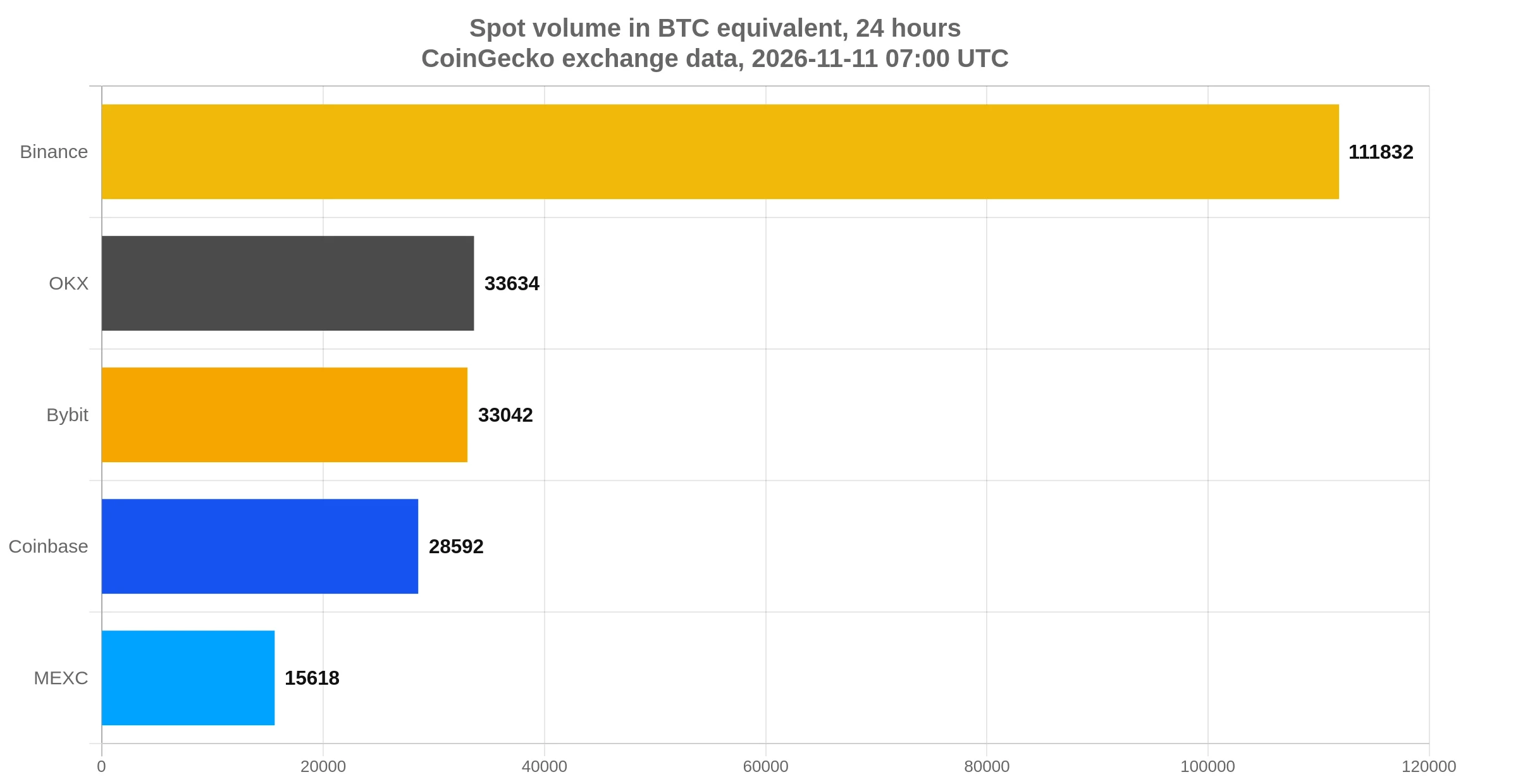
CoinGecko’s exchange table put MEXC at 15,618 BTC of 24-hour spot volume at 07:00 UTC on November 11, against 111,832 BTC at Binance. MEXC is therefore trading about 14% of Binance’s volume, or roughly one seventh of it. Priced at bitcoin’s $73,557 at the same timestamp, MEXC’s figure works out to about $1.15 billion a day. That lands close to Treasury’s own “more than $1 billion” for September 2026, from a completely separate data source, which is a useful cross-check on the size of the venue being cut off.
The second calculation cuts the other way, and it is the one worth doing before repeating the $16 billion figure as if it were a daily flow. Sixteen billion dollars spread across five years is about $8.8 million a day. Against MEXC’s current throughput that is roughly 0.76%. The $16 billion is a cumulative estimate of transactions FinCEN attributes to sanctions evasion, cybercrime and darknet activity over a five-year window. It is not a claim that most of the exchange’s book was illicit, and Binance’s notice does not repeat it as one.
The composition matters for the same reason. Russian-linked flows at nearly $1.5 billion account for about 9.4% of the cited total. The A7A5 stablecoin figure of almost $200 million is about 1.2%. The remaining balance is spread across Iranian exchangers, ransomware and scam payments, and darknet market activity, each with its own evidentiary weight. A user reading “primary money laundering concern” is reading a regulatory finding about control failures, not a criminal conviction, and the order does not allege one.
Where the Notice Writes Its Own Rules
The order and the notice are not the same instrument, and the difference is where a user’s exposure actually lives. The order binds covered institutions and stops there. The notice binds Binance accounts, extends to indirect transactions, adds an undefined affiliate category, and attaches a review process with no published duration, no criteria and an offboarding outcome. It also arrives early, before any U.S. institution is required to do anything.
That is the countercase to reading this as straightforward enforcement. Private de-risking can be broader and less reviewable than the state action it anticipates, because the state must publish reasons and the exchange must only publish a list. Binance has a commercial reason to be conservative, and a user has almost no standing to contest a held deposit while the review is open. The order, for all its severity, at least names its statutory basis and its date.
What Would Show Whether the Blockade Holds
Four observable signals will settle the question over the next month, and none of them requires a court ruling. The first is whether other large venues publish comparable notices before December 10; if the pattern stops at one exchange, the blockade is a commercial choice rather than an industry norm. The second is what happens to withheld deposits after review, and how long the reviews take. A queue that clears in a week is a compliance process; a queue that does not clear is a seizure with a softer name.
The third is whether MEXC’s own rails degrade in measurable terms, through stablecoin outflows, withdrawal complaints or a change in its reported volume share. The fourth is legal: a challenge to the finding, a correction in the Federal Register, or a revision of the entity list would each change who is blocked and when. Until one of those lands, the cleanest description is that the largest venue has decided a question the government has not yet had to enforce, and MEXC’s customers are absorbing the cost of that decision in the space between November 10 and December 10.
Disclosure: This article does not represent investment advice. The content and materials featured on this page are for educational purposes only.