




Strive, Inc. reported $509.0 million of net income for the third quarter, and almost none of it came from running a business. The Dallas company earned $2.696 million in revenue between July and September. It recorded $533.7 million of unrealized gains on the bitcoin it holds. The mark-up was 198 times the revenue line and larger than the entire profit.
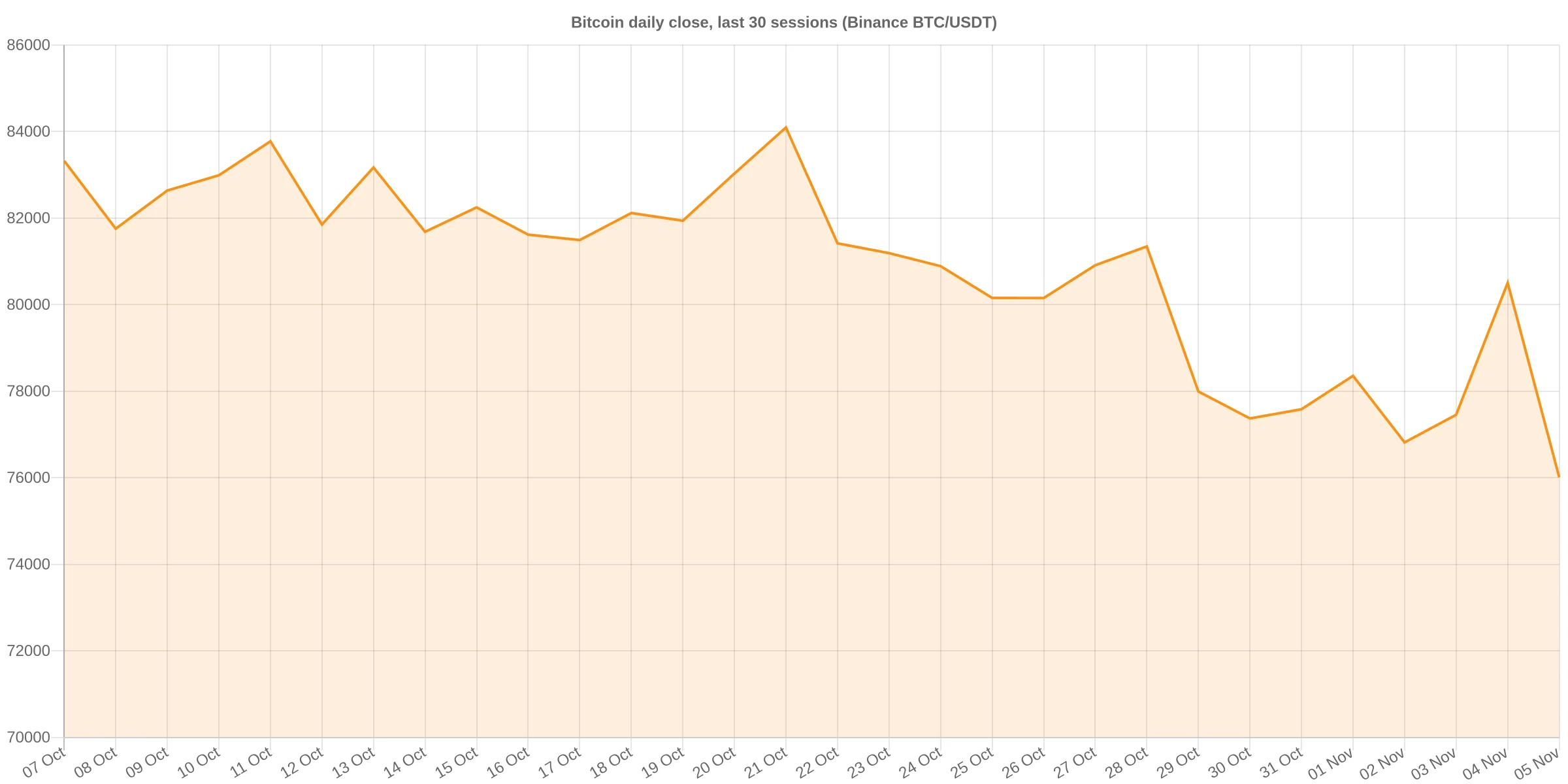
That is the shape of a digital-asset treasury company in a rising quarter, and Strive is now one of the larger ones: 43,124 bitcoin as of October 30, worth about $3.26 billion at $75,630 per coin, the price CoinGecko showed at 19:33 UTC on November 6. The company disclosed the figures in an earnings release filed with the SEC and in the Form 10-Q for the quarter. Its October purchases, made at an average of $83,310, are already under water.
What Strive Actually Reported
The income statement is short enough to read in one pass. Total revenue of $2.696 million came from investment advisory fees ($1.559 million) and medical device sales ($1.133 million). Operating expenses were $38.699 million, including $15.633 million of employee compensation and a $14.65 million impairment of a medical device research and development intangible.
Strip the investments out and the quarter was a $36.0 million operating loss. The investments did the rest: $533.697 million of unrealized bitcoin gains, $8.833 million from the company’s stake in Strategy’s variable-rate preferred stock, and $1.497 million of other investment gains, for $544.027 million in total investment gains. Net operating income came to $508.024 million, other income added $1.008 million, and net income landed at $509.032 million.
Preferred dividends of $34.231 million left $474.801 million attributable to common stockholders. Diluted earnings per share were $5.24 on 90.5 million diluted shares. On a non-GAAP basis the company reported adjusted net income of $494.6 million, or $5.46 per diluted share.
Chairman and CEO Matthew Cole framed the quarter as validation of the strategy that produced those marks.
“Strive has continued to successfully execute on its treasury management strategy, delivering a strong bitcoin yield year to date in 2026, which I believe is the primary driver of our common equity’s outperformance relative to Bitcoin so far this year,” Cole said in the release.
He added: “With the recent issuance of SATS, we believe Strive has never been in a better position to generate long-term returns in excess of Bitcoin for our common equity shareholders.”
The Profit Lives in One Line Item
Under ASC 350-60 , bitcoin held by a company is carried at fair value and the change in that value runs through net income. Strive marks its coins to Coinbase quotes at each quarter end. A rising price therefore produces accounting income with no cash attached, and a falling price produces accounting losses the same way.
Two comparisons make the dependence plain. First, the $533.7 million mark was 105% of the quarter’s $509.0 million net income, so every other item in the quarter, netted together, was negative by roughly $24.7 million. Second, the nine-month picture is still a loss: Strive reported a $14.477 million net loss for the first nine months of 2026 despite three quarters of bitcoin accumulation. The third quarter alone flipped the year because bitcoin rallied into September 30.
None of this is improper. It is how the rule works, and peers including BitMine report the same way. But a reader comparing Strive with an operating company should know that $509 million of “earnings” is a price observation, not a margin.
October’s 15,124 Bitcoin at $83,310
The quarter ended with about 28,000 bitcoin on the books, carried at $2.34 billion, or roughly $83,578 per coin. Between October 1 and October 30 the company bought 15,124 more at an average of $83,310 including fees, which took the treasury to 43,124. That is 54% growth in one month.
| Measure | Figure |
|---|---|
| Bitcoin held, Sept 30 | ~28,000 |
| Bitcoin bought, Oct 1–30 | 15,124 at ~$83,310 |
| Bitcoin held, Oct 30 | 43,124 |
| Cash and equivalents, Oct 30 | $490.4 million |
| Strategy preferred (STRC) stake | $50.1 million |
The arithmetic on the October tranche is unkind at today’s price. 15,124 coins at $83,310 cost about $1.260 billion. At $75,630 they are worth about $1.144 billion, a paper loss of roughly $116 million, or 9.2%. The company’s final purchase of the month, 124 bitcoin bought between October 24 and October 30 at an average of about $80,526, was disclosed separately in a November 2 filing and sits about 6% below spot.
The sensitivity is worth memorising: every $1,000 move in bitcoin moves the value of the treasury by about $43.1 million, and moves reported net income by the same amount in the quarter the move lands. A $10,000 decline, if it happened before December 31, would produce roughly $431 million of accounting loss on the current stack.
Who Pays for the Buying
Strive does not fund purchases from revenue. It sells preferred stock, and the terms are steep. The 15.00% Series A Perpetual Preferred, ticker SATS, pays a 15% annual dividend on a $100 stated amount. The company sold 7,000,000 SATS shares on October 20 for net proceeds of about $609.0 million; with 7,003,418 shares outstanding at October 30, the annual dividend obligation on that series alone is about $105.1 million.
The older variable-rate SATA series carried 12,940,621 shares and a $1.3 billion liquidation preference at September 30, rising to 14,030,176 shares by October 30. Add the two series and roughly $2.10 billion of preferred claims rank ahead of the common stock.
Set that against the balance sheet. Bitcoin worth $3.261 billion plus $490.4 million of cash plus the $50.1 million Strategy preferred stake comes to about $3.80 billion. Subtract the $2.10 billion preferred preference and the residual for common shareholders is roughly $1.70 billion, or $13.34 per share across 127.3 million common shares.
The common stock last traded at $20.57, which values the equity at about $2.62 billion. On the standard treasury-company measure, market capitalisation plus preferred minus cash and the Strategy stake divided by bitcoin value, Strive trades at about 1.28 times its coins. Its gross bitcoin per share is $25.61, or 33,868 satoshis, but that figure ignores the preferred layer standing in front of it.
The gap between those two numbers explains the capital structure. Selling stock above the residual value per share adds bitcoin per share for existing holders, which is precisely what the company’s preferred programmes are designed to do. It also means the accumulation depends on buyers continuing to pay a premium for paper that pays 15% a year.
Strive’s own risk factors name the trade-off: “dilution caused by Strive’s issuance of additional shares of its Class A common stock, SATA Stock, or SATS Stock.”
Bitcoin Yield, Read Carefully
The headline metric in the release is bitcoin yield of 63.2% for the first nine months of 2026, 18.5% for the third quarter and 19.3% for October. The filing defines it plainly.
“Bitcoin Yield is a metric that represents the percentage change in bitcoin per share from the beginning of a period to the end of a period,” the 10-Q states.
It measures accumulation per share, not investment return. A company that sells equity at a premium and buys bitcoin can post a high yield while the bitcoin itself falls in price, and that is what happened here: yield rose 63.2% year to date while the October purchases lost 9.2% of their value in six days. The company also reports BTC Gain per ADSO of 5,359.93 satoshis for October and a dollar equivalent of $4.11 per assumed diluted share, both of which are unit metrics rather than profit.
What to Watch Next
The fourth quarter starts with the treasury marked at a purchase price above spot. Strive publishes weekly or near-weekly updates, including the November 2 filing that added 124 coins, and each one will show the average price paid against a market that has spent the past week near $76,000. If bitcoin stays here, the Q4 income statement will carry a mark-down rather than a mark-up, and the $509 million quarter will read in hindsight as a snapshot of a September price.
Two other things matter more than the next purchase. The first is the dividend bill: about $105.1 million a year on SATS alone, plus the SATA rate, against $490.4 million of cash. The second is the premium. As long as the common trades above its residual value per share, issuing more preferred to buy coins is arithmetically accretive to bitcoin per share; if that premium closes, the machine that produced the 63.2% yield slows with it.
For context on how large the corporate bitcoin trade has become, Tether alone holds about 150,000 bitcoin , roughly three and a half times Strive’s stack, and BitMine’s ether treasury ranks second only to Strategy’s.
Frequently Asked Questions
43,124 bitcoin as of October 30, 2026, according to its Form 10-Q. That was worth about $3.26 billion at $75,630 per coin on November 6.
Because accounting rules require bitcoin to be marked to market through net income. Strive booked $533.7 million of unrealized gains on its coins in the quarter, more than the entire profit. No cash changed hands on that gain.
Part of it. The 15,124 coins bought between October 1 and October 30 cost an average of $83,310 and were worth about $75,630 each on November 6, a paper loss of roughly $116 million. The September 30 stack was carried at about $83,578 per coin.
By issuing preferred stock. It sold 7,000,000 shares of its 15.00% SATS series on October 20 for about $609.0 million in net proceeds, and has a variable-rate SATA series with 14,030,176 shares outstanding at October 30. The combined liquidation preference is roughly $2.10 billion.
On an enterprise basis, yes. Market capitalisation plus preferred, minus cash and the Strategy stake, is about 1.28 times the value of its bitcoin. The common stock at $20.57 also sits above the $13.34 per share left for shareholders after preferred claims.
This article is for informational purposes only and is not investment advice. Figures are taken from Strive’s SEC filings dated November 6, 2026 and from market data timestamped in the text. Educational purposes only.