


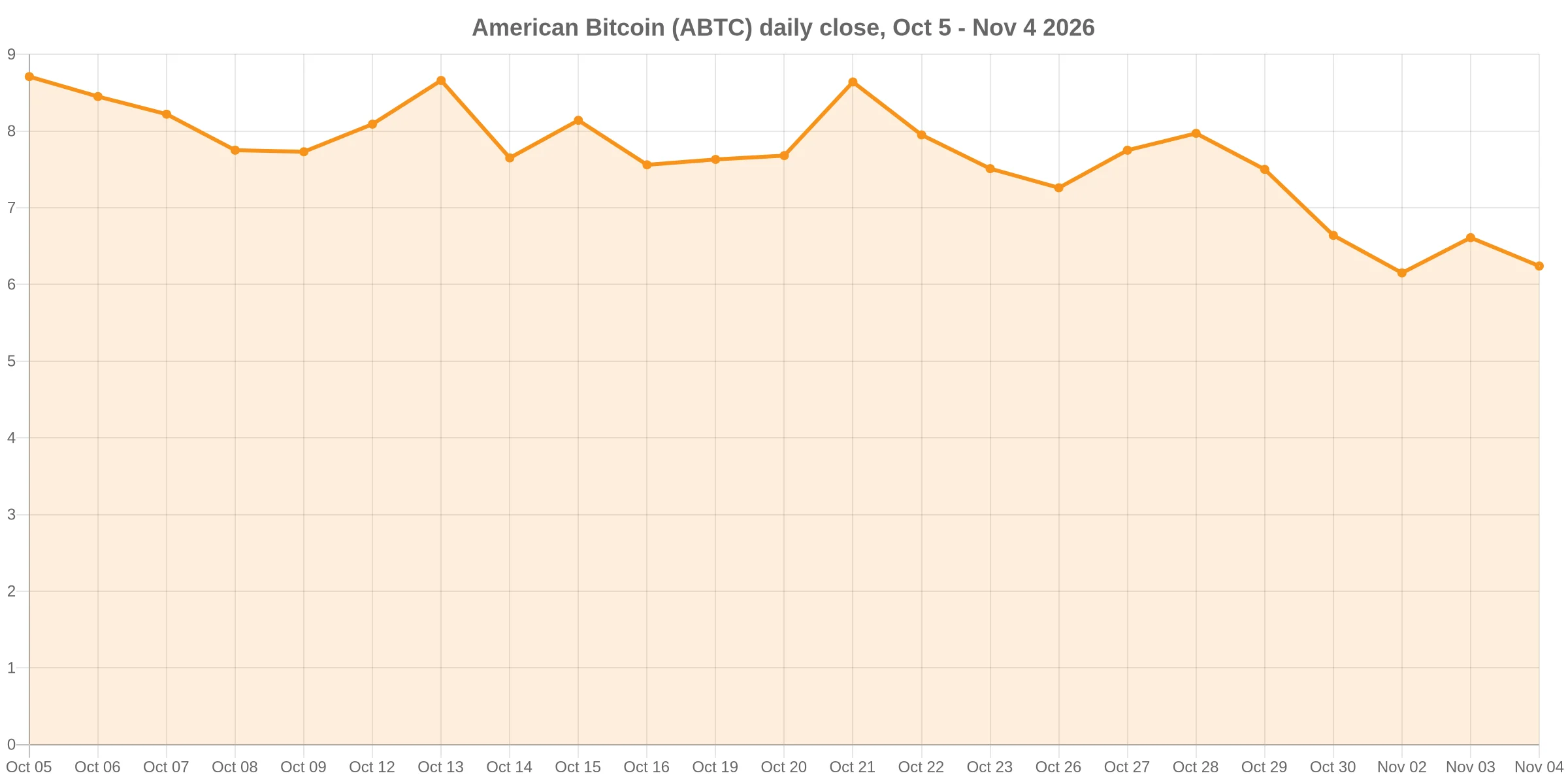
American Bitcoin Corp. reported about $126 million of net income for the third quarter of 2026 on roughly $63.4 million of mining revenue, a profit nearly twice the size of the top line it came from. The Nasdaq-listed miner, majority owned by Hut 8, also grew its Bitcoin stack from about 8,002 to about 8,427 coins and raised Satoshis Per Share by roughly 5% without selling stock through its at-the-market programme. Shares closed at $6.24 on 4 November, down 5.6% on the day, before the results release landed after the closing bell.
Read the two headline numbers together and the quarter stops looking like a mining result. A business that mines 891 Bitcoin and books $63.4 million of revenue does not produce $126 million of net income from digging. Something else in the quarter did the heavy lifting, and the release does not itemise it.
The gap between gross profit and net income
Start with what the release does spell out. Gross profit was about $25.8 million at roughly a 41% margin, down from $33.0 million and 49% in the second quarter. Adjusted EBITDA came in at about $221 million, against a loss of about $45.0 million in the prior quarter. Net income swung from a $57.2 million loss to a $126 million gain.
Those three lines cannot be reconciled by mining alone. Gross profit of $25.8 million sits $100.2 million below net income, and the gap has to be filled by items below the gross-profit line: gains on derivatives and warrant liabilities, tax effects, depreciation, or fair-value moves the company has not yet broken out. The release defines Adjusted EBITDA to strip out exactly those categories, which tells you they were large and moving.
The honest reading is that the quarter’s profit is an accounting result as much as an operating one, and the composition will only be visible in the quarterly report. That is not a criticism of the numbers. It is a warning against reading $126 million as a run-rate for a miner with $63 million of quarterly revenue.
What the rigs actually earned
The operating layer is cleaner. American Bitcoin mined about 891 Bitcoin in the third quarter, down from 932 in the second, and booked about $71,100 of revenue per coin against a cost to mine of about $42,100. Multiply the $29,000 spread by 891 coins and you get $25.8 million, which is the gross profit the company reported.
So the mining business cleared roughly $29,000 per coin before corporate costs, interest and everything else. The compression is visible in the cost line: $42,100 per Bitcoin against $36,500 in the second quarter, a 15% increase that the company attributes to seasonal power prices at its sites. Its own release says higher seasonal power costs “contributed to quarter-over-quarter margin pressure”, and the 49% to 41% margin slide is the arithmetic behind that sentence.
Fleet size was about 89,242 miners with 28.1 EH/s of installed capacity at quarter end. Third-quarter production represented about 21% of everything the company has mined since its 31 March 2025 launch, which says as much about how young the operation is as about how much it produced.
Where the 891 coins went
The reserve grew by about 425 Bitcoin while the company mined 891. That implies it kept roughly 48% of production and sold the rest to cover operating costs, which is what the release says happened: “Sold a portion of Bitcoin production to cover operating costs while continuing to build the Company’s strategic Bitcoin reserve.”
The share metric is the part management wants investors to watch. Satoshis Per Share rose from about 10,989 at the end of June to about 11,572 at the end of September, a 5.3% increase in a quarter. Mike Ho, the chief executive, framed it as evidence of discipline:
“Our third-quarter results demonstrate our commitment to building a disciplined, Bitcoin-denominated operating business. Despite seasonal power cost pressures, we continued mining Bitcoin at a structural discount to spot, grew our strategic reserve, and increased Satoshis Per Share by approximately 5%, all without issuing shares through our ATM program or purchasing Bitcoin during the quarter.”
That distinction matters more than it usually does for a treasury company. American Bitcoin did not buy coins with raised capital in the quarter and did not dilute to buy them. Every coin added came out of the machines. The trade-off is that roughly half of production went out the door to pay the bills, so the accumulation rate is capped by the mining margin rather than by whatever the capital markets will fund.
A stock priced under its own coins
Work backwards from the share metric and you can put a rough value on the treasury. With 8,427 Bitcoin held and 11,572 satoshis attributable to each share, implied shares outstanding come to roughly 72.8 million. At Bitcoin’s $80,053 print on 5 November, the reserve is worth about $674.6 million. At the $6.24 close, the equity is worth about $454 million, or 0.67 times the coins.
That discount comes with a caveat the release flags in a footnote: about 3,090 Bitcoin were pledged for miner purchases under agreements with Bitmain. Strip those out and the unencumbered stack is about 5,337 coins, worth roughly $427 million, which puts the equity at about 1.06 times the Bitcoin it actually controls free and clear.
The structure explains part of the discount. American Bitcoin is a majority-owned subsidiary of Hut 8, and it was reverse split 1-for-15 on 2 July 2026. The stock trades at $6.24 against a 52-week high of $80.355 and a low of $4.92, so the market has already repriced it hard once. Our coverage of that 95% drawdown tracked how quickly the equity decoupled from the treasury it holds.
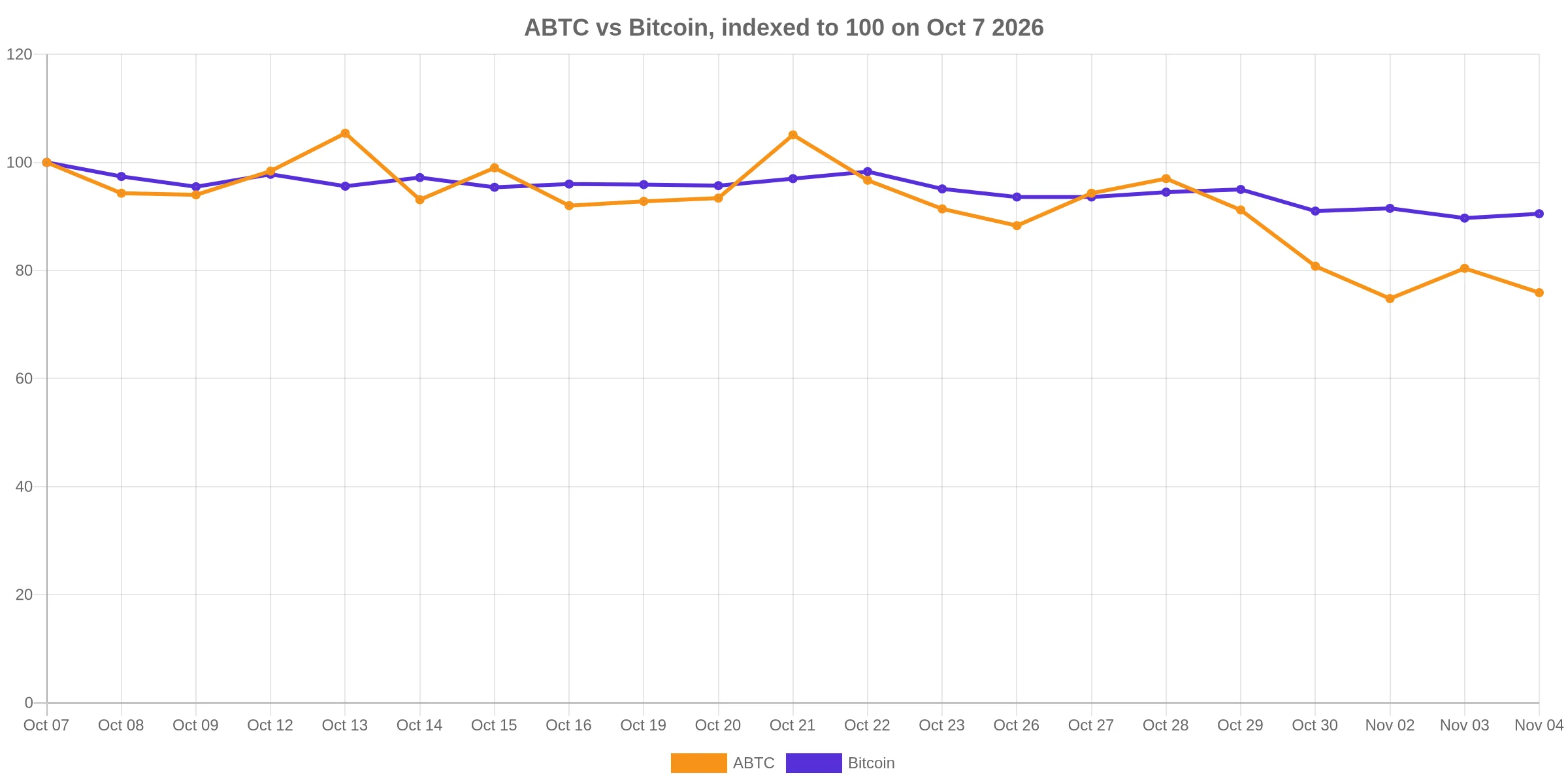
The equity has also lagged the asset it accumulates. From 7 October to 4 November, ABTC fell 24.1% while Bitcoin fell 9.5%, a 2.5-to-1 underperformance over a month in which the company was still adding coins.
The Trump line in the release
Eric Trump, co-founder and chief strategy officer, used his quote to tie the quarter to the wider pitch rather than to the numbers:
“This quarter, we delivered approximately $126 million in net income and $221 million in Adjusted EBITDA, while growing our Bitcoin reserve and increasing Bitcoin per share. These are significant results, particularly in a challenging digital asset market, and they reflect the discipline and long-term conviction behind this business.”
The political association is now a permanent feature of how this equity is bought and sold, and it cuts both ways in a market where the post-election risk bid has favoured Bitcoin over smaller listed vehicles. When the company added 500 coins earlier this year, it ranked as the 16th largest corporate holder . It is now at 8,427 coins, a size that still leaves it well behind the largest treasury vehicles.
What the next two filings have to show
The first test is the quarterly report. It has to explain the $100 million between gross profit and net income, and the answer decides whether the quarter was an operating success or a mark-to-market one. Watch for gains on derivatives and warrant liabilities, and for how the company values its Bitcoin under its accounting policy.
The second is the ATM. Management made a point of not using it in the third quarter, and the share count did not grow. If the stock stays at a discount to its coins, issuing equity to buy more Bitcoin destroys the very metric the company is marketing, so the discipline is self-reinforcing while the discount lasts. If the discount closes, the calculus flips.
The third is power. The cost to mine rose 15% quarter over quarter on seasonality, and gross margin fell eight points with it. American Bitcoin’s model depends on mining below spot; at $80,053 Bitcoin, a $42,100 cost still leaves room. At a $60,000 Bitcoin, the same cost structure would leave very little.
Frequently Asked Questions
Yes on a GAAP basis for the third quarter of 2026, with about $126 million of net income against roughly $63.4 million of mining revenue. The release does not itemise how much of that profit came from mining operations versus below-the-line items, so the operating profit is the $25.8 million of gross profit it reported.
About 8,427 Bitcoin as of 30 September 2026, up from about 8,002 at the end of June. The release notes that roughly 3,090 of those coins were pledged for miner purchases under agreements with Bitmain.
At the $6.24 close on 4 November, the implied market value of about $454 million equals roughly 0.67 times the $674.6 million value of its Bitcoin at an $80,053 price. Part of the gap reflects the pledged coins and the company’s structure as a majority-owned Hut 8 subsidiary.
No. The company said it did not issue shares through its at-the-market programme and did not purchase Bitcoin during the quarter, and that its reserve grew from mining plus retained production.
Data: SEC Form 8-K, Exhibit 99.1 , SEC EDGAR filings , CoinGecko . Bitcoin price is a snapshot at 12:28 UTC on 5 November 2026; the ABTC close is the 4 November session.
This article is for information only and is not investment advice. Prices, levels and market data are a point-in-time snapshot and can change at any moment.