




A bitcoin wallet untouched since 2013 has moved 411 BTC worth roughly $34 million , according to on-chain tracking by Arkham — coins acquired in the days when bitcoin traded near $131 , per the platform’s data. The move is the latest sign that the market’s oldest hands are stirring as bitcoin holds near $82,000 and the year-end $100,000 debate heats up.
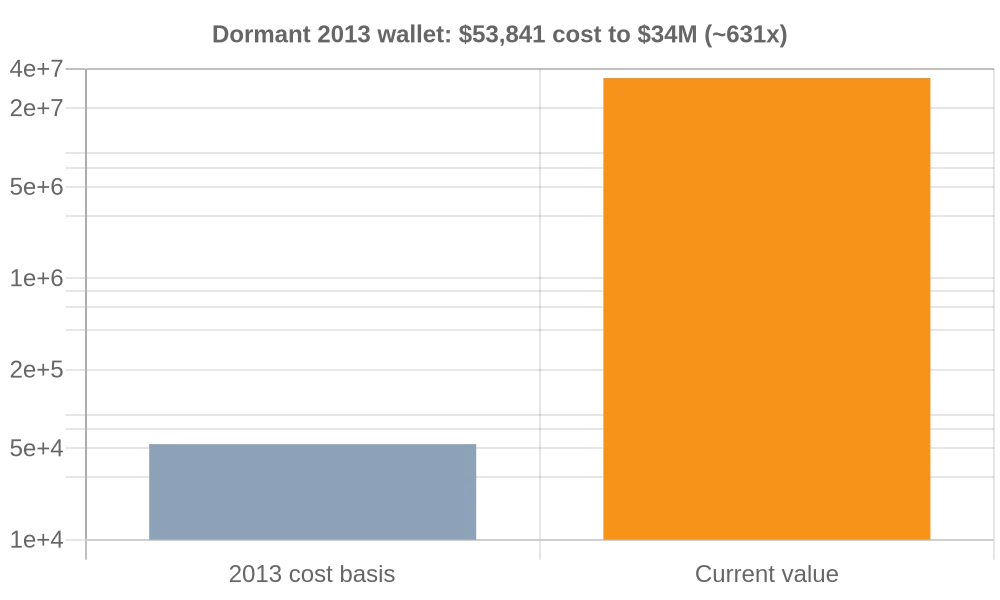
The arithmetic of the move is the story. At $131 a coin, the wallet’s original cost basis was roughly $53,841 . At bitcoin’s recent price near $82,725 , those same 411 coins are worth about $34 million — a gain of roughly 631 times over roughly thirteen years. That is the entire value proposition of bitcoin’s scarcity in a single wallet: the patient holder who never sold is now sitting on a life-changing multiple.
Why a dormant wallet moving matters
Dormant-whale movements are tracked closely because they cluster around decision points. When a wallet that has sat still for a decade finally transacts, it usually means one of two things: the holder is taking profit, or the holder is repositioning — moving coins to an exchange to sell, splitting into new wallets, or consolidating to a custodian. Either way, the reactivation of a 2013-era address is a signal about the conviction of bitcoin’s earliest buyers at this specific price, per CoinGecko’s price data .
The 2013 cohort is the most important to watch. These are coins accumulated before the first great exchange collapses, before the futures market, and long before the spot ETFs. If the oldest hands begin distributing at scale, it reads differently than a one-off movement. A single 411-BTC transfer is not that — but it is the kind of data point that, repeated across a cohort, becomes a market call.
The 2013 cohort is the deepest-conviction money
To understand why this wallet matters, it helps to remember what holding from 2013 actually means. A buyer at $131 in 2013 lived through bitcoin’s first parabolic run to over $1,100 and its collapse below $500, the Mt. Gox implosion that vaporized a large share of the market’s liquidity, the Silk Road shutdown, and then every subsequent cycle from the 2017 top to the 2022 bear. Anyone who held through all of that — and never took profit at $60,000 or $100,000 along the way — represents a conviction that is structurally different from the capital that entered after the spot ETFs.
That is why cohort-level behavior is the signal, not the single transaction. When the 2013-era addresses as a group begin moving coins toward exchanges, it historically marks a meaningful distribution phase. A lone 411-BTC transfer does not establish that pattern on its own — but it is the first kind of data point that, if it repeats, does.
How to read on-chain whale data without over-reading it
Platforms like Arkham identify dormant addresses by the age of the coins and the inactivity of the wallet, then flag the reactivation when the balance moves. What the data does not tell you is intent: a transfer to a new self-custody wallet, a split into smaller addresses, a move to a custodian, and a move to an exchange all look identical on-chain at the moment of the transfer. A sell only becomes visible when coins reach an exchange or an over-the-counter desk and are subsequently spent or swapped.
The disciplined reading, then, is to treat a dormant-whale alert as a question rather than an answer. The question is whether this wallet is the first of many, or an isolated holder taking a thirteen-year profit at a price that — at $82,000 — is still within sight of bitcoin’s cycle high. The answer only arrives over the following weeks, in the form of either more reactivations or silence.
What the move does not mean
It would be wrong to read a single wallet as a top signal. Four hundred and eleven bitcoin is a rounding error against the market’s daily turnover — bitcoin routinely trades tens of billions of dollars a day, and a $34 million transfer would not move the price on its own. Nor does a transfer prove a sale: coins moving on-chain can be a cold-storage rotation, a wallet split, or a transfer to an OTC desk rather than an open-market dump.
The more honest reading is that it is one data point in a broader picture. Bitcoin has been trading in a tight range around $82,000 while analysts split over whether it can reach $100,000 by year-end, with inflation clouding the outlook. A dormant whale choosing this moment to move — rather than, say, at $40,000 — is consistent with the idea that the range is a decision point for long-term holders, not just for traders.
What to watch next
The signal to track is not this wallet but the cohort. If more 2013–2015 addresses wake up and begin moving coins toward exchanges in the coming weeks, that would be the first sign of distribution among bitcoin’s oldest holders. The counter-signal is silence: if this is a one-off, the range simply continues until either the macro picture or the ETF flows resolve it.
For now, the move is a reminder of the asymmetry that built bitcoin’s base. A $131 coin held through every drawdown is now worth $82,000 — and the people who never sold are the ones whose movements matter most. Track the wider bitcoin picture in our Bitcoin hub .
The macro backdrop is what turns this into a question
The wallet’s reactivation lands at a moment when bitcoin’s own setup is unsettled. Bitcoin has spent recent weeks oscillating around $82,000 while spot-ETF flows turn choppy and analysts split over whether a $100,000 year-end print is still in reach, with inflation data clouding the path. In that environment, the behavior of the oldest holders matters more, not less: if the 2013 cohort is comfortable selling here, the range resolves one way; if it stays quiet, the supply overhang that bears worry about never materializes.
The bottom line is that one wallet does not make a market. But a $131 cost basis turned into $34 million is a useful reminder of who built bitcoin’s floor — and the next few weeks will show whether this whale is an outlier or the first of a wave. Watch the cohort, not the single transaction.
Disclosure: This article does not represent investment advice. The content and materials featured on this page are for educational purposes only.