


Key takeaways
- An exploit at BNB Chain protocol POTS Money drained about $5.7 million in USDT from the IBS/USDT liquidity pool on PancakeSwap.
- Blockaid says a privileged governance account minted one billion new IBS tokens, which were then sold into the pool.
- IBS, designed to hold a minimum value of $1, fell to roughly $0.00000008 within an hour.
- Locked liquidity did not help: it stops LP withdrawals, not trades against the pool with newly minted tokens.
- How the account was accessed is unclear, and no verified reimbursement plan has been published.
The POTS Money exploit has drained approximately $5.7 million in USDT from a liquidity pool on BNB Chain, sending the protocol’s IBS token plunging to near zero.
Blockchain security firm Blockaid flagged the incident early Sunday, November 29, after identifying unusual token issuance involving an account with elevated governance permissions. The newly created tokens were exchanged for USDT held in the protocol’s liquidity pool.
The incident follows the recent Kava Lend exploit , which exposed a separate vulnerability in DeFi collateral accounting.
For IBS holders, the collapse raises an uncomfortable question about a token that was designed to maintain a minimum value of $1: what happens when the system responsible for managing its supply becomes the source of the problem?
One Billion New Tokens and Millions in Missing Liquidity
Blockaid identified the incident at 04:59 UTC, reporting that a “privileged governance account” had been used to create one billion IBS tokens.
On-chain monitoring platform Lookonchain subsequently reported approximately $5.71 million in USDT proceeds, linking the activity to a transaction on BscScan .
The damage was concentrated in the IBS/USDT market on PancakeSwap. Rather than simply stealing existing IBS from investors’ wallets, the reported exploit involved creating new supply and exchanging it for stablecoins already held in the pool.
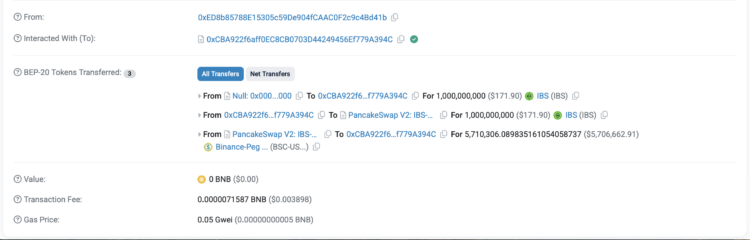
The distinction matters because the value lost is not limited to the tokens created during the incident. Existing holders were left with an asset whose main source of trading liquidity had been severely depleted.
IBS was trading at approximately $0.00000008 at 05:48 UTC on Sunday.
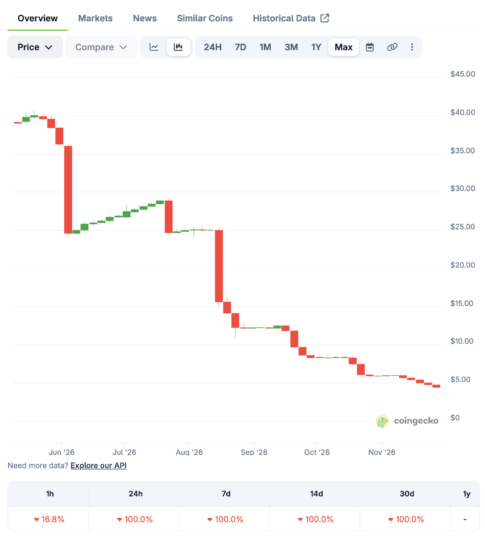
| Time | What happened |
|---|---|
| 04:59 UTC | Blockaid flags a privileged governance account minting one billion IBS tokens |
| Shortly after | New IBS is sold into the IBS/USDT pool on PancakeSwap for about $5.71M in USDT |
| 05:48 UTC | IBS trades at roughly $0.00000008 |
Timeline of the POTS Money exploit on Sunday, November 29, based on early reports. Data: Blockaid, Lookonchain, CoinGecko. Visualization: NewsBTC.
Why Locked Liquidity Couldn’t Protect IBS
POTS Money describes itself as a decentralized bond issuance protocol. IBS, its algorithmic token, was designed around collateral reserves and a mechanism intended to support a minimum price.
The incident exposes a limitation that is easy to overlook when assessing DeFi projects.
Locking liquidity can prevent the owner of liquidity provider tokens from directly withdrawing the underlying reserves. It does not, however, prevent those reserves from being exchanged through normal trading activity.
When a token’s supply expands dramatically without corresponding economic backing, the price support that investors thought they had can disappear.
A token can have millions of dollars in locked liquidity and still be vulnerable if the rules governing its issuance are not adequately protected. The strength of the liquidity lock is only part of the security equation.
NewsBTC covered a related risk earlier this month when the Fusionist ACE bridge exploit involved the issuance of unbacked tokens. While the underlying systems differ, both incidents illustrate the financial consequences of excessive minting privileges.
Security Audit Flagged Minting Risks Months Before the Exploit
A historical record from blockchain security auditor CertiK listed an audit of POTS Money as being in progress, with findings undergoing remediation.
More importantly, the risks associated with privileged accounts had been identified months before Sunday’s incident. A security audit by ScaleBit dated March 23 flagged centralization concerns, including unlimited minting permissions, and recommended introducing multisignature controls and a timelock.
The finding was marked as partially fixed.
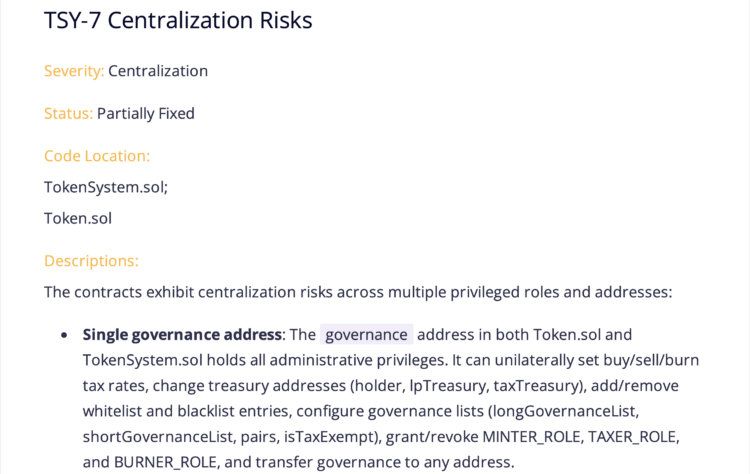
ScaleBit identified partially resolved centralization risks involving privileged accounts and token minting permissions. Source: ScaleBit, March 2026.
An audit may cover the implementation of a smart contract without eliminating every risk associated with the accounts authorized to operate it. Private key security, governance controls and restrictions on token issuance remain important even when the underlying code has been reviewed.
Whether the same permissions flagged by ScaleBit were involved in Sunday’s exploit remains unconfirmed. It is also unclear how the privileged account was accessed or whether another failure within the protocol was responsible.
Can IBS Holders Recover Their Funds?
Security researchers have reportedly identified a wallet associated with the extracted USDT, but identifying funds on a blockchain is not the same as recovering them.
A credible recovery plan would need to establish how much collateral remains available, whether the affected minting permissions have been disabled and how legitimate IBS balances will be treated.
The full financial impact on individual investors also remains unknown. The amount removed from a liquidity pool should not automatically be treated as the sum of all customer losses.
No verified reimbursement plan was available in the sources reviewed for this report.
For IBS holders, the immediate priority is to avoid unofficial compensation and recovery links while awaiting authenticated information from the project.
Restoring a token’s quoted market price may be possible. Restoring confidence in the rules governing its supply is likely to be a considerably harder task.