


Celo Core Co. launched the Celo FX Alliance at Binance Blockchain Week on 28 November, with Opera, Frax, Schuman Financial, VNX Global, Ripio, IDRX, cNGN, Minteo and Textile FX as founding members. The network already carries 35 stablecoins across 20 currencies, and the group’s first public commitment is a live corridor dashboard by the end of the first quarter of 2027.
That is the whole announcement: a coordination body, a data product and a liquidity promise. No new token, no exchange listing, no regulatory approval. What makes it worth a trader’s attention is the market underneath it. Celo has collected local-currency stablecoins that most chains ignore, and the Alliance is an attempt to price the conversions between them as one market rather than 20 separate pools.
What the Alliance Actually Commits To
Three deliverables, all dated to the end of Q1 2027. A public dashboard covering every corridor on Celo, updated around the clock with live prices, volume, spreads and depth. An onchain FX market report that tracks each corridor’s development. And deeper liquidity on one priority corridor, chosen with the founding members and market makers.
The first two are transparency products. The third is the one that matters for anyone trading the pairs, because depth is the difference between a quoted rate and a fill. Celo Core Co. has not named the priority corridor, the size of the liquidity commitment or who provides it. Until those details exist, the Alliance is a measurement plan with a distribution partner list attached.
The structure also tells you what this is not. Celo Core Co. is not issuing a stablecoin, is not becoming a market maker, and is not asking regulators for anything. Each member keeps its own commercial, technical and regulatory decisions, which is the standard architecture for industry coalitions and also the reason most of them move slower than their launch posts suggest. Frax, Ripio and the cNGN team bring issuance and local rails. Opera brings the wallets. Textile FX brings the conversion layer that lets an app quote one local currency against another without routing through the dollar.
Nine Members and a Market That Already Exists
The numbers behind the announcement are less about the future dashboard and more about what Celo has already accumulated. The network’s 35 stablecoins span 20 currencies, and 11 of them were added in 2026, roughly a third of the total in a single year. That works out to about 1.75 stablecoins per currency, which is the shape of a market where several issuers compete inside the same corridor rather than one issuer monopolising it.
| Founding member | What it brings to onchain FX |
|---|---|
| Opera (NASDAQ: OPRA) | MiniPay, the self-custodial stablecoin wallet built on Celo |
| Frax | Stablecoin and asset issuance, including yield-bearing sfrxUSD |
| Schuman Financial | EURØP, a MiCA-authorised euro e-money token |
| VNX Global | European local-currency issuance and metals tokens |
| Ripio | Latin American ramps and the wFIAT conversion stack |
| IDRX | Indonesian rupiah stablecoin and local distribution |
| cNGN | Nigerian naira stablecoin |
| Minteo | Colombian peso and Andean market access |
| Textile FX | Onchain FX quoting between local currency pairs |
Opera’s MiniPay is the distribution channel that gives the Alliance its scale claim. The company says the wallet has passed 20 million activations and more than $2 billion in cumulative transaction volume across 70 or more countries. Those are Opera’s figures, published through Celo, and they mix activations with transaction value; neither number tells you how much of that volume was a currency conversion rather than a simple transfer.
Celo’s own claims are larger and similarly self-reported. The network says non-USD stablecoins on Celo have processed more than $14.5 billion in lifetime volume, that it carries more than 6 million weekly Tether USD₮ users, more than any other chain, and that it has handled over 1.5 billion transactions. Treated as company claims, they establish that the corridors exist at some scale. They do not establish that the corridors are deep enough to absorb institutional size, which is the gap the dashboard is supposed to expose.
A MiCA Euro Arrives as the 36th Coin
Alongside the Alliance, Schuman Financial announced it will deploy EURØP, its euro stablecoin, on Celo, making it the 36th stablecoin on the network and the first MiCA-authorised euro to join the set. EURØP is issued by Schuman as an electronic money institution licensed by France’s ACPR, with the authorisation extending across the EU and EEA, and it is backed one-for-one by euros held at government-supervised EU banks including Société Générale. KPMG is the statutory auditor and issues quarterly attestations that supply matches reserves.
The integration also carries payment rails that most stablecoin deployments do not: SEPA and SWIFT access, named IBANs in euros and sterling, and cross-currency settlement through Schuman’s StablecoinFX product. For a developer on Celo, that means a euro balance that can be redeemed into a European bank account through the same issuer that minted it, rather than a bridged asset with a second-layer risk story attached.
“We built EURØP so people and businesses anywhere could hold and use Euros onchain with confidence,” said Martin Bruncko, founder and CEO of Schuman Financial. “Celo puts EURØP in front of wallets and payment apps that already serve millions of stablecoin users in fast-growing markets, many of which do a lot of business with Europe.”
The timing matters more than the marketing. Euro stablecoins are the smallest meaningful segment of the stablecoin market, and every new regulated euro adds a redemption path that did not exist before. EURØP’s total circulating supply is about €14.0 million, according to the eurostablecoins.xyz MiCA tracker , which puts it at roughly 1.8% of the €770.1 million the tracker counts across all MiCA-authorised issuers. Celo is getting a small euro, not a large one, and the announcement does not say how much supply will migrate to the network or when.
The Euro Is Still About 1% of Onchain Dollars
That €770.1 million figure is the number to hold onto. According to eurostablecoins.xyz, 22 of the 37 euro stablecoins it tracks have an issuer recorded as authorised, 19 electronic money institutions and three credit institutions, and together they account for 97.9% of tracked circulating supply as of 28 November 2026. The concentration inside that pool is extreme: Circle’s EURC holds €458.7 million, or 59.6% of the authorised total, while Société Générale’s EURCV holds €169.0 million.
| Euro stablecoin | Issuer | Circulating (€) |
|---|---|---|
| EURC | Circle Internet Financial Europe | 458.7 million |
| EURCV | Société Générale FORGE | 169.0 million |
| EURXT | CACEIS Bank | 58.9 million |
| EURe | Monerium | 25.4 million |
| EURI | Banking Circle | 22.4 million |
| EURØP | Schuman Financial (Salvus SAS) | 14.0 million |
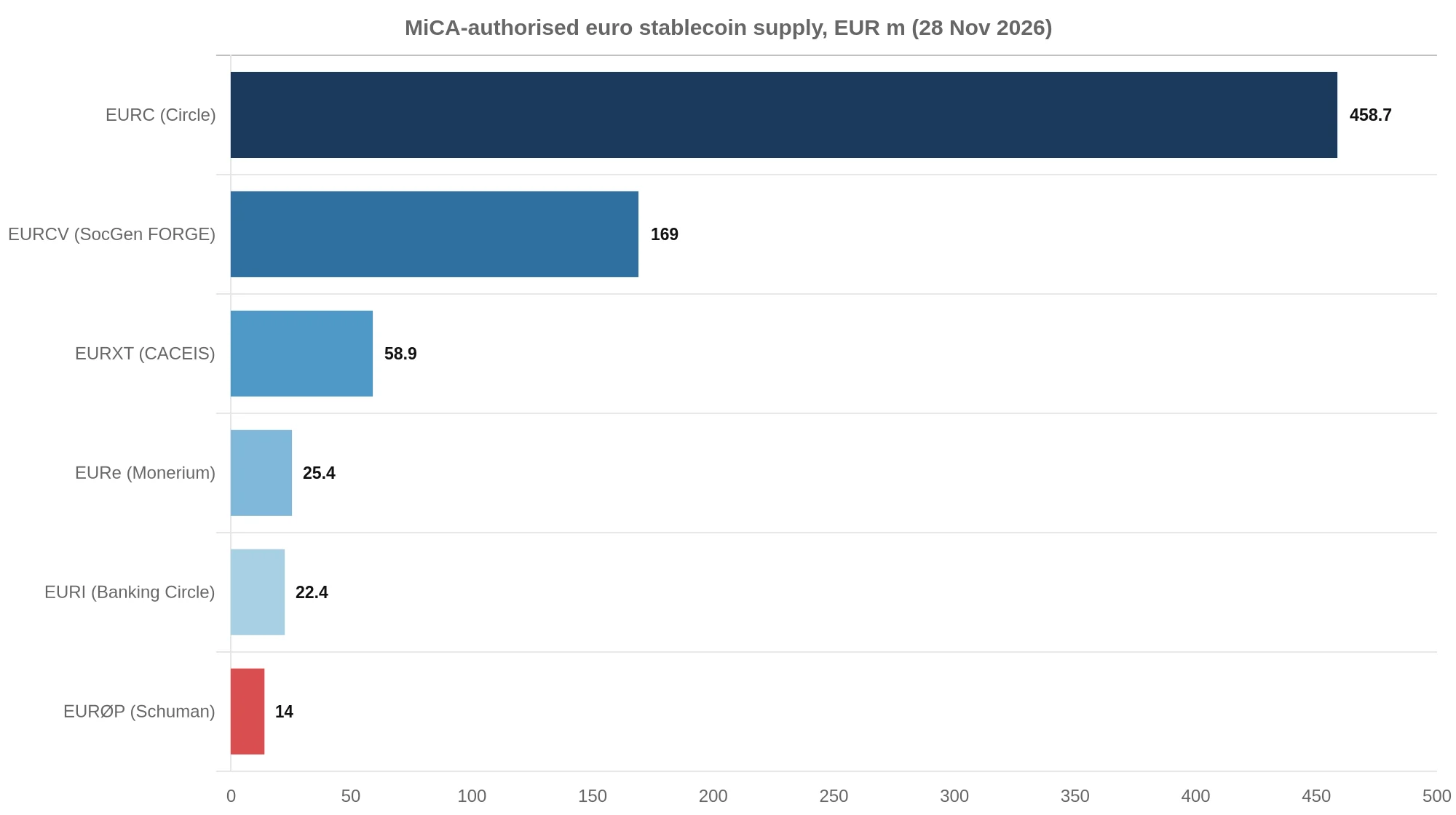
Set that against the dollar. Schuman’s own consortium material states that dollar stablecoins account for 99% of market value and euro stablecoins for less than 1%, a ratio that has barely moved despite MiCA being in force. The same material notes that MiCA-compliant euro stablecoins grew about 70% in the 12 months to 24 November 2026. Run that backwards and the €770.1 million authorised pool implies a base of roughly €453 million a year earlier, an increase of about €317 million. That is less than the €458.7 million Circle’s EURC alone holds today, which is the clearest way to see how small the euro complex still is.
The Alliance’s pitch is that the missing piece is not issuance but conversion. A euro stablecoin that cannot be swapped into a naira, a rupiah or a peso without a dollar leg is a settlement asset, not a currency market. Celo’s existing non-USD volume suggests the demand is real. Whether a dashboard and one deepened corridor can turn that into institutional flow is a different question, and the announcement does not answer it.
What the Numbers Do Not Show
Two limits matter here. First, supply is a stock and volume is a flow, so comparing Celo’s $14.5 billion lifetime non-USD volume with a €770.1 million euro stock does not tell you which is bigger in any trading sense. The comparison is only useful as a reminder that cumulative flow dwarfs outstanding supply on payment chains, which is exactly why depth, not market capitalisation, is the metric that decides whether a corridor works.
Second, every figure in the Celo release is first-party. “Most widely adopted blockchain for stablecoin payments”, the 6 million weekly Tether users and the $14.5 billion in non-USD volume are Celo Core Co. statements, not audited network statistics. The independent check available today is the third-party tracker data on supply, and that data shows a euro market still dominated by two issuers and still under 1% of the stablecoin complex.
There is also a structural risk in the coalition model. Nine members with nine commercial agendas have agreed to publish data and deepen one corridor. They have not agreed to share liquidity obligations, and the release names no minimum depth, no capital commitment and no deadline for the priority corridor beyond the end of Q1 2027 for the dashboard. Alliances of this kind often ship the dashboard and stall on the liquidity, because the dashboard is a product and the liquidity is a cost.
Signals to Watch Before the Q1 2027 Deadline
The first real test is the dashboard itself: whether it publishes spreads and depth per corridor, with a methodology, or only headline volume. The second is EURØP’s supply on Celo, which a third-party tracker can verify without the issuer’s help. The third is whether the priority corridor is named with a size attached, and whether the market makers behind it are disclosed.
For traders, the practical read is narrower than the press release. Celo’s stablecoin fees flow to the Community Fund through CELO buybacks, according to the company, so any genuine increase in conversion volume is a revenue signal for the network token rather than a narrative one. That claim is first-party and unaudited, and it only becomes investable when the corridor data does. Onchain FX is one of the few crypto use cases where the volume is measurable, the counterparties are identifiable and the revenue is fee-based. The Alliance is a bet that publishing those numbers will attract the liquidity to make them worth publishing.
The euro leg is the part with the clearest regulatory floor. EURØP is an e-money token with a licensed issuer and quarterly attestations, and the EURØP product page sets out the redemption terms. What it does not have is scale, and no coalition announcement changes that. Celo is adding a compliant euro to a market that already trades 35 stablecoins; the question is whether the 36th coin and the dashboard make the other 35 easier to move between.
The Alliance is also a test of a claim the euro stablecoin market has been making for two years: that regulated issuance alone creates liquidity. Celo’s proposition is the opposite order. Build the conversion market first, then let regulated issuers plug into it. That sequencing already has one precedent on the network, where IDRX’s rupiah stablecoin launched on Celo with Textile FX providing liquidity . Whether it scales now depends on the corridor numbers, and on whether wallets treat a local-currency quote as a product rather than a feature.
Frequently Asked Questions
It is a group launched by Celo Core Co. on 28 November 2026 with nine founding members, including Opera, Frax, Schuman Financial, VNX Global, Ripio, IDRX, cNGN, Minteo and Textile FX. It is designed to grow onchain foreign exchange between local-currency stablecoins on Celo by publishing corridor data and deepening liquidity on one route.
Celo Core Co. says the network trades 35 stablecoins across 20 currencies, 11 of which were added in 2026. The EURØP deployment announced alongside the Alliance would be the 36th stablecoin.
Schuman Financial announced plans to deploy EURØP on Celo and said developers can integrate Celo-native EURØP today. The release does not give a separate switch-on date for trading or list the venues where it will quote. EURØP supply across all chains is about €14.0 million, per eurostablecoins.xyz.
eurostablecoins.xyz counts 22 authorised issuers holding €770.1 million, or 97.9% of tracked circulating supply, as of 28 November 2026. Circle’s EURC is 59.6% of that total. Dollar stablecoins still account for roughly 99% of the stablecoin market by value.
No. The announcement covers a dashboard, a market report and liquidity on one corridor, all targeted for the end of Q1 2027. It does not create a token, change Celo’s protocol, or alter any member’s regulatory permissions.
Disclosure: This article does not represent investment advice. The content and materials featured on this page are for educational purposes only.
The post Celo FX Alliance Opens With 35 Stablecoins Across 20 Currencies appeared first on BlockchainReporter .