


Bluefin will stop trading perpetual futures on Sui on December 4, 2026 at 21:00 UTC, and the venue that closes is the one that built the market. In a statement published on its official X account on November 26 , the team told traders to close open positions before that timestamp and said withdrawals would stay available “for a period after trading ends,” without naming an end date.
The scope is larger than one product line. Bluefin says its perps book carried 95% of all perpetual futures volume Sui has ever processed, inside a platform that has handled more than $100 billion in cumulative volume across 2.5 million accounts since launch. After 21:00 UTC on December 4 there is no venue left on Sui with that record, and no published date by which the remaining collateral must be out.
The reason Bluefin gives is structural rather than commercial. “As the Sui team internalizes more of the network’s perps initiatives, we believe Bluefin’s resources are best focused on opportunities that complement that direction,” the post reads. The company says it will concentrate on Bluefin Spot, tokenization and real-world assets, and that the matching infrastructure behind the perps venue will stay available to other teams through the Bluefin Liquidity Network.
What the December 4 deadline actually covers
The instruction in the post is narrow and explicit. “As part of this shift, Bluefin Perps will be discontinued on December 4, 2026 at 21:00 UTC. Please close any open positions before then.” That is a trading deadline, not a settlement mechanism: Bluefin has not published how a position that is still open at 21:00 UTC will be handled, whether it is closed at the prevailing mark price, or whether the protocol takes any step on the trader’s behalf.
Withdrawals are the second half of the timeline and the less defined one. “Withdrawals will remain available for a period after trading ends,” the post says. No duration, no calendar date, and no cut-off for collateral that stays in the vault. Traders who leave funds in place are relying on a follow-up announcement that has not been published.
An update on Bluefin’s next chapter. As part of this shift, Bluefin Perps will be discontinued on December 4, 2026 at 21:00 UTC. Please close any open positions before then. Withdrawals will remain available for a period after trading ends.
— Bluefin (@bluefinapp) November 26, 2026
Three things the announcement does not contain matter as much as the ones it does. It does not disclose perps-only volume in dollars, only the network-wide $100 billion figure across all Bluefin products. It says nothing about the BLUE token, staking or rewards programmes tied to perp trading. It does not address API keys, trading bots or integrators that route orders into the perps book, which is where a non-trivial share of on-chain perp flow usually originates.
Why Sui is bringing perps in-house
Sui’s own documentation describes DeepBook as the network’s native liquidity layer, a central limit order book built for “spot trading, margin trading, and prediction markets,” with every integration calling the same public Move functions. That is the infrastructure a first-party team can extend without a third-party venue in the middle, and it is the direction Bluefin points to when it cites the Sui team internalizing perps initiatives.
The economics of that shift are familiar from other chains. A perps venue earns its place by matching orders faster than the base layer can, offering incentives the foundation will not fund, and carrying risk the core team does not want on its balance sheet. When the L1 team decides the order book is core infrastructure, the third-party venue keeps the tail risk and loses the franchise. Bluefin’s own framing accepts this: it says its resources are better spent on products that “complement that direction” rather than compete with it.
What is not established is the Sui side of the story. Bluefin’s post is the only public description of the internalization that BlockchainReporter could verify as of November 27; no separate Sui Foundation or Mysten Labs statement setting out a perps roadmap, launch date or product scope was published alongside it. Readers should treat the direction as Bluefin’s characterization of a decision it is responding to, not as a documented Sui product plan.
The volume numbers sit badly next to the token
Bluefin’s cumulative $100 billion is the headline figure, and it is a lifetime number, not an annual one. Set against the token that represents the protocol, the ratio is stark: at a $4.18 million market capitalisation on November 27, the platform has turned over roughly 23,900 dollars of cumulative volume for every dollar of BLUE market value. That comparison is a rough scale check rather than a valuation claim, because cumulative volume includes spot, perps and lending across four years, and none of those flows accrue to token holders directly.
The token’s own record is worse than the volume line suggests. BLUE traded at $0.00663 on November 27, down 99.2% from its all-time high of $0.8567 on December 14, 2024, with 629.9 million of a one billion supply in circulation and $138,817 of 24-hour volume on CoinGecko’s Bluefin market page . Over the last 90 days the price slid from $0.00903 to $0.00663, a decline of 26.5%, with the October peak near $0.0130 now well out of reach.
None of that establishes that the shutdown moved the price. BLUE was already trading within a few percent of its record low before November 26, and the 24-hour change on the day after the announcement was a gain of about 1.2%, which is noise for an asset with $139,000 of daily turnover. The honest reading is that the market had priced a venue with $100 billion of lifetime volume at a four-million-dollar valuation long before the deadline was announced.
Where the liquidity actually sits
Volume and locked capital tell different stories about the same protocol. DefiLlama separates Bluefin into two products: Bluefin Spot, a Sui-based DEX with $7.68 million in total value locked, and Bluefin Pro , the derivatives venue being wound down, with $1.06 million. Of that Pro figure, $642,362 is staking, which leaves roughly $421,600 of non-staking TVL actually sitting behind the perps book.
Read as a ratio, spot holds 7.2 times the capital of perps. Read as a share, about 60% of the derivatives venue’s locked value is staking rather than trading collateral. Neither number says perps trading was small; a margin venue can turn over enormous notional against thin TVL because positions are collateralised rather than funded. What the split does say is that the product Bluefin is keeping already holds most of the capital, which makes the pivot to spot, tokenization and real assets a smaller operational jump than the volume headline implies, and the choice between order-book perp venues matters less when the model itself is being retired.
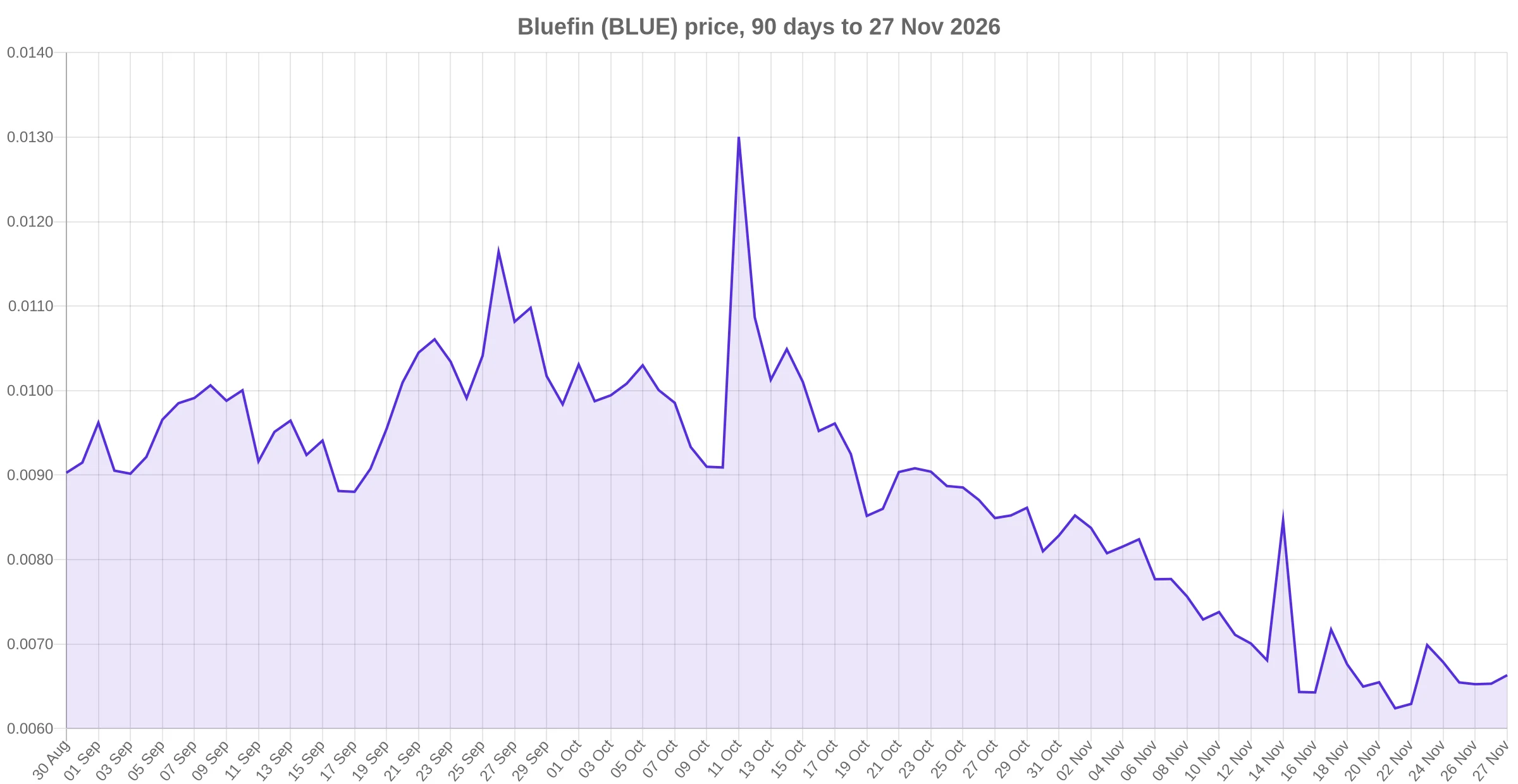
The chart above uses daily closes from CoinGecko and ends on November 27. It is a token chart, not a measure of the venue: BLUE’s price reflects the whole protocol’s prospects, including the spot business it is keeping, and a perps shutdown that frees engineering capacity is not automatically a loss of value.
What traders have to do before 21:00 UTC on December 4
Bluefin’s instruction covers one action: close open positions. The rest of the checklist below is BlockchainReporter’s own guidance for the gap between a trading deadline and an undefined withdrawal window, not official vendor instructions.
First, close or reduce every open perp position before 21:00 UTC, and record the closing price for each. Second, withdraw collateral once trading ends rather than waiting for a deadline Bluefin has not published; a venue in wind-down is not a place to leave a balance. Third, if you run a bot or an integration, confirm whether your keys and endpoints still authenticate after the venue closes, because the announcement does not address API access. Fourth, export trade history for accounting and tax purposes while the interface is still live, since archive access after shutdown has not been promised.
Interface risk is the practical one. Order-book venues rarely fail at the moment trading stops; they fail in the weeks after, when the front end is still up, the matching engine is off, and a withdrawal button returns an error that nobody is monitoring. Anyone holding size should test a small withdrawal early rather than discovering a broken path on the last day.
What the exit leaves on Sui
If Bluefin carried 95% of Sui’s all-time perps volume, the remaining venues account for the other 5%. That much follows arithmetically from Bluefin’s own share figure, but the dollar amount does not: the $100 billion covers all products, so the perps-specific totals for Bluefin and for its competitors cannot be separated from public statements. Any published claim about how much perp volume Sui loses in absolute terms on December 4 rests on an estimate, not on a disclosed number.
The network-level context is a market that has already repriced. SUI traded at $0.6865 on November 27, 87.2% below its January 2025 high of $5.35, with a $2.84 billion market capitalisation. A perps venue with a four-million-dollar token was always going to be a marginal business inside an ecosystem trading at that discount, which is part of why the internalization argument is credible: the foundation can subsidise a market maker programme that no independent protocol can justify. Sui has kept attracting infrastructure even so; Hashi’s mainnet went live on the network in November with more than 20 partners behind its bitcoin finance stack.
What happens to Sui’s funding rates, basis and liquidation depth after December 4 is not yet measurable. The order book that handled nearly all of the network’s perps history goes dark on a fixed date, the infrastructure behind it is being offered to other teams, and the chain’s native order book keeps expanding. Whether liquidity migrates to DeepBook-based venues, to the Bluefin Liquidity Network, or simply leaves the chain is the question the next quarter of Sui perps volume will answer.
Frequently Asked Questions
Bluefin Perps stops trading on December 4, 2026 at 21:00 UTC. Bluefin asked users to close any open positions before that time and said withdrawals would remain available for a period after trading ends, without specifying an end date.
Bluefin has not published a settlement rule for positions left open at 21:00 UTC, so the treatment of an unclosed position is unknown as of November 27. Traders should close positions themselves rather than rely on an unannounced auto-close.
No. Spot stays open and becomes the focus, alongside tokenization and real-world assets. DefiLlama shows Bluefin Spot holding $7.68 million in TVL against $1.06 million on the derivatives venue being discontinued.
Bluefin says the Sui team is internalizing more of the network’s perps initiatives, so its own resources are better spent on products that complement that direction. No separate Sui Foundation statement describing a perps roadmap was published with the announcement.
The announcement does not mention BLUE, staking or rewards. BLUE traded at $0.00663 on November 27 with a $4.18 million market cap, 99.2% below its December 2024 high, and the token had already fallen 26.5% over the previous 90 days.
This article is for information only and does not constitute investment advice. Prices and total value locked figures are as of November 27, 2026 and will change.
Disclosure: This article does not represent investment advice. The content and materials featured on this page are for educational purposes only.
The post Bluefin Perps Stops Trading on Dec. 4 With 95% of Sui’s Perp Volume appeared first on BlockchainReporter .