


For five days in November, a room at Spain’s national police headquarters in Seville held roughly 40 investigators from 11 countries. Their assignment was not to seize streaming servers. It was to work out who was being paid. When the coordination week closed on 20 November, Europol reported 57 illegal IPTV services disrupted and 321 websites identified, but the number that explains the method sits in the middle of the release: more than €26 million in cryptocurrency transactions traced, with analysis described as ongoing.
That figure is not a seizure. It is not a forfeiture order and it is not a charge sheet. It is the value that, according to the agency, investigators were able to connect to the payment networks behind services selling cut-price access to premium channels, live sport and films. Everything else in the announcement follows from how that tracing was done, and from who was in the room to help with it.
What the Seville Operation Actually Produced
The release is specific about the operation’s shape and careful about its legal aftermath, which is normal at this stage. The disclosed numbers:
| Item | Figure as published by Europol |
|---|---|
| Operation window | 16 to 20 November 2026, five days |
| Location | Spanish National Police headquarters, Seville |
| Participants | About 40 people, including 30 law enforcement officers from 11 countries |
| Services disrupted | 57 illegal IPTV services |
| Websites identified | 321 sites offering copyrighted content illegally |
| Combined annual traffic | More than 7.3 million visits |
| Crypto traced | More than €26 million |
| Coordination | Europol’s Intellectual Property Crime Coordinated Coalition |
| Other participants | EUIPO, INTERPOL, AAPA, Binance, Coinbase, Chainalysis |
The states named are Belgium, Bulgaria, Croatia, Greece, Ireland, Italy, the Netherlands, Portugal, Romania, Spain and the United States. Europol ran the week through its Intellectual Property Crime Coordinated Coalition, IPC3 , which supplied analytical support, real-time cross-checks and a secure channel between the agencies in the room.
Note what “disrupted” covers here. The release says 57 services were disrupted and 321 websites identified as illegally offering copyrighted content, as laid out in the full Europol announcement . It does not say the operators were arrested, that domains were seized under court order, or that the €26 million was frozen. Those are separate legal steps, and on this document they have not happened yet.
The Target Was the Payment Chain, Not the Stream
Illegal IPTV is a subscription business with a low price point and a wide customer base. A few euros a month buys thousands of channels, and the collection mechanism is the part that matters: subscriptions have to be paid repeatedly, across borders, by people who do not want their names attached to the transaction. Crypto solves that specific problem, which is why operators use it, and why it is also the weakest link in their setup.
Europol’s own framing makes the shift explicit. “Removing an illegal service does not necessarily stop the criminals behind it,” the release states, adding that investigators are increasingly “targeting the financial infrastructure that allows these businesses to operate.” That is a different theory of the case from the domain-takedown model that defined piracy enforcement for two decades. A takedown removes a storefront, and the same group can stand up another one. A payment map, if it holds up in court, identifies who was collecting and where the money went next.
The agency is also blunt about the limit of its own reach: “But the use of cryptocurrency does not make criminals invisible.”
The €4.83 Billion Figure Has an Author
Two of the largest numbers in the release do not come from Europol’s investigation. They come from the Audio-visual Anti-Piracy Alliance, an industry body that was also a participant in the operation. AAPA estimates that 60 million people across Europe use unauthorised IPTV services, that legitimate providers lose €4.83 billion a year as a result, and that governments forgo a further €1.08 billion in unpaid taxes.
Those are modelling estimates from rights holders, not audited losses and not figures produced by police. They are useful for scale and should be read that way. The gap between an industry estimate of €4.83 billion in annual harm and €26 million traced in a five-day operation is not a measure of failure, because the two numbers describe different things: one is a modelled annual market loss across a continent, the other is what one group of investigators could attribute in one week.
What a Payment Trail Can and Cannot Prove
A public blockchain records transfers, not identities. Investigators can see that one wallet paid another, when, and how much. Turning that into a person requires an off-chain anchor: an exchange account that passed know-your-customer checks, a deposit address tied to a service’s checkout page, a cash-out at a payment processor. That is why the participant list carries more weight than the on-chain figures in the release.
Binance, Coinbase and Chainalysis were in Seville alongside the police. Two are exchanges that hold identity records on their customers and are bound by know-your-customer obligations when they onboard users and move funds (an explainer on the site covers what those checks require in practice ). The third sells clustering and attribution software that groups addresses into likely entities. Europol credits the group with helping “identify the financial networks behind illegal IPTV services,” and describes the week as a joint exercise rather than a unilateral police action.
None of that makes the exchanges independent observers of the operation. They are participants with commercial and regulatory interests of their own, and their data is only as reliable as their onboarding. Read the attribution claims in the release as the agency’s account of what its partners supplied, not as a finding verified by a third party.
Five Days of Tracing, Two Days of Estimated Losses
Put the released numbers against the AAPA estimate and the scale becomes easier to hold. At €4.83 billion a year, the modelled loss runs at about €13.2 million a day. The €26 million traced across the five-day operation is therefore roughly two days of that estimated annual loss, or about 0.54% of a full year.
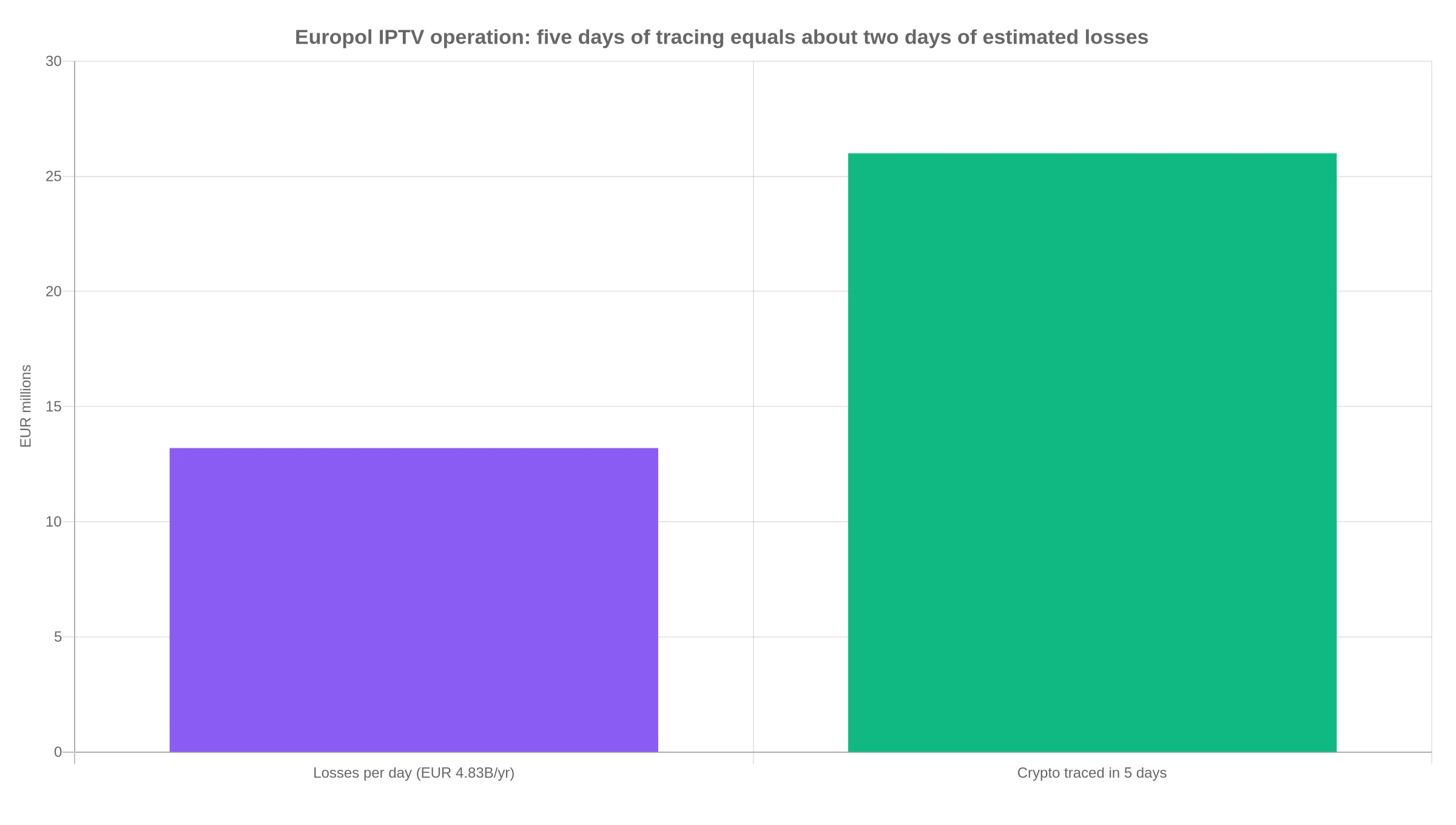
Per target, the averages are modest. €26 million divided by 57 disrupted services is about €456,000 traced per service, and 321 websites across 57 services works out to about 5.6 domains per operation. The 7.3 million combined annual visits spread over 321 sites is roughly 22,700 visits per site per year, a long-tail structure of small storefronts rather than a handful of large portals. That shape is what a payment-focused investigation is built for: the money converges even when the sites do not.
What the Release Does Not Say
Four absences are worth naming before anyone fills them in for a headline.
No arrests. The release names no suspects, no companies and no operating countries for the services. It says the information gathered “will now support national investigations, including efforts to identify suspects, disrupt illegal services and trace assets linked to criminal activity.” Identification is the next step, not a completed one.
No seizure. €26 million is described as traced. Tracing and confiscation are different procedures with different legal thresholds, and nothing in the document says funds were frozen or recovered.
No breakdown. The agency does not say which chains, which tokens or which exchanges carried how much, nor whether €26 million is gross flow or net. Without that, an outside researcher cannot reconcile the figure.
No transaction dates. The release dates the coordination week, not the payments. The underlying transfers could span years, and the total is only as current as the analysis behind it.
That is not a criticism of the announcement. It is the state of the record, and the record is what a newsroom can report without adding to it.
Why the Model Will Be Repeated
Piracy enforcement has a structural problem that other property crimes do not: the asset is infinitely copyable and the storefront is disposable. What is not disposable is the customer relationship, because it has to be paid for. Every subscription is a payment event, and every payment event is a data point. In this operation Europol treated the money trail as the case itself rather than as a follow-up to a takedown.
The economics push the same way. AAPA’s 60 million user estimate implies a large pool of people already paying small amounts in crypto for content, and the regulated exchanges serving them hold records. As the EU’s implementation of the FATF travel rule matures, the data available to investigators grows without any new surveillance power being created, a mechanism explained in this breakdown of the thresholds and obligations . The constraint is not access. It is analysis capacity, which is why a five-day sprint with 30 officers produced a €26 million map and a promise of follow-up rather than indictments.
What to Watch
Three things will show whether the week produces more than a press release. First, whether any national authority announces arrests or asset freezes tied to the 57 services in the coming months. Second, whether Europol publishes a follow-up with chain-level detail, which would make the €26 million checkable. Third, whether the exchanges disclose what they contributed in request volumes or account actions, since that is the part of the operation the public cannot see.
Until then, the defensible summary is narrow. Eleven countries spent five days in one room following payments, identified 57 services and 321 sites, and traced €26 million in crypto. The servers were the visible target. The payment chains were the working one, and €26 million is the figure that measures how far the tracing got.
This article reports a law enforcement announcement and does not constitute financial or legal advice. No trading recommendation is made.
The post Europol Followed €26 Million Through Exchanges to Find the IPTV Owners, Not the Servers appeared first on BlockchainReporter .