Key takeaways
- BlackRock has launched its first tokenized money market fund in Asia-Pacific, the HKD Digital Liquidity Fund, for investors in Hong Kong.
- The tokenized D OnChain class lists a minimum investment of HK$10, against HK$10 million for the conventional I class, but access through stablecoins is reportedly limited to professional investors.
- The fund gives HKDAP, the Hong Kong dollar stablecoin issued by Anchorpoint Financial, a use beyond payments, while the returns still come from the underlying short-term instruments.
- Tokenization does not remove dealing deadlines or redemption limits, and the disclosures reviewed did not yet give total fund assets or current yields.
BlackRock has launched its first tokenized money market fund in Asia-Pacific, giving investors in Hong Kong a new way to move money between traditional investments and blockchain-based financial products.
The BlackRock tokenized fund, known formally as the HKD Digital Liquidity Fund, supports both conventional and tokenized investment units. It also introduces a use case for HKDAP, the Hong Kong dollar stablecoin issued by Standard Chartered-led Anchorpoint Financial.
The development follows Anchorpoint’s plans to expand HKDAP to Solana , announced in late October.
However, there is an interesting detail in BlackRock’s product disclosures. One of the fund’s tokenized classes requires a minimum investment of just HK$10, while access through stablecoins is reportedly limited to professional investors.
The technology may be making financial products more accessible, but the institutions behind them still decide who gets through the door.
What BlackRock’s New Tokenized Fund Actually Offers
BlackRock announced regulatory authorization for the fund on September 10, with its product listings identifying November 16 as the inception date. The commercial launch was reported on Tuesday, November 24.
Unlike many of the investment products available across decentralized finance, BlackRock’s fund does not depend on cryptocurrency lending, liquidity pools or token incentives to generate returns.
Its investment strategy revolves around short-term financial instruments, including government-backed securities and bank deposits.
Investors gain exposure to those assets through fund units. With tokenized units, blockchain technology is used to maintain ownership records.
BlackRock’s official product disclosure lists a minimum initial investment of HK$10 for its D OnChain class, alongside a management fee of 0.31% and daily income distributions.
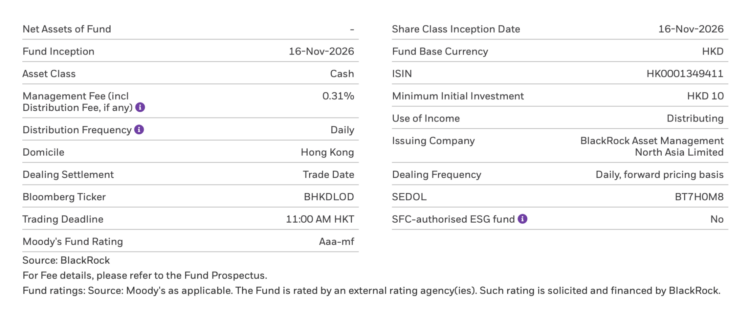
For comparison, the fund’s conventional I class requires a minimum initial investment of HK$10 million.
The difference is substantial, although a lower investment minimum should not be confused with unrestricted access. Different share classes and distribution channels come with their own conditions.
A Stablecoin That Can Finally Do More Than Move Money
Perhaps the most interesting part of BlackRock’s launch is what it means for HKDAP.
Anchorpoint Financial, a joint venture between Standard Chartered, Animoca Brands and HKT, received its stablecoin issuer licence from the Hong Kong Monetary Authority in April.
Until now, much of the discussion surrounding regulated Hong Kong dollar stablecoins has focused on payments, transfers and their potential role in financial infrastructure.
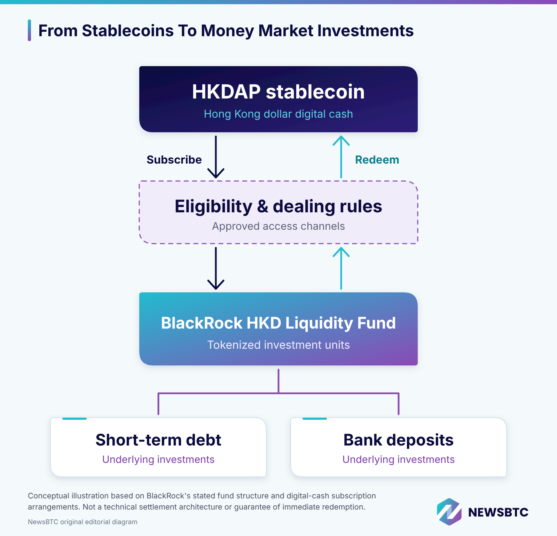
BlackRock’s fund introduces another practical application. Eligible investors can use digital money denominated in Hong Kong dollars to access investments denominated in the same currency.
In its September announcement, BlackRock stated:
““Investors will be able to use HKDAP” to subscribe to and redeem investments from the fund.
BlackRock · September announcement
Imagine a company that already holds HKDAP for operational payments. Instead of leaving all its surplus liquidity in stablecoins, it could potentially move some of that balance into a money market fund and earn investment income while the money is not needed.
The important distinction is that the stablecoin itself is not generating the fund’s returns. The underlying financial instruments are.
For stablecoin issuers, this kind of integration could ultimately prove more valuable than simply securing another exchange listing. It gives businesses a reason to hold and use digital cash beyond cryptocurrency trading.
The Blockchain Is Always Open. The Fund Isn’t.
There is still a noticeable difference between what blockchain infrastructure can do and what BlackRock’s product currently offers.
The D OnChain class lists a daily dealing schedule with an 11 AM Hong Kong time trading deadline and settlement on the trade date.
Anyone familiar with decentralized finance will recognize the contrast. A blockchain does not stop processing transactions because a bank has closed or a fund has passed its dealing deadline.
But tokenizing an investment does not automatically change the operating hours, liquidity arrangements or legal obligations of the underlying fund.
BlackRock also warns that technology failures, compromised wallets and disruptions involving blockchain service providers could interfere with investors’ ability to access or redeem their holdings.
Restrictions on redemptions are possible under stressed market conditions, while investors remain exposed to potential capital losses.
These limitations are not necessarily a failure of tokenization. Institutional investors have regulatory, custody and accounting obligations that cannot simply be removed by deploying a smart contract.
Still, if investors ultimately have to work around many of the same deadlines and intermediaries they encounter in traditional finance, the immediate advantages of tokenization become narrower.
Hong Kong Is Building The Infrastructure Around Tokenized Finance
Earlier this month, the Hong Kong Monetary Authority expanded its EnsembleTX settlement initiative to support continuous settlement using tokenized central bank money.
The initiative involves several major financial institutions, including BlackRock, and supports applications involving tokenized deposits and investment funds.
These developments are gradually connecting different parts of the financial system that previously operated separately.
There are now regulated digital currencies, tokenized investment products and settlement infrastructure being developed to move value between them.
However, BlackRock’s latest launch also shows why the size of the tokenization market should not be measured solely by the number of financial products being brought onto blockchains.
The more interesting figures will be how much money actually enters these funds through digital cash, how frequently investors move between the two products and whether those transactions become cheaper or faster.
BlackRock’s product disclosures reviewed for this article did not yet provide usable figures for total fund assets or current yields.
Nor does the launch establish unrestricted access through decentralized exchanges or lending protocols.
Those are the developments worth watching before declaring that tokenized finance has moved beyond institutional adoption and into the hands of ordinary crypto users.
Hong Kong now has another piece of the infrastructure. The next challenge is getting people to use it.