
At 16:13:24 UTC on 21 November, a Solana transaction credited 5,213,000 CYBER to a wallet that had held none of the token. The associated token account it came from was empty before the transaction and empty after it. One minute and forty-seven seconds later, an Ethereum transaction moved exactly 5,213,000 CYBER out of the contract that holds the asset for cross-chain transfers.
The two transfers carry the same amount, the same ticker and the same second-digit precision. They differ in one respect that matters for anyone holding the token: the first created supply on Solana, and the second released existing supply on Ethereum from a vault that, after the transaction, held 6,696 CYBER.
Upbit suspended CYBER deposits and withdrawals on the Ethereum network at 17:08:03 UTC, 55 minutes after the mint. It cited Article 17, Item 2(b) of the Enforcement Decree of Korea’s Act on the Protection of Virtual Asset Users. Twelve minutes later it published a second notice warning of price volatility and linking the Solana and Ethereum transactions to its customers.
Two Transactions, 107 Seconds Apart
The Solana leg is a single instruction bundle against the token program. Its post-token balances show 5,213,000 CYBER, nine decimals, credited to wallet
58ZgoAHMgfFPuzLkA6avW5nCh8vHibt1qDfCSvpPZvSo
. The mint itself,
5gzCDgVf5Nk6gosa5dpYZV6P6RiAytvCyQUaMwAVyf8z
, is the same asset that trades on Ethereum as an ERC-20 at
0x14778860e937f509e651192a90589de711fb88a9
.
The Ethereum leg is block 26,464,606. It called the contract at
0x173272739bd7aa6e4e214714048a9fe699453059
, emitted an ERC-20 Transfer of 5,213,000 CYBER from
0xcb07992de144bdee56fdb66fff2454b43243b052
to
0xaf32a9db0b0ac8eaa860a43a9d32a1c9277277cc
, and logged an event from
0x1a44076050125825900e736c501f859c50fe728c
, the LayerZero endpoint that Cyber’s omnichain token standard routes messages through. The endpoint log carries nonce 30,168.
Cyber’s own documentation describes CYBER as an OFT, an omnichain fungible token built on LayerZero, a design in which one contract locks or burns supply on the source chain and a second chain mints or releases the matching amount after a message is verified. The two transactions fit that architecture exactly. They also show why the architecture is where the risk sits: the second chain does not independently know how much supply exists on the first.
What the Vault Had Left
Vault
0xcb07992de144bdee56fdb66fff2454b43243b052
now holds 6,696.36 CYBER. Before the release it held 5,219,696.36, so the transaction removed 99.87% of the balance in a single call. The receiving wallet
0xaf32a9db0b0ac8eaa860a43a9d32a1c9277277cc
holds no CYBER today and 0.00042 ETH, with 24 outgoing transactions from the address. Whatever happened to the tokens after the transfer, they are no longer at the address that received them.
That combination is unusual in the way it narrows the question. A bridge drain that leaves the vault almost empty while the recipient address is empty too means the supply did not sit still. It moved into a market that trades $8.8 million of CYBER a day against a $12.5 million market capitalisation, and the price chart for the week shows a token that barely moved.
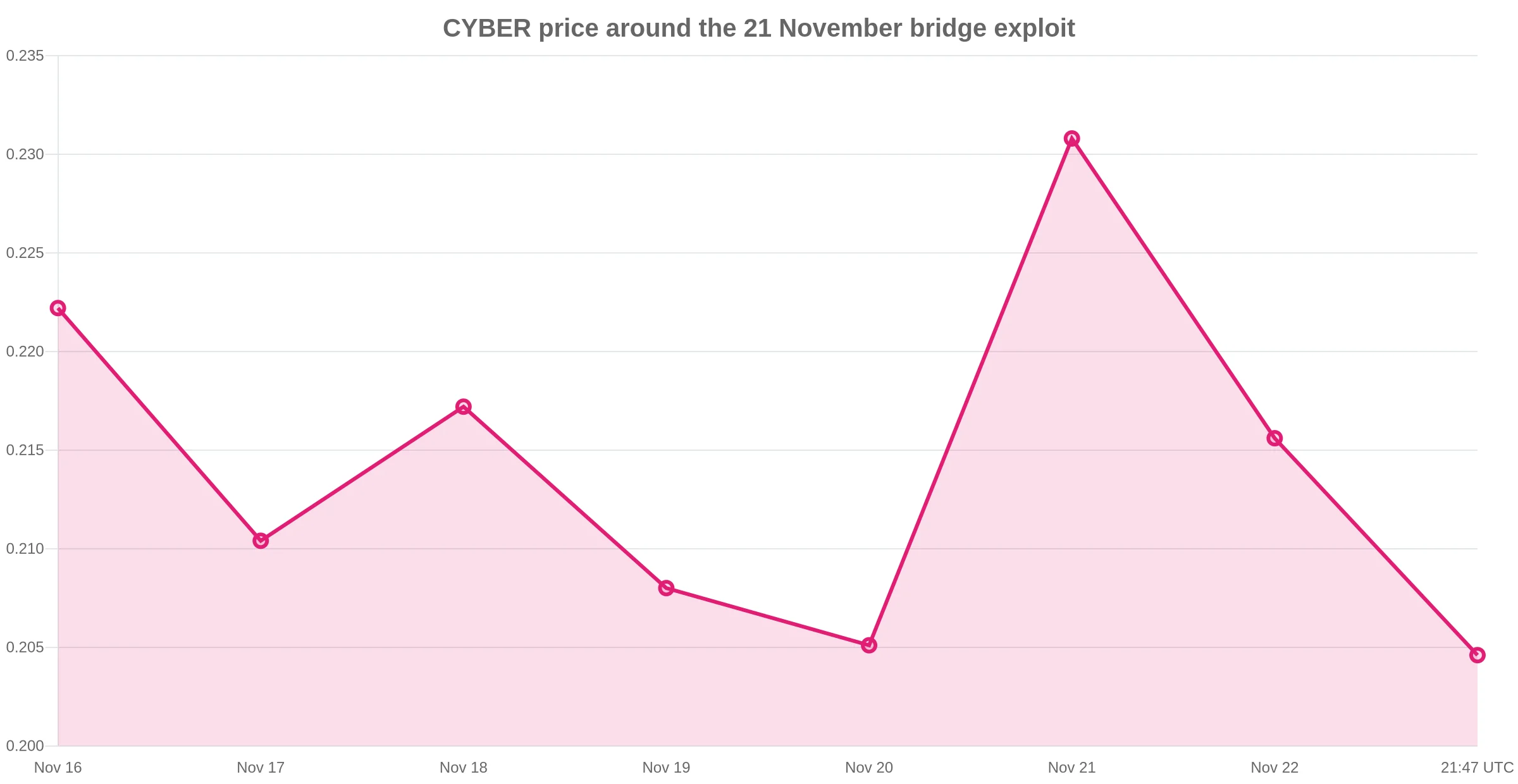
The comparison with last week’s Chainflip vault drain is instructive. Chainflip lost 4.88 million dollars of customer assets from an Ethereum vault and its token broke within two hours, because the loss was denominated in assets the protocol had to replace. Cyber’s loss is denominated in its own token, and the protocol does not have to buy it back at a fixed price. The damage shows up as dilution, not as a hole in a balance sheet.
Upbit’s 55 Minutes
The first Upbit notice is procedural and precise. “Due to circumstances indicating a security incident at Cyber (CYBER), we are temporarily suspending CYBER deposit and withdrawal services,” it reads, citing the Enforcement Decree clause that lets a Korean exchange halt transfers to protect users. The scope is narrow: CYBER on Ethereum, deposits and withdrawals, from the moment of publication until stability is confirmed.
The notice also confirms what the suspension does not do. Its stated scope is deposits and withdrawals of CYBER on Ethereum; spot trading is not part of it. The exchange paused both its deposit-return process and new withdrawal-address registration for the duration. Holders could trade on the venue but could not move the token on or off it. Upbit has used the same caution mechanism before, most recently on KAVA earlier this month .
The second notice, twelve minutes later, is the one that names the transactions. “On 22 November 2026, circumstances suggesting a security problem at Cyber (CYBER) were identified,” it says, adding that “price volatility may therefore increase, so please take extra care with your investment.” Both sentences are translations from the Korean notices published at 02:08 and 02:20 KST. The exchange’s legal basis, its scope and its two transaction links are the only on-record statement it has made.
The Supply Math
CYBER has a fixed maximum of 100 million tokens and 61,074,734 in circulation, according to CoinGecko at 21:46 UTC on 22 November. The 5,213,000 tokens released from the vault equal 8.54% of that float, and 5.2% of the fully diluted supply.
At the prevailing price of $0.2047, the released tokens were worth about 1.07 million dollars. The market capitalisation of the whole float was 12.5 million dollars, and the fully diluted valuation 20.5 million. A single transaction therefore moved a sum equal to 8.5% of the market capitalisation into a market that turns over 8.8 million dollars a day, and the price fell 3.8% over 24 hours and 7.8% over the week.
That gap between the size of the mint and the size of the price move has three plausible explanations, and the data supports all three at once. The float is small relative to the 100 million cap, so a large block is easier to absorb than the headline suggests. The daily volume is 70% of market capitalisation, which is high enough for a market maker to work an order without moving the screen much. And the tokens are fungible with the circulating supply, which means the market repriced the float rather than a single holder’s position.
It does not support the conclusion that the incident was contained. An 8.5% supply increase that no one has burned is a permanent overhang, and the token is already 33.5% lower over 30 days and 98.7% below its all-time high of $15.79.
What the Transactions Do Not Prove
Three things are established by primary records: the mint, the release, and the exchange suspension. The rest is inference.
It is not established how an unbacked mint was accepted on the destination side. Cyber’s blog carried no statement on the incident as of 21:45 UTC on 22 November, and neither Upbit notice describes a mechanism beyond “circumstances indicating a security incident”. The LayerZero endpoint log proves a message was delivered and executed; it does not prove what the message contained or which verification path approved it.
It is also not established that the two flagged transactions are the full scope. Upbit linked one Solana transaction and one Ethereum transaction because those are the ones it could point to. A post-mortem from the project, or a second flagged transfer, would change the arithmetic above.
What Would Change the Picture
The first test is whether the 5,213,000 released tokens are burned or blacklisted. If the project can burn the unbacked supply, the float returns to 61.07 million and the overhang disappears. If it cannot, the tokens stay in circulation and the dilution is permanent regardless of who holds them.
The second test is Upbit’s resumption notice. The exchange has said it will publish the restart through the same notice, after it confirms stability. Its earlier caution designations show the pattern: the venue reopens only when the project supplies an explanation it can stand behind, and the token trades at whatever price the market sets in the meantime.
The third test is the bridge itself. Cyber has not said whether the bridge is paused, and a restart without a published fix would put the same contract back in the path of the same message flow. For holders, the number to watch is not the price. It is the circulating supply, which the market is now pricing at 8.5% above where it stood on 20 November.
Frequently Asked Questions
5,213,000 CYBER, equal to 8.54% of the 61,074,734 tokens in circulation at the time of writing. The same amount was released from the Ethereum vault contract 107 seconds later.
No. Upbit suspended deposits and withdrawals on the Ethereum network at 17:08 UTC on 21 November. Spot trading continued, and the exchange said it would restore transfers through the same notice once stability is confirmed.
Not publicly. Cyber’s blog carried no statement on the incident as of 21:45 UTC on 22 November. The two transactions became public through Upbit’s caution notice, which linked them on Solscan and Etherscan.
Data: CoinGecko , Etherscan , Solscan , Upbit notice 6807 , Upbit notice 6808 .
This article is not intended as financial advice. Educational purposes only.
The post Cyber’s Bridge Minted 5.21 Million Tokens. Its Ethereum Vault Released the Same Amount 107 Seconds Later appeared first on BlockchainReporter .