
Strategy holds 850,849 bitcoin, and according to a post the company published on November 20, not one of those coins is pledged to a lender. The same post puts its net reserve at $35 billion. Bitcoin traded at $59,272 at 04:12 UTC on November 22, up 4.6% over 24 hours on CoinGecko data and 21.4% below the $75,452 average purchase price Strategy reports for its stack.
During the 2022 bear market, our Net Reserve was negative. 1/3rd of our BTC was pledged as collateral. But we survived and emerged stronger.
Today, our Net Reserve is $35 billion. All our BTC is unencumbered. And our conviction and optionality have never been stronger. $MSTR
— Strategy (@Strategy) November 20, 2026
The post is a solvency argument, and it arrives at the right moment for one. Bitcoin spent November 21 near $55,100, its lowest level in two years, before recovering. A treasury company holding more than 4% of the 21 million coins that will ever exist has to answer one question in a drawdown of that size: can anyone force it to sell? The answer, per the company, is no.
The number doing the persuading is harder to audit than the claim next to it. Strategy has not published a definition of net reserve, a measurement date, or the line items behind the $35 billion. The filings do carry most of the parts, and when you assemble them, the reserve comes out about $5 billion smaller than the post says.
What the post claims, and what it does not
Three sentences carry the weight. The company wrote that “During the 2022 bear market, our Net Reserve was negative,” and that “1/3rd of our BTC was pledged as collateral.” Against that it set the present: “Today, our Net Reserve is $35 billion. All our BTC is unencumbered.” It closed with the line every treasury bull wanted this month, that “our conviction and optionality have never been stronger.”
What the post does not say is how $35 billion was calculated, whether dollar holdings are inside the figure, or at which bitcoin price it was struck. That matters because a net reserve built from bitcoin moves every hour, while the debt and preferred stock sitting ahead of it do not.
The pledge-free status is also older than the post implies. Strategy’s quarterly report for the period ended September 30 states that it held roughly 847,666 bitcoin at that date and 672,500 at December 31, 2025, “all of which were unencumbered as of such dates.” The November 20 message is a restatement made in public during a selloff, not a new balance-sheet event.
The filing numbers that bracket the claim
Strategy’s 10-Q gives a useful anchor. As of October 25 the company held 848,517 bitcoin with an aggregate market value of $68.27 billion, using a price of $80,456 from the Coinbase exchange. Four weeks later the same coins at the current price are worth $50.43 billion, a fall of $18.0 billion, or 26.3%, on the asset side of the balance sheet.
The liabilities did not move with it. Total debt stood at $6.715 billion at September 30, split between $1.046 billion due within a year and $5.670 billion long term, across convertible notes maturing in 2028, 2029 and two 2030 tranches. Preferred stock carried a liquidation preference of $14.11 billion against a book value of $13.06 billion. Dividends on that preferred stock cost $1.049 billion in the first nine months of 2026, including $419.6 million in the third quarter alone.
Holdings come from a separate Form 8-K filed November 16, which reports 850,849 bitcoin at an aggregate purchase price of $64.20 billion and an average of $75,452 a coin, fees included. That is the most recent count the company has put in a filing.
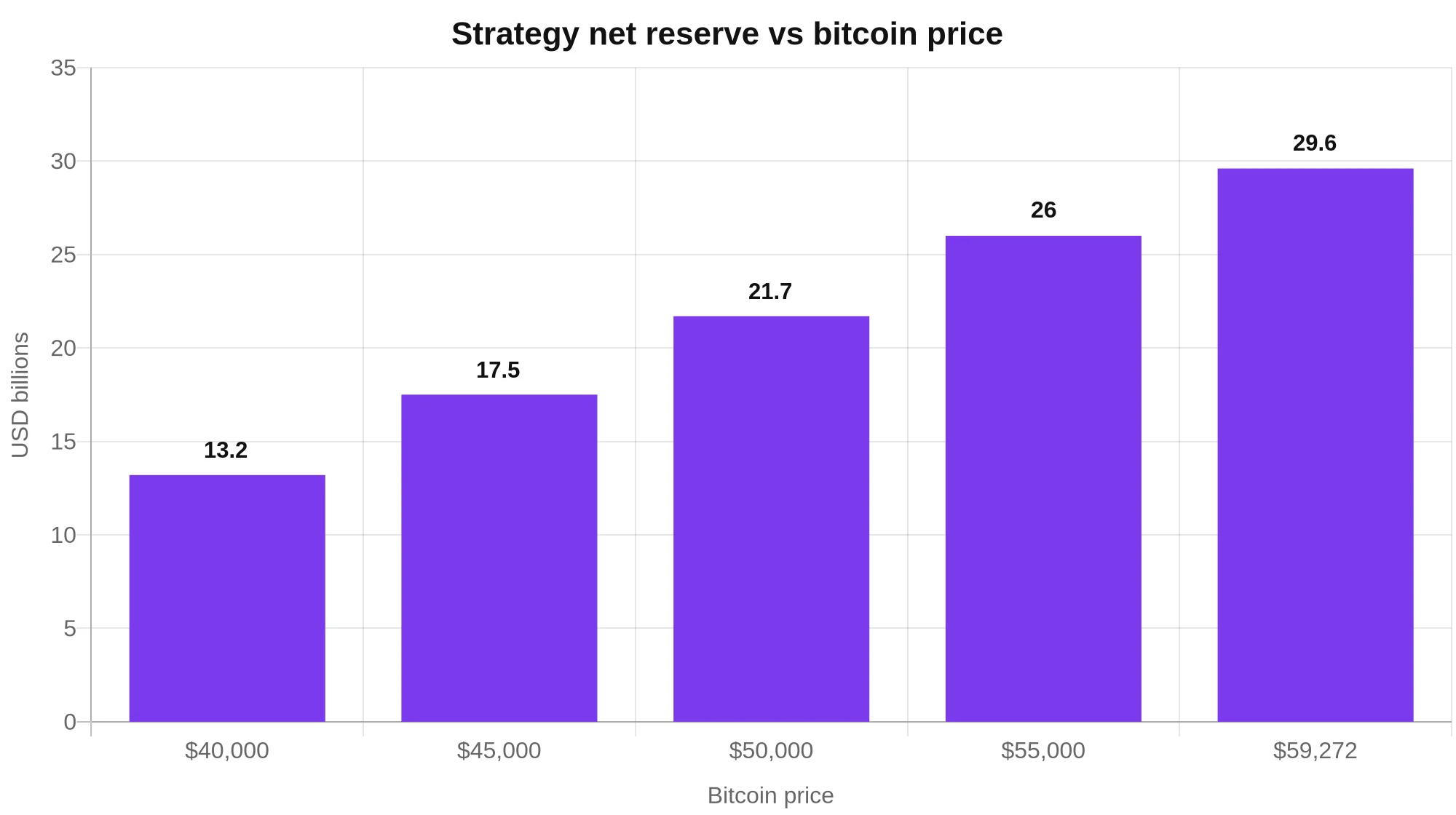
Our arithmetic puts the reserve near $29.6 billion
Take the coins at the current price, subtract the two claims that rank ahead of common shareholders, and you get a reserve of $29.60 billion: $50.43 billion of bitcoin, less $6.72 billion of debt, less $14.11 billion of preferred liquidation preference.
The $5.4 billion gap between that and the company’s $35 billion is roughly the size of the dollar reserves Strategy says it holds outside bitcoin to cover dividends and interest. The company describes a USD Reserve and a separate USD Cash pool in the 10-Q without tying a figure to either at the latest date. If those balances sit near $5 billion, the two numbers reconcile within a few hundred million dollars. Strategy has not published that bridge, so the $35 billion stays management’s figure rather than a filed one.
| Bitcoin price | Value of 850,849 BTC | Debt and preferred | Net reserve |
|---|---|---|---|
| $40,000 | $34.03B | $20.83B | $13.20B |
| $45,000 | $38.29B | $20.83B | $17.46B |
| $50,000 | $42.54B | $20.83B | $21.71B |
| $55,000 | $46.80B | $20.83B | $25.97B |
| $59,272 | $50.43B | $20.83B | $29.60B |
| $24,480 | $20.83B | $20.83B | $0 |
The floor sits 59% below spot
Run the same model down and the reserve reaches zero at $24,480 a coin, which is 58.7% under the current price and below the 2022 cycle low. Every $1,000 move in bitcoin shifts the figure by about $851 million, because there are 850,849 coins behind it.
Treat $24,480 as the conservative bound. If the dollar reserves are counted as assets, as the company’s own figure appears to do, the floor drops to roughly $18,100. Either way, the mechanics are the same: the coin count is fixed and slowly rising, the claims are fixed in dollars, so the reserve is a leveraged expression of the bitcoin price with a strike far below the market.
The ATM is now buying back preferred stock
The November 16 filing also shows where new money went in the week of November 9 to 15. Strategy sold 2,087,040 Class A shares for $244.7 million of net proceeds. Of that, $206.3 million funded repurchases of STRC preferred stock, $33.4 million bought bitcoin, and $5.0 million went to USD Cash.
That split is worth pausing on. Eighty-four cents of every dollar raised went to retire preferred stock, and 14 cents went to bitcoin. The company bought 485 coins in the week at an average of $68,887, which is 14.0% above the current price. The newest bitcoin on the balance sheet is also the most underwater.
Retiring STRC reduces a dividend obligation that ran $1.05 billion over nine months, so the trade has a logic beyond sentiment. It also means the marginal dollar of dilution is no longer a bitcoin purchase. Strategy’s equity issuance is partly financing the senior stack that stands in front of the same shareholders.
Unencumbered removes one mechanism, not the risk
Pledged bitcoin is the mechanism that turned several treasuries into forced sellers this year. KULR sold its entire 1,099-bitcoin treasury for $80.1 million and repaid a Coinbase-backed loan rather than post more collateral. Nakamoto pushed $60 million of Kraken debt into 2027 and pledged its derivatives book to do it. Both had a lender with a claim on the collateral and a margin level to defend.
Strategy has neither on its bitcoin. A lender cannot demand more collateral against assets that secure nothing, and no price triggers a forced sale of the stack. The company’s own risk language still concedes the trade-off: the 10-Q warns that “we may be unable to enter into loans or other capital raising transactions collateralized by our unencumbered bitcoin,” which is the flip side of the same fact.
What remains is dilution, dividends and time. The company can keep selling shares to buy coins, as it did with 485 bitcoin last week, but each sale at a market capitalization below the value of the treasury transfers value to buyers. Dividends on $14.11 billion of preferred stock keep accruing whatever bitcoin does, and the dollar reserves that cover them are the same balances that make the company’s reserve figure larger than the one the filings support.
What to watch in the next filing
Three things would settle the open questions. The first is whether Strategy itemizes net reserve, with a definition and a measurement date, in its next quarterly report. The second is the average purchase price in the next 8-K, which will show whether the company kept buying above $65,000 or slowed as the price fell. The third is the split between bitcoin purchases and preferred repurchases, since the last week’s 84-to-14 ratio says more about capital allocation than any post on X.
For now the claim the filings do support is narrower than the headline. Strategy owns 850,849 bitcoin, none of it pledged, with $20.8 billion of debt and preferred stock standing ahead of it. The reserve that separates the two is real, and it is a function of a price that fell 26% in four weeks.
The post Strategy Says All 850,849 Bitcoin Are Unencumbered. The $35 Billion Reserve Is a Price Bet appeared first on BlockchainReporter .