

At 04:00 UTC on Friday, a token that its issuer describes as a claim on Monero traded at $496.54 on Hyperliquid. Two hourly candles later it closed at $1.00. The Monero it was meant to represent had not moved: it sat near $477, down 5.29% on a day when the whole crypto market was red.
The token is XMR1, minted by the swap service Wagyu and redeemable, according to the company’s own documentation, for native Monero. Between the 03:00 close of $494.68 and the 05:00 close, holders lost 99.8% of the market value of that claim. At 10:33 UTC the best bid was $0.9221 and the mid price $0.937, against a Monero spot price of $476.93 on CoinGecko. That is 509 times below parity.
Then the part that does not fit the usual story of a depeg. The bridge did not close. Wagyu’s
live terms endpoint
, queried at 10:47 UTC, returned
deposit: true
and
withdraw: true
for XMR, a 2% withdrawal fee and a 0.01 XMR minimum. Its quote endpoint priced a withdrawal of 1,000 XMR1 at 980 XMR and returned
"available": true
. At $476.93, those 980 coins would be worth $467,391. The same 1,000 XMR1 cost $937 on the Hyperliquid order book at the ask.
The hour the tape stopped agreeing with the documentation
Hyperliquid’s hourly candles for the XMR1 market, pair @260, put the break inside a single two-hour window on Friday morning. The 03:00 UTC candle closed at $494.68. The 04:00 candle opened at $496.54, printed a high of $503.21, then fell to $85.00 and closed at $161.93. The 05:00 candle opened at $161.93, touched $369.62 on the way up, and closed at $1.00 after a low of $0.77.
Volume confirms that this was not a thin print. The 05:00 hour traded 244,510 XMR1, and the following two hours added 54,438 and 110,567. Across the trailing 24 hours the market turned over 478,064 XMR1. A market that fills hundreds of thousands of tokens an hour is not a market where one careless seller sets the price.
Monero itself did nothing comparable. The asset fell 5.29% over 24 hours and 10.56% over seven days, part of a broad crypto decline that took the total market cap down 4.37% on the day. One is a fall of more than 99%. The other is a 5.3% decline in an asset that was already selling off.
What Wagyu’s bridge documents actually promise
The bridge documentation is unusually specific about mechanics. “A deposit sends native XMR or ZEC and mints XMR1 or ZEC1 to a Hyperliquid address. A withdrawal sends XMR1 or ZEC1 back and pays out native XMR or ZEC,” the page states. It quotes redemptions at “deposits cost 0% and withdrawals 2% right now,” with a 0.01 XMR minimum, and warns integrators not to assume availability: “Do not hard-code an asset as available because it worked earlier.”
The same page explains why a configuration check is not a solvency check. “Each asset is switched on or off independently, per direction. An asset stays listed while it is off (with its fees and minimum), so a picker can grey it out instead of hiding it.” Switching withdrawals on describes an operational setting. It does not describe a balance.
That distinction matters here because the page, read in full on Friday, covers minting, redemption, fees, minimums, order lifecycle, refund addresses and settlement amounts. It does not describe reserves, custody arrangements or an attestation that circulating XMR1 is matched one-for-one by native Monero. The documentation footer says its facts “come from the live API and are checked when the site builds,” and the bridge page was built on 12 November 2026 at 18:11 UTC.
A spread that should not survive one round trip
If redemption works, the arithmetic is not subtle. One XMR1 bought at the $1.00 offer and withdrawn returns 0.98 XMR after the fee, worth $467.39 at Friday’s spot price. That is roughly 467 times the dollar paid for it. Measured from the $0.937 mid price instead of the offer, the same claim sits 509 times below the Monero it is meant to represent.
The size is not trivial either. The ask side of the XMR1 book held 238,115 tokens at $1.00 when checked, about $238,115 of inventory. Redeemed in full, that would pay out 233,353 XMR, or roughly $111.3 million at $476.93.
Nobody took it. An offer that large, sitting that far below the redemption value its issuer quotes, is the market’s own verdict on whether the redemption path settles at size. The quote endpoint returning
available: true
is a statement about configuration, in the same sense the documentation uses the word when it calls a refusal “a temporary refusal about Wagyu’s configuration.” It is not a promise that 233,353 XMR will be paid out, and nothing in the public documentation reviewed for this article says how large a withdrawal the issuer will honour or how quickly.
The other three wrappers on the same order book
Hyperliquid lists three more tokens that represent Monero held elsewhere, and their behaviour separates an asset problem from an issuer problem. XMR2, issued by Beluga and traded as pair @1189, mid-priced at $481.355, about 0.93% above CoinGecko’s spot. XMRN, from noiho.xyz and traded as @1191, sat at $478.105, roughly 0.25% above spot.
Both quotes are thin. XMR2 printed 4.09 tokens of volume in its last active hour and XMRN 2.18. Thin, however, is different from broken: both kept tracking the metal.
A fourth venue looks worse than either. FXMR, the Freedom XMR token that investigators previously linked to illicit flows on Hyperliquid , showed bids of $5.001, $5.00 and $3.00 with an empty offer side, no daily candles and zero volume over 24 hours. With no offers, it has no meaningful price at all, and its $32.65 mid is a quotation without a counterparty.
Taken together, the four markets make a narrow point. Monero’s price did not break on Friday. One issuer’s claim on Monero broke, and the other wrappers kept their peg within about a percentage point.
The Monero perpetual never moved
Hyperliquid’s native XMR perpetual future is the cleanest control in this comparison. Its mark price was $477.94 against an oracle price of $477.879, with $48.8 million of notional volume over 24 hours and 163,052 XMR of open interest, about $77.9 million at that mark. The previous day’s price was $503.54.
That is an ordinary down day for a derivative tracking a coin that fell 5% in the same session, as Monero’s slide from its 200-day average has already been tracking. The perpetual and the spot market agreed with each other. Only XMR1 disagreed, which points at the wrapper rather than the underlying.
What caused the selling is a separate question, and the public record available on Friday does not settle it. Large transfers from a wallet tied to the token’s creation preceded the collapse, but the candles show what happened to the price, not who authorised the sales or why. Presented as fact, “a compromised key” and “an issuer winding down” would be equally unsupported.
What holders can and cannot establish
A holder of XMR1 has one asset: a claim on Wagyu’s bridge. The token has no independent value, no redemption outside that service and no market maker obliged to bid for it. The 2% withdrawal fee is the price of converting the claim into Monero, and the 0.01 XMR minimum is the smallest redemption the service quotes.
What the public documentation reviewed for this article does not provide is a statement of how much native Monero backs the outstanding XMR1 supply, where that Monero is held, or what happens to holders if the issuer stops paying. A reader trying to value XMR1 at anything other than the order book price is therefore guessing at a counterparty’s balance sheet.
The order book is the only live, public verdict available, and on Friday it said the claim is worth about 0.2% of the Monero it is meant to represent.
What would change the picture
Three observable events would move this from an open question to a settled one. A lift of the $1.00 offers, followed by an on-chain payout of native XMR, would show the redemption path works at size and that the spread was a liquidity artefact. A flip of the terms endpoint to
withdraw: false
would show the issuer has closed the exit rather than repriced it. A published reserve figure, matched against the token supply, would replace the current guesswork with a number.
Until one of those appears, the gap between a $0.937 token and a $476.93 coin is not a discount. It is the market pricing the probability that the bridge pays.
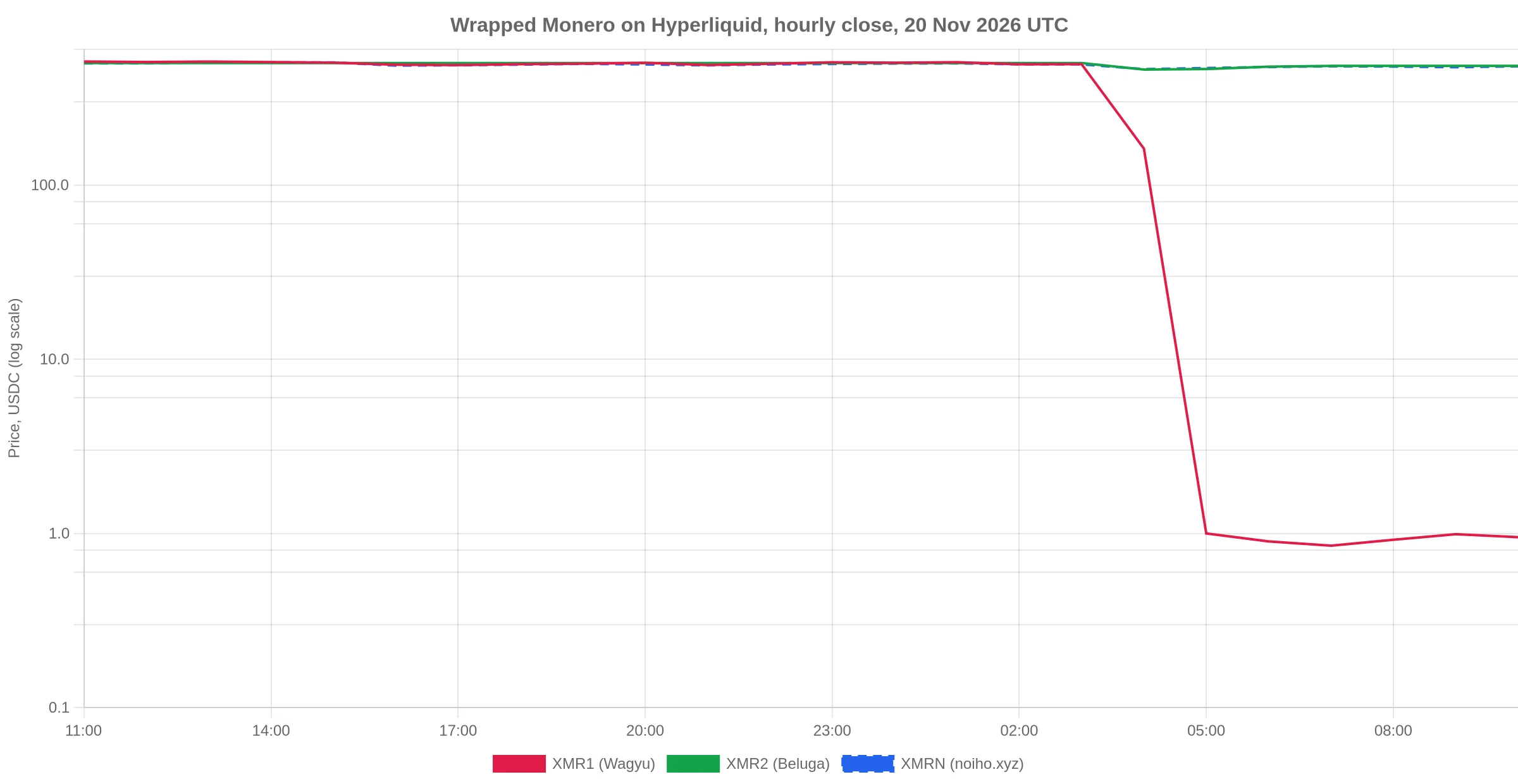
Hourly closes on Hyperliquid for the three wrapped Monero tokens that traded on 20 November 2026. Series are forward-filled where an hour had no trade. Source: Hyperliquid info API.
Data: Hyperliquid , CoinGecko .
This article is not investment advice. Figures are quoted as observed on 20 November 2026 and market data moves continuously; readers should verify current prices and the issuer’s terms before acting.
The post XMR1 Fell 99.8% and Still Quotes a 509-Fold Gap to Monero Through Wagyu’s Open Bridge appeared first on BlockchainReporter .