


Bitcoin miners have sold nearly half their BTC reserves since January 2026, with MARA and Riot liquidating billions to fund operations and AI expansion.
Publicly traded Bitcoin mining companies have sold nearly half their BTC reserves since January 2026, marking a significant departure from the accumulation strategies that dominated the industry for years.
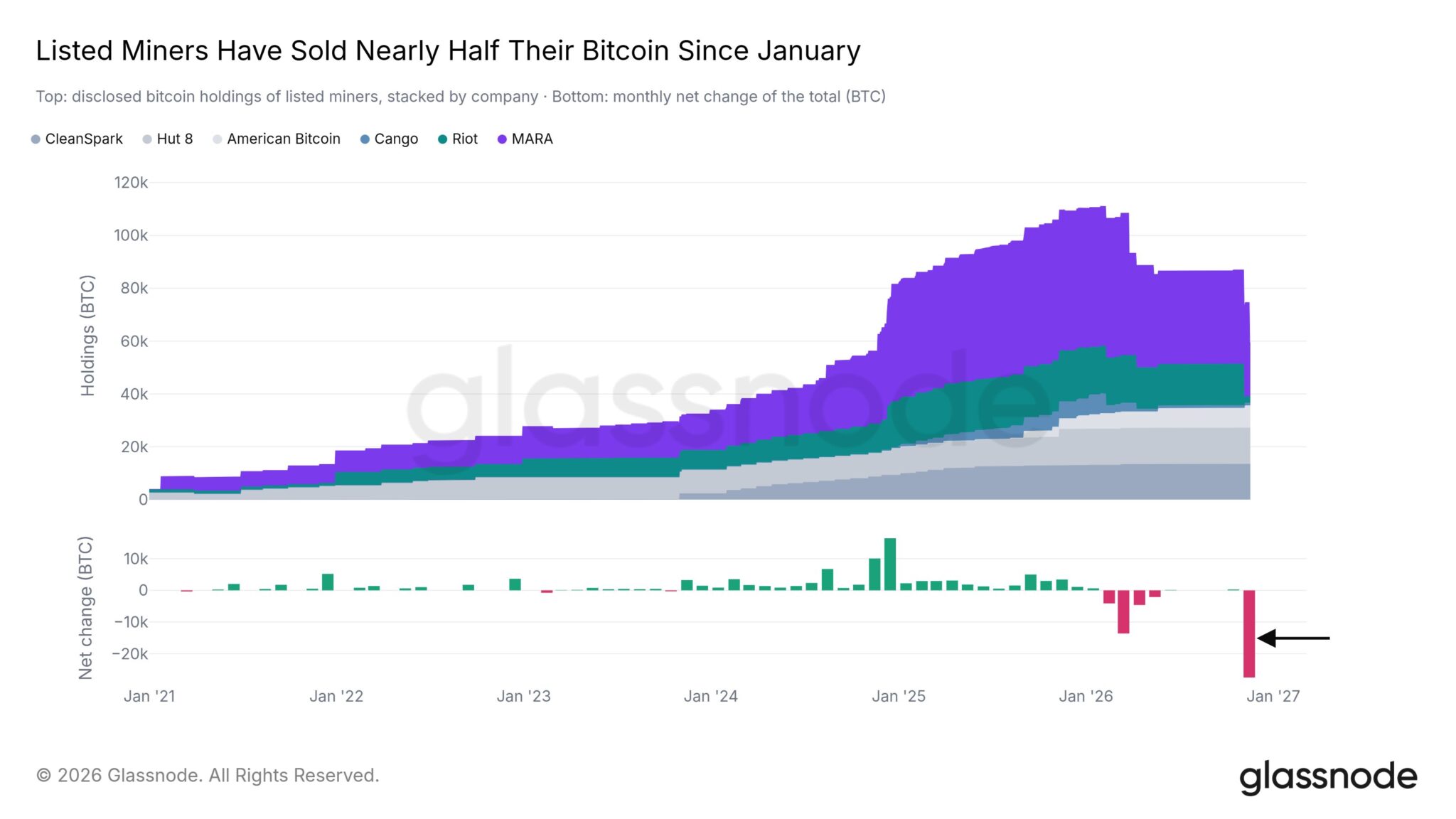
According to new data released by Glassnode on November 18, listed miners are increasingly liquidating their Bitcoin holdings to finance their expansion into artificial intelligence and data center infrastructure.
The development comes as mining companies face changing economics and growing demand for computing capacity, prompting them to redirect capital previously held in Bitcoin toward new business opportunities.
Bitcoin Miners Have Sold Nearly Half Their Reserves
Glassnode’s latest figures track the disclosed Bitcoin holdings of six publicly traded mining companies: CleanSpark, Hut 8, American Bitcoin, Cango, Riot Platforms, and MARA Holdings.
Their combined reserves expanded significantly between 2021 and early 2026, reflecting a prolonged period when companies retained much of the Bitcoin they mined.
Some miners also purchased additional BTC to strengthen their corporate treasuries.
However, this trend has reversed during 2026.
The latest data indicates that the tracked miners have collectively sold nearly half their Bitcoin holdings since January, with particularly sharp reductions appearing toward the end of the reporting period.
Monthly net position changes have also turned substantially negative, illustrating how quickly the accumulation strategy has shifted toward distribution.
The nearly 50% figure applies to Glassnode’s tracked group of listed miners, not the entire Bitcoin mining industry.
MARA and Riot Lead Major Bitcoin Treasury Reductions
The change has been visible in corporate disclosures throughout 2026.
In March, The Crypto Basic reported that MARA had revised its Bitcoin treasury policy , allowing the company to sell assets accumulated on its balance sheet.
MARA’s latest quarterly filing confirms that the company sold approximately 26,984 BTC for $1.9 billion during the first nine months of 2026.
Despite these sales, MARA still held 34,012 BTC as of September 30.
Riot Platforms has taken an even more aggressive approach to reducing its reserves.
The company disclosed selling 20,264 BTC for approximately $1.5 billion during the same nine-month period, primarily to finance data center development.
Riot consequently ended September with just 2,418 BTC on its balance sheet.
Together, MARA and Riot reported selling 47,248 BTC during the first nine months of 2026, although the proceeds supported different business and financing priorities.
Bitcoin Reserves Are Now Funding AI Data Centers
The selling comes amid a broader transformation of the mining industry.
Bitcoin miners already control substantial energy infrastructure, making their facilities attractive for AI computing and high-performance data centers.
However, expanding these operations requires significant capital investment.
As The Crypto Basic previously documented , CoinShares identified increasing pressure on mining profitability as companies redirected resources toward AI infrastructure.
The report estimated that approximately 30% of listed miners’ revenue was already coming from AI and related computing activities, with the share potentially reaching 70% by the end of 2026.
The transition has also affected smaller operators.
In September, Hyperscale Data shut down Bitcoin mining at its Michigan facility to prepare the site for an AI data center customer.
Its Bitcoin holdings had fallen 79% from the previously reported July level.
What the Selling Means for Bitcoin
The reduction in miner reserves introduces another source of potential selling pressure in the Bitcoin market.
Historically, retaining newly mined BTC reduced the amount of supply miners immediately offered for sale.
That dynamic changes when companies liquidate existing reserves in addition to monetizing newly mined coins.
However, the reduction in reported holdings does not establish that all sales occurred on exchanges or that they directly caused Bitcoin’s recent price weakness.
The figures also do not measure every mining company’s position.
The broader development is a shift in how public miners manage their treasuries: Bitcoin is increasingly being used as a source of corporate funding rather than solely as a long-term reserve asset.