



DBS and Circle said on 18 November that eligible institutional clients can mint and redeem USDC directly through the Singapore bank, with dollar settlement running at any hour instead of inside a banking day. The arrangement, set out in the joint announcement , gives those clients a way to obtain the stablecoin from the issuer through their bank rather than by buying it on a venue.
The timing is worth stating plainly against the supply data. USDC’s market capitalisation stood at $68.86 billion at 10:37 UTC on 18 November, down 5.40% from $72.78 billion on 21 August, and that is the lowest reading in the 90-day window tracked by CoinGecko. The bank rail is being switched on while the asset it serves is shrinking, not growing. Nothing in the announcement shows up in that series yet, and the release does not claim it does.
What the two firms actually turned on
Under the partnership, eligible institutional clients can directly mint and redeem USDC through DBS. Circle describes the purpose in the release as letting institutions “diversify their reliance on secondary market liquidity to meet their USDC needs”, and says the arrangement enables 24/7 USD-USDC settlement when minting and redeeming through the bank, so clients can move between fiat and the token “without the constraint of banking hours and cut-off timings”.
That last clause is the substance. Stablecoin issuance has been live around the clock for years; the fiat leg behind it has not. A treasurer who wants $50 million of USDC at 02:00 on a Sunday can already buy it from a market maker, but the dollars to pay for it typically settle when the correspondent bank opens. Moving the mint itself inside a bank that quotes continuously removes one of the two clocks that institutional flows run on.
The release leaves a lot unspecified. It does not publish a fee schedule, per-client limits, which DBS legal entity books the service, whether EURC is included, or a list of eligible client types beyond “eligible institutional clients”. It gives no volume figures and no live date beyond the announcement itself. A partnership announcement is not evidence of usage, and this one does not pretend otherwise.
Evy Theunis, head of digital assets for DBS’s institutional banking group, framed the product as a menu rather than a single answer: “Institutions are increasingly looking to tokenized money to manage liquidity more efficiently and support their growth across new markets,” she said, adding that the bank expects “different forms of tokenized money serving different needs”. Circle chief commercial officer Kash Razzaghi put the same point from the issuer side, saying financial institutions are “looking for trusted ways to access stablecoins and integrate blockchain-based infrastructure into their financial operations”.
Minting is not the same as buying on a venue
The mechanical difference matters more than the marketing language. Minting creates new USDC against reserves held by Circle’s regulated issuing entities, priced at par. Buying on an exchange or from an over-the-counter desk transfers coins that already exist, at whatever price the book offers, and the trade depends on someone else being on the other side at size.
USDC printed $0.99953 at 10:37 UTC, about 4.7 basis points below par. That is a normal, small discount, but it is not zero, and on a $100 million ticket it is roughly $47,000 of basis that a par mint does not pay. The bigger saving for a large client is not the basis; it is the absence of a depth question. There is no partial fill, no slippage ladder, and no need to check whether the venue’s USDC book can absorb the order without moving.
What does not change is the compliance layer. A direct mint through a bank still runs identity checks, sanctions screening and credit approval, and it still needs a fiat account at that bank. The counterparty shifts from an exchange or a market maker to a combination of the bank and the issuer. For a corporate treasury that already banks with DBS, that is a shorter chain; for one that does not, the operational gain is smaller than the headline suggests.
The survey number behind the launch
DBS is selling this to a specific demand profile it measured itself. Its Treasury Prism survey , published on 28 October 2026, polled 422 finance leaders at companies with revenue above $500 million across 11 markets. It found 88% already deploying or piloting tokenised money use cases, which scales to roughly 371 of the respondents, and 63% adopting stablecoins, the single most used instrument ahead of tokenised deposits at 53% and tokenised money market funds at 52%.
The most relevant figure for a bank product is buried further down: 64% of respondents said they wanted a bank to act as a single point of integration into the tokenised money ecosystem, and 63% wanted help running pilots and proofs of concept. That is a demand for consolidation, not for more venues. Lim Soon Chong, DBS’s group head of global transaction services, made the same argument in the survey release, warning that “many emerging settlement networks are developing in parallel” and that “fragmentation may add complexities and compliance obligations” for corporates.
Read carefully, the survey explains why the product exists. It does not forecast volume. Self-reported deployment includes pilots that never scale, and a 422-company sample of large-revenue firms is not the whole institutional market.
The supply data is the harder test
Stablecoin supply is the cleanest available proxy for whether institutional money is actually entering these rails, and the direction is currently negative for both major dollar tokens, not just USDC.
| Metric (CoinGecko, 18 Nov 2026, 10:37 UTC) | USDC | USDT |
|---|---|---|
| Price | $0.99953 | $0.99910 |
| Market capitalisation | $68.86bn | $175.28bn |
| 24-hour volume | $12.68bn | $48.52bn |
| 24-hour volume as share of market cap | 18.4% | 27.7% |
| Change since 21 August 2026 | -5.40% | -4.25% |
| Share of total crypto market cap | 3.14% | 8.00% |
Three numbers are worth pulling out of that table. USDC holds 28.2% of the combined USDC and USDT float of $244.1 billion, and its 24-hour turnover of 18.4% of market cap runs roughly two-thirds of USDT’s 27.7%. The gap is a rough measure of how much of each token’s stock is in motion on a given day rather than sitting still, and it is consistent with USDC being held more as a settlement balance and less as a trading vehicle in Asia.
The decline is also not a USDC story. USDT is down 4.25% over the same 90 days, from $183.04 billion to $175.26 billion. When both of the two largest dollar tokens contract together, the driver is usually the broader market rather than one issuer’s distribution: total crypto market capitalisation was $2.18 trillion at the same timestamp, with Bitcoin at 59.08% dominance. USDC peaked at $75.29 billion on 27 September. Recovering that level would take $6.43 billion of net new supply, or 9.3% growth from here.
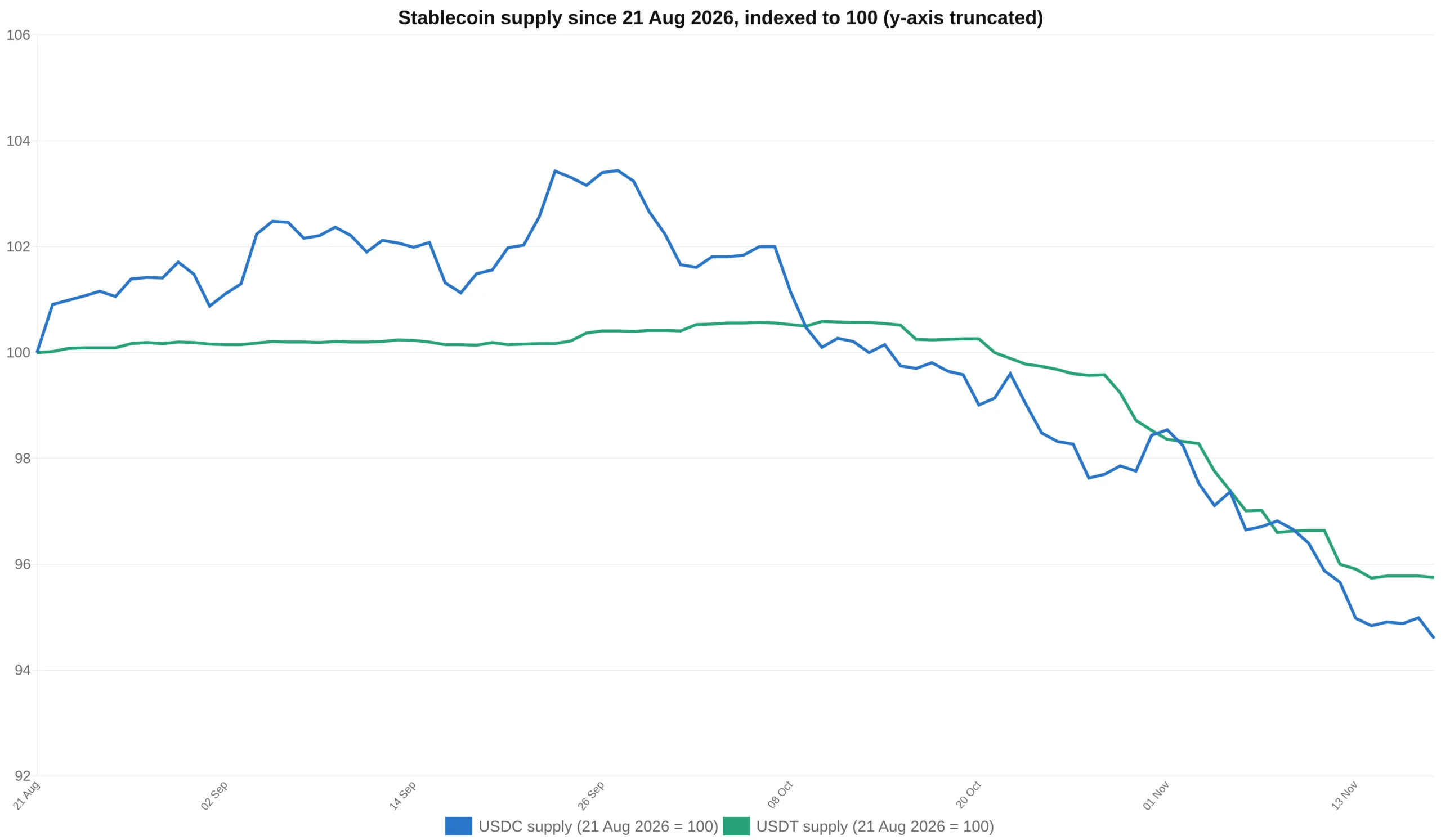
The honest reading is that the DBS rail has no visible footprint in the supply series on the day it launched, and it is too early for one. Institutional onboarding into a new mint channel takes weeks of documentation before the first dollar moves. The check that matters is where the line goes in December, not where it sat in November.
Where Singapore’s rules sit under this
The partnership is explicitly tied to Project BLOOM, the Monetary Authority of Singapore’s public-private settlement initiative. MAS describes BLOOM as work that “will enable the use of settlement assets such as tokenised forms of commercial bank money and stablecoins that meet regulatory expectations”, and its stated aim is to reduce the need for institutions to build separate bilateral arrangements with each counterparty or market. Malaysia’s and Thailand’s central banks joined BLOOM as policymaker members in October 2026, which widens the cross-border frame the DBS arrangement can eventually plug into.
Direct bank minting is not new in itself. Standard Chartered became the first global systemically important bank to offer direct USDC minting and redemption in July 2026, so the DBS arrangement extends an existing model into Singapore rather than inventing one. What is new is the combination: a Singapore-licensed balance sheet, MAS’s settlement framework, and a client base that already runs tokenised balances across Asian corridors. Circle supplies the token and the reserve attestations; DBS supplies the licence, the balance sheet and the client relationship. Both companies already appear on BLOOM’s participant list alongside J.P. Morgan, Standard Chartered, Coinbase and StraitsX, and the initiative’s October expansion added Visa, Mastercard and the World Bank Group. DBS operates in 19 markets and carries AA- and Aa1 credit ratings, and the release leans on both facts. For a corporate treasurer weighing whether to hold a tokenised dollar balance overnight, the bank’s rating is the part of the pitch that answers the counterparty question.
This is the second bank-and-stablecoin arrangement we have covered in two weeks, and the two are not copies of each other. PNC began taking USDC from corporate clients and converting each payment into dollars, which is a receipt-and-convert model: the stablecoin arrives and leaves as fiat. DBS is selling the opposite direction, new issuance for clients who want to hold and move the token. Circle’s own economics set the backdrop: its third-quarter revenue rose 17% to $865 million while reserve income fell 8%, and 59% of revenue went to distribution partners. A bank mint channel is one more partner to pay, which is why the fee schedule that this release does not include matters as much as the capability it does.
What would count as proof this works
Three measurable things would separate a real rail from a press release. First, USDC supply turning higher: a move back above the 27 September peak of $75.29 billion would be the first hard evidence that bank-channelled minting is adding dollars rather than rerouting existing ones. Second, disclosure of the terms the release omits, particularly the mint and redemption fee and any per-client cap, because a bank rail priced near zero is a different product from one priced at 20 basis points. Third, a second bank in the same corridor, or EURC added to the same channel, which would show the model is repeatable rather than a single bilateral deal.
The invalidation is equally clear. If USDC supply is still falling through December with the DBS channel live, the constraint on institutional stablecoin use is demand and balance-sheet appetite, not access to issuance. That would not make the rail pointless; it would mean the bottleneck was misdiagnosed.
Frequently Asked Questions
Eligible institutional clients can mint and redeem USDC directly through DBS, with 24/7 settlement between US dollars and the stablecoin, instead of relying on secondary market liquidity to obtain it.
The announcement names only eligible institutional clients. It does not describe a retail service, and it does not list which client categories qualify.
No. USDC market capitalisation was $68.86 billion on 18 November, down 5.40% since 21 August and at a 90-day low. The announcement does not appear in the supply data yet.
Minting creates new USDC against reserves at par. Buying transfers coins that already exist at the market price, and the trade depends on the depth of the order book at that moment.
The release does not publish a fee schedule, per-client limits or a full list of eligible client types. Those terms have not been disclosed.
Data: CoinGecko . Market capitalisation and volume figures are a timestamped snapshot taken at 10:37 UTC on 18 November 2026.
This article is for information only and is not investment advice. Market data is a timestamped snapshot and changes continuously.
The post DBS Opens Round-the-Clock USDC Minting to Institutions, Skipping the Order Book appeared first on BlockchainReporter .