



After Binance was hacked for more than $6 billion, several centralized parties chose to freeze assets quickly in an attempt to prevent user and exchange losses. There is a deep irony that digital asset holders needed to rely on a handful of traditional companies to safeguard their assets. And there are genuine questions about how the occasional exercise of discretionary power to preserve assets by those same parties sits alongside their traditionally laissez-faire attitude towards sanctions and (smaller) hacks.
Those are interesting questions. But what we are going to look at here is a public exchange we find genuinely puzzling on a related issue: would any of this Binance hack stuff have been different under the Clarity Act? Of course the Act did not pass and does not look likely to pass. But it is worth considering if, and how, the Act would have worked. Yes, this is a bit of historical fiction. But it can also be instructive. There are no double-blind trials for legal systems, so thought experiments like this are the best we can do.
To start, we are going to look at the public viewpoints of two public figures with markedly different perspectives: Sen. Cynthia Lummis for the pro-crypto crowd and Amanda Fischer, policy director and COO of Better Markets, for the anti-crypto crowd. These two had a spirited and public back-and-forth on the subject which we will quote and then dissect. Yes, these are just two viewpoints. Notice this is a column and not a law school seminar.
The Comments
The day after the hack, Lummis issued the following public statement on X:
Yesterday, hackers stole more than $6 billion from Binance in less than 4 hours, the biggest heist in history. The Clarity Act would have given crypto firms legal cover to freeze suspicious transactions the instant law enforcement calls. Every minute lost is money gone for good.
Fischer responded by claiming Lummis' claim was false, and Fischer quoted a portion of the Act:
This is not true. Clarity requires stablecoin issuers to freeze per a court order. For exchanges, here’s the relevant language. Check out (1) below.
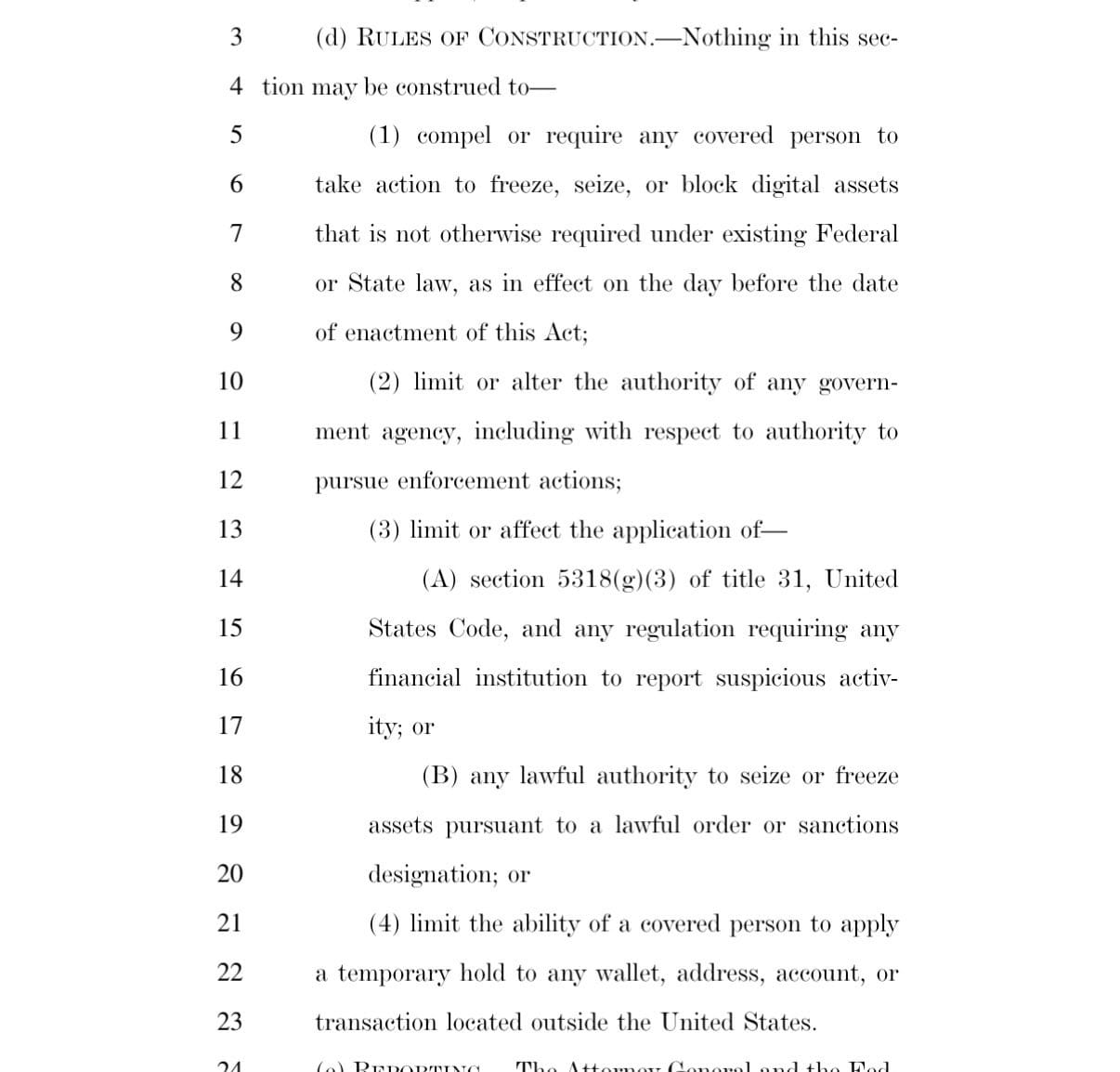
And then Lummis replied with:
Nice try, but what you’re citing is a savings clause. It keeps existing finance and sanctions law in force but it doesn’t erase the rest of the section. What you fail to understand about the Clarity Act is that it would classify Binance as a covered person because it is a digital asset service provider.
No law stops every bad actor, but the Clarity Act would have given the people fighting them better tools and the ability to act faster. Your party voted no, and you have to own that.
Of course these interpretations have never been, and likely will never be, subject to real judicial scrutiny. But we can learn a lot from the contours of the debate anyway. And as is usually the case in this column we agree with both sides a bit and disagree with each of them a bit too.
The Issues
For us the first question is whether any of this applies to Binance at all. Binance is not a US company. As part of its 2023 settlement with the US government, Binance committed to a complete exit from the United States. Binance does have a small US subsidiary and that is clearly subject to US law. But it is tiny and basically irrelevant. Nobody is talking about Binance.US because, well, nobody ever talks much about Binance.US. We are going to ignore the impact of the Clarity Act on Binance.US because that impact is capped at however large Binance's US operation is. So it is at most tiny.
So when Lummis asserts that "the Clarity Act ... would classify Binance as a covered person because it is a digital asset service provider" it is a bit puzzling. The Clarity Act does not place every digital asset service provider anywhere and everywhere under US jurisdiction. To the extent Binance operates legally inside the US, that bit is subject to US rules. But, again, that is both tiny and out of scope here (because it is too small to move any needles). The most charitable interpretation we have is that Lummis was speaking about a world in which Clarity is law and Binance runs primarily out of the US in a compliant fashion under Clarity.
In that case, fair enough. In that world Lummis is surely correct about US jurisdiction. But her initial claim was that "the Clarity Act would have given crypto firms legal cover to freeze suspicious transactions the instant law enforcement calls." If Binance were operating within the US under a normal, compliant framework, then cooperating with US law enforcement would not be seen as a real victory here. Passing Clarity would not be the thing that brought cooperation and compliance. Getting Binance to subject itself to such a regime would be a victory. But that battle was won – again in this alternate world – when Binance submitted to supervision and not when law enforcement came knocking and asking Binance to freeze funds after Binance was hacked.
In the real world, Binance voluntarily imposed a partial shutdown on itself following this hack, suspending withdrawals for about two days. The existence, or not, of legal cover clearly was not important to real Binance. And Binance would not magically decide to accept US jurisdiction simply because Clarity passes. Lummis' claim is a few predicates short of reasonable.
Fischer's response was of similar substance to, but in a different direction from, our own views. She pointed out that all this asset freeze legal cover stuff was about stablecoin issuers rather than exchanges. Certainly we agree such issuers got a lot of attention in Clarity discussions. And that Clarity's language with respect to non-issuer service providers is a bit more confusing and convoluted. Section 305 of the Senate draft would in fact let stablecoin issuers and digital asset service providers place temporary holds on suspicious transactions, including at law enforcement's written request, with a safe harbor from private lawsuits. But we think the dispute misses the point.
Lummis argued that passing Clarity would have made it easier for service providers to freeze funds. Fischer countered that the law might not actually matter for the relevant service providers (or that Binance itself might not have been given additional cover). Our view is that Circle, Tether and the Arbitrum Security Council rapidly froze funds without formal legal process and so it is not clear what additional cover (or not) would have done anyway.
By way of analogy consider someone who is attacked and kills their attacker in "self-defense." Self-defense may or may not be a valid legal defense, depending on a range of circumstances in various jurisdictions. Now assume there is a pending law that would provide "clarity" that what this person did was in fact legally self-defense. Some proponent of that law is going to argue in favor of passing the law citing this as an example. But what if you go ahead and interview the person and they state clearly they had no idea about the new law and do not follow the news? Whether the law is still pending, or recently passed, or rejected or whatever: it clearly had zero impact in this case. Binance, Circle, Tether and the Arbitrum Security Council did what they did without the cover of Clarity. Maybe they would have acted 15 minutes faster if Clarity passed? Or not? Who knows. Clarity clearly would not have made a massive difference here and Lummis is surely making unjustifiably broad claims.
Voluntary & Discretionary
Circle long claimed it would not freeze funds without a judicial order (or similar). That is clearly no longer the policy in all cases. Arbitrum's Security Council has now, for the second time , taken unilateral action to freeze funds absent any legal process whatsoever. And Tether, the other big freezer here, has long considered requests to freeze and seize assets from law enforcement on a sort of voluntary, non-precedential, discretionary, best-efforts basis.
Circle and Arbitrum may be a bit complex legally and hard to analyze over long periods of time. But absolutely nobody would describe Tether as a company that is always looking for legal cover and trying to make sure every little action is properly papered.
Also recall that these firms went ahead and froze billions of dollars in assets without formal legal process. Is Lummis right that in some alternative world they would have had more legal cover? Maybe. Maybe not. Would that have made any difference here? It sure does not feel like it!
On-Shore Off-Shore
Now let us assume for a moment that Fischer is correct and this all only applies to stablecoins. Even if that is true, it also clearly only applies to stablecoins subject to US law. So yes, this might have had an impact on Circle. And maybe the Arbitrum Security Council as quite a few members are US people or companies. But Tether, like Binance, is an offshore creature. The US cannot just declare Tether is subject to US jurisdiction and expect compliance. The US can try, though. And it is worth exploring that gambit in a little detail here.
The Tether case overall is extremely instructive on this point. The US openly relies on Tether's voluntary assistance. We know from public reporting and our own work that Tether routinely declines to provide voluntary assistance or requests more information from the US government before making a decision. The US could try to force compliance onto Tether. The US could, for example, sue Tether in a US court under some theory the company is subject to US jurisdiction and see what happens.
The US could also sanction Tether, or threaten to do so, or otherwise issue a statement that "unless Tether does X we will cut them off from the US economy." FinCEN just cut off MEXC like it had previously done to Huione .
Of course the US could lose in court. Or it could find that it won in court, and FinCEN did its thing and Tether marched on anyway. That would be a massive loss for the US as many other actors would surely decide there was little risk in defying US government requests. Whatever you think of the US economy and government, it is clearly not some closed off totalitarian dictatorship where the government always wins in court and every economic actor reliably follows all government commands.
We have to assume a calculation was made that voluntary compliance from Tether was a sufficiently good outcome that it was not worth risking a massive loss. We have had a number of private conversations which support this view. Even if you view the probability of such a loss as fairly low, think about the impact on the legal team that brings the losing case. You may find it difficult to get a job as a lawyer if you are known as the one that squandered a lot of the US' powers of persuasion. Probably you would get a lot of interesting speaking gigs in offshore financial centers. Something for someone, somewhere, to think about.
So?
While it is possible that passage of the Clarity Act would change that last calculation, that seems pretty unlikely. Lummis is surely wrong that Clarity, or any even vaguely similar legislation, would significantly impact off-shore operators like Binance and Tether. Yes they might choose to relocate to the US under some unknown future regime. Or not. Who knows. "X would happen if Clarity passes" is a relatively simple statement to evaluate. And it is a good way to look at evaluating a law that might pass. But "X would happen if Clarity passes and enough other stuff happens that Binance and Tether relocate to the US" is getting close to science fiction. Certainly the size of the gap between here and there is such that all speculation looks equally (im)plausible.
In short, we think Lummis is off her rocker and Fischer is too focused on criticizing various industry-supported initiatives to see the real truth: the US government just is not that powerful in this arena. This is part of a broader problem, well covered in a recent RUSI piece . It is not the US government specifically that is losing power here. It is governments and government-adjacent institutions that are, currently, waning while parts of the private sector are waxing. It remains to be seen how this plays out. And our only strongly-held view here is that only those who recognize the power transition currently in progress have any chance of retaining meaningful power through the later stages of this currently-unfolding process.
The real policy lesson of the Binance hack is that governments really are not that big a part of the emergency response process and that written laws are largely irrelevant for this area of finance. This is not even a situation where the legal system gets there but slowly. Slowly means irrelevant when it comes to freezing funds. This system is based on voluntary action and the best efforts of largely unregulated parties. That is the reality today and it is not clear what would be sufficient for those parties to voluntarily give up their effective sovereignty and submit to government oversight. What would they possibly have to gain from that in today's circumstances? We do not see much.