


The Federal Reserve’s November financial stability report describes the stablecoin market as flat: about $310 billion of outstanding market capitalization, unchanged over the past year.
The contrast sits in the Fed’s own tables. Between the second quarter of 2025 and the second quarter of 2026, securities lending grew 16.6%, repo 14.1%, money market fund assets 12.5% and uninsured deposits 9.0%. Stablecoins grew by nothing, in a report that places them in the same funding-risk chapter as every one of those instruments.
For anyone holding or trading crypto, that is the number worth keeping. It is the central bank’s own measure of how much dollar liquidity exists in token form, and it says the stock stopped expanding while crypto prices fell. The November report reflects data through 28 October, and the stablecoin passage is four sentences long.
What the Fed Actually Wrote About Stablecoins
The relevant passage sits in Section 4, Funding Risks, under a heading that reads “Stablecoin assets plateaued”:
“The market capitalization of stablecoins—digital assets designed to maintain a stable value relative to a national currency or another reference asset—remained relatively flat at around $310 billion over the past year amid lower crypto-asset prices.”
The passage runs three sentences and carries one causal clause, “amid lower crypto-asset prices,” with no flow data. The report does not say whether the flat stock came from redemptions, from new issuance offsetting redemptions, or from stablecoins being minted and burned inside the same trading venues. It reports the level and the reason it considers most likely.
A footnote narrows the composition: “Approximately 99 percent of the market capitalization of stablecoins is denominated in U.S. dollars.” At the reported level, that is roughly $307 billion of dollar-denominated claims, a figure the report does not state but its own components imply.
Stablecoins Sit Inside the Total but Never in the Rows
The report’s Table 4.1 puts total runnable money-like liabilities at $28,157 billion , up 11.8% year over year. Uninsured deposits account for $7,969 billion, domestic money market funds $7,900 billion, repo $6,765 billion, commercial paper $1,451 billion, securities lending $1,442 billion. Stablecoins appear nowhere in that list. They are named in the table’s footnote instead, among the “unlisted components” that make the total larger than the sum of the printed rows.
Divide one number by the other and stablecoins are about 1.10% of the runnable money-like liabilities the Fed tracks. That ratio is our arithmetic, not the Fed’s, and it comes with a caveat the report makes explicit: because stablecoins sit in the unlisted bucket, Table 4.1 cannot be used to cross-check the $310 billion figure, and the $28,157 billion total already includes them.
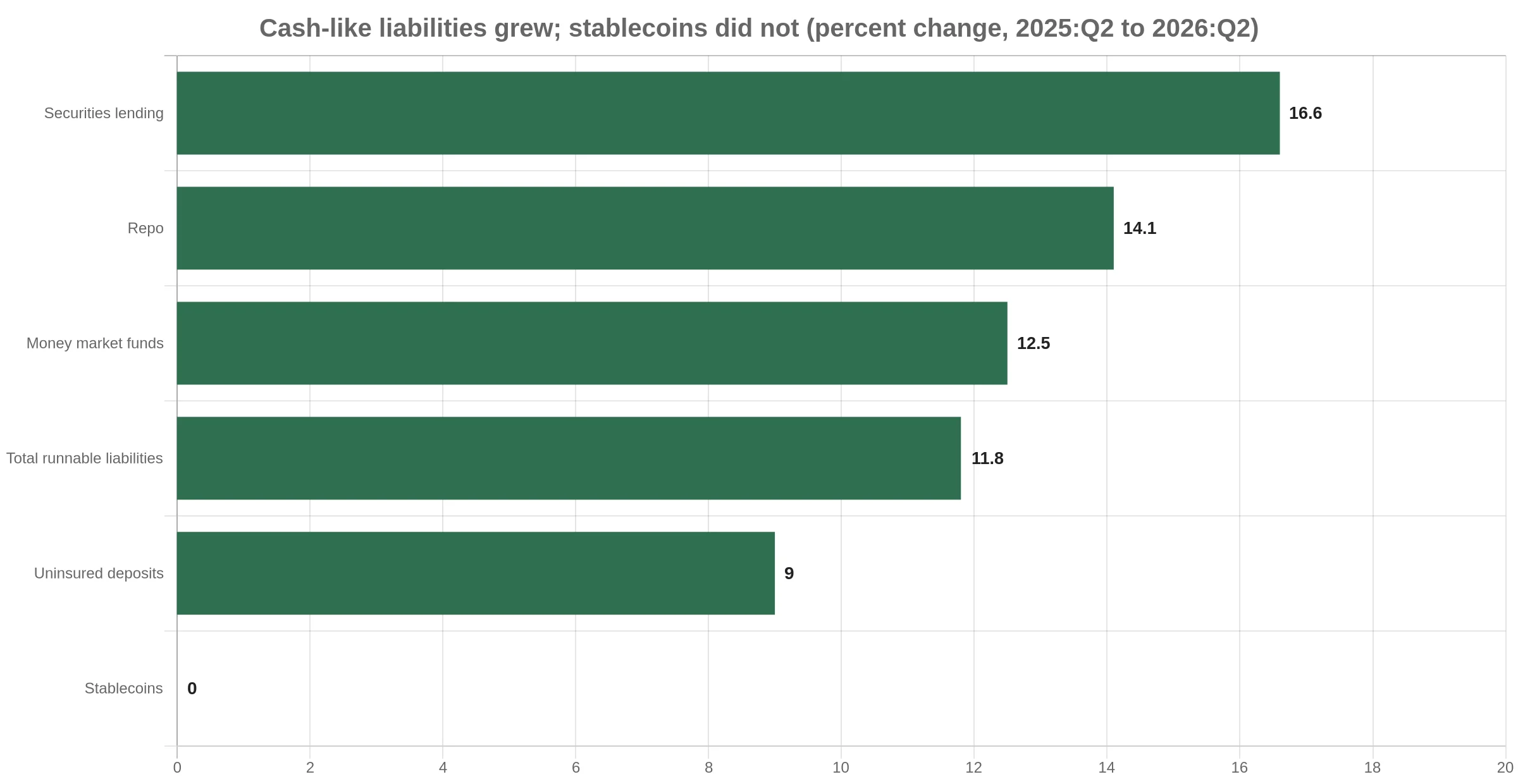
Chart: BlockchainReporter. Growth rates for 2025:Q2 to 2026:Q2 from Table 4.1 of the Federal Reserve’s November 2026 Financial Stability Report. The stablecoin rate reflects the report’s statement that market capitalization stayed flat over the past year.
Six Months Ago the Fed Reported Growth, Then a Slowdown
This is not the first time the Fed has written about stablecoin supply, and the sequence matters more than any single snapshot. The May 2026 report said stablecoin assets had “grown 16 percent from July 2025 to the end of last year,” then added that “this rapid growth has moderated in recent months,” with the level at $320 billion , “concentrated among the two largest issuers.”
Six months later the level is $310 billion. That is a decline of $10 billion, or 3.1%, across two Fed snapshots. If the stablecoin stock had grown at the 11.8% rate the Fed recorded for cash-like liabilities overall, $320 billion would have become about $358 billion. The gap, roughly $48 billion, is illustrative arithmetic on two point estimates taken at different dates, not a measured shortfall.
What the pair of reports does establish is a turn: from 16% growth in the second half of 2025, to “moderated” growth in May 2026, to flat in November 2026. The Fed attributes the flattening to lower crypto prices. It does not publish issuer-level supply, redemption volumes or reserve composition, so the mechanism behind the plateau stays outside the document.
Two Issuers, 99% Dollars, and 66 Days
Concentration is the second half of the Fed’s stablecoin paragraph: “The market continues to be concentrated among the two largest issuers.” The report does not name them or give their shares; its figure 4.5 charts total market capitalization by issuer and the text stops there. The two largest dollar stablecoins by supply remain Tether’s USDT and Circle’s USDC, and the Fed’s phrasing indicates their combined share is high enough that the aggregate number is effectively a two-company statistic.
The compliance clock is the part with a fixed date. “The GENIUS Act (Guiding and Establishing National Innovation for U.S. Stablecoins Act), which will become effective on January 18, 2027, establishes a federal regulatory framework for the issuance and transaction of ‘payment stablecoins,'” the report states, adding that “the Office of the Comptroller of the Currency has finalized its rules to implement the act, and other federal agencies have proposed rules to implement the legislation.”
From the report’s 13 November publication to 18 January 2027 is 66 days . The OCC’s final rule landed in October; the other agencies are still at the proposal stage, which means issuers will meet the effective date with part of the rulebook final and part of it not. BlockchainReporter covered the comment window closing with 91 days left on the clock, and 26 of those days are now gone without a final rule from the agencies that had only proposed one.
Why a Run Would Land in Funding Markets First
The reason stablecoins appear in this chapter at all is the reserve side. “Stablecoins are typically backed by a pool of ‘reserve’ assets that include Treasury bills and other short-term instruments, but some stablecoins also include loans and other digital assets as part of their reserves,” the report’s footnote 14 reads. A dollar stablecoin is therefore a claim on short-term dollar instruments, redeemable at par, issued outside the deposit insurance system.
That makes the $310 billion comparable to instruments the Fed already watches for runs. It is about 21% of the $1,451 billion of commercial paper outstanding in the same table, and about 3.9% of domestic money market fund assets. Under stress, redemption means selling the reserve assets, which is why the report files stablecoins under funding risk rather than treating them as a crypto-market curiosity.
The gap is disclosure. The Fed counts the total, notes the concentration and describes the reserve pool in general terms, but publishes no issuer-level reserve breakdown and no redemption data. A reader cannot tell from this report how much of the $310 billion is backed by T-bills alone, how much sits in repo, or what portion of reserves would have to be sold to meet a given redemption.
The Risk the Report Ranked Above Stablecoins
Stablecoins are a subsection. The report’s survey of salient risks, run by the New York Fed with 23 market contacts in September and October, ranks something else first. Artificial intelligence was cited by 87% of respondents, up from 50% in the spring. A risk-asset correction came second at 52%, up from 35%. Higher long-term rates were named by 48%, against 20% in the spring, cyberattacks by 43%, against 20%, and fiscal debt sustainability by 43%, against 30%.
The leverage picture behind those answers is the one macro traders will recognise: “Leverage at hedge funds reached the highest level since the data began in 2013 and was concentrated in a small number of large funds,” the report states. Treasury yields rose markedly over the six months since May, and term premiums climbed above their median since the late 1990s. Equity valuations stayed well above their historical median, which the Fed links partly to enthusiasm for super intelligence.
Crypto sits inside the “risk asset correction” category without being named in it. The survey does not mention digital assets at all. What it does say is that a correction in risk assets was the second-most-cited risk among professional contacts, which is a statement about the company crypto keeps in a leveraged, high-multiple market rather than a forecast about bitcoin.
The Skeptical Read
A flat market capitalization is not the same as a shrinking one, and the report does not distinguish between the two mechanisms that produce flatness. If stablecoin supply is mostly a function of crypto trading volume, as the May report implied when it tied growth to crypto prices, then a flat stock during a price decline could mean the float held while turnover collapsed. The November report gives no turnover data to test that.
There is a second reason to be careful with the $310 billion: market capitalization at par understates what happens in a depeg. A stablecoin trading at 97 cents still counts its full nominal supply in this measure, so the Fed’s number captures the size of the claim, not the market’s confidence in it.
And the GENIUS Act cuts both ways for the plateau. Rules that define permitted reserve assets and require disclosure tend to favour the largest issuers, who can absorb compliance costs, over smaller ones. That points toward more concentration than the Fed already reports, not less, at least through the first compliance cycle.
What to Watch Before 18 January
Three dates and documents will move this story. The first is the remaining agency rules: the OCC has finalized, and the report says other agencies have only proposed, so the next Federal Register publication from Treasury, the FDIC or the Fed is the operative event for issuers deciding how to structure reserves.
The second is the issuance data. The next Financial Stability Report , due in the spring, will be the first compiled with the GENIUS Act in force, and it will show whether the plateau the Fed reported in November was a pause around a price decline or the end of the growth phase that took stablecoins from a niche settlement tool to $310 billion of dollar claims.
The third is the reserve mix. If compliance pushes issuers further into Treasury bills, the stablecoin stock becomes a more direct transmission channel between crypto redemptions and the short-term government market. The Fed has now put the number in writing. It has not yet put the composition there.
This article is not intended as financial advice. Figures cited are from the Federal Reserve’s November 2026 Financial Stability Report, which reflects data as of 28 October 2026.