



Canaan Inc. reported net income of US$8.0 million for the third quarter of 2026, a swing from a US$97.6 million loss in the prior quarter. The same income statement shows a US$42.9 million operating loss and two fair-value lines that added US$52.0 million: a US$20.1 million gain on the company’s own bitcoin and a US$31.9 million gain on financial derivatives.
Remove those two marks and the quarter becomes a net loss of about US$44.0 million. Canaan’s chief financial officer, Jin “James” Cheng, said as much in the release: “We recognize that this non-cash gain is distinct from underlying operating performance.”
The distinction matters because the headline number arrived alongside a revenue base that has almost disappeared, a treasury that is mostly pledged to lenders, and a share price that closed at US$0.1649 on Nov. 10, down 18.4% on the session, according to StockAnalysis data, near the low end of a 52-week range of US$0.1516 to US$1.28.
What the US$8.0 Million Actually Consists Of
The reconciliation is short. Canaan’s GAAP net income for the three months ended Sept. 30, 2026 was US$7.96 million, or US$0.01 per ADS. Pre-tax income was US$6.4 million, reached only after the two fair-value gains were booked below the operating line.
Above that line, the operating result was a loss of US$42.9 million. Gross loss was US$8.6 million on US$14.5 million of revenue. Operating expenses of US$34.2 million included US$13.1 million of research and development, US$14.1 million of general and administrative costs, and a US$5.7 million impairment of property, equipment and software.
The company’s own non-GAAP adjusted EBITDA was a gain of US$22.4 million, and its reconciliation shows why that measure looks healthy: it adds back US$3.6 million of depreciation, US$4.3 million of share-based compensation and the US$5.7 million impairment to an EBIT figure of US$8.8 million. Adjusted EBITDA is a legitimate disclosure, but it is not a cash-flow statement, and Canaan does not present operating cash flow in the release. Readers who want to know whether the mining and hardware businesses funded themselves in Q3 will have to wait for the Form 6-K financial statements.
Revenue Fell 90%, and the Q4 Guide Implies More of the Same
Total revenue was US$14.5 million, against US$31.9 million in the second quarter and US$150.5 million in the third quarter of 2025. That is a 54.4% sequential decline and a 90.3% year-over-year decline, both computed from the figures in the release.
The split shows where the damage sits. Mining equipment revenue was US$4.8 million, down 95.9% from US$118.6 million a year earlier. Canaan sold 1.0 million TH/s of computing power in the quarter, against 2.5 EH/s, or 2.5 million TH/s, in the second quarter, a 60% sequential drop in volume. Mining revenue fell 69.0% year over year to US$9.5 million, and mining is now almost two-thirds of the business.
Guidance for the fourth quarter is US$18 million to US$22 million. The midpoint, US$20 million, is 37.5% above Q3 but roughly 89.8% below the US$196.3 million Canaan recorded in the fourth quarter of 2025, per its first-quarter 2026 release . Management attributed the equipment weakness to “continued weakness in bitcoin mining equipment demand and intense industry pricing competition.”
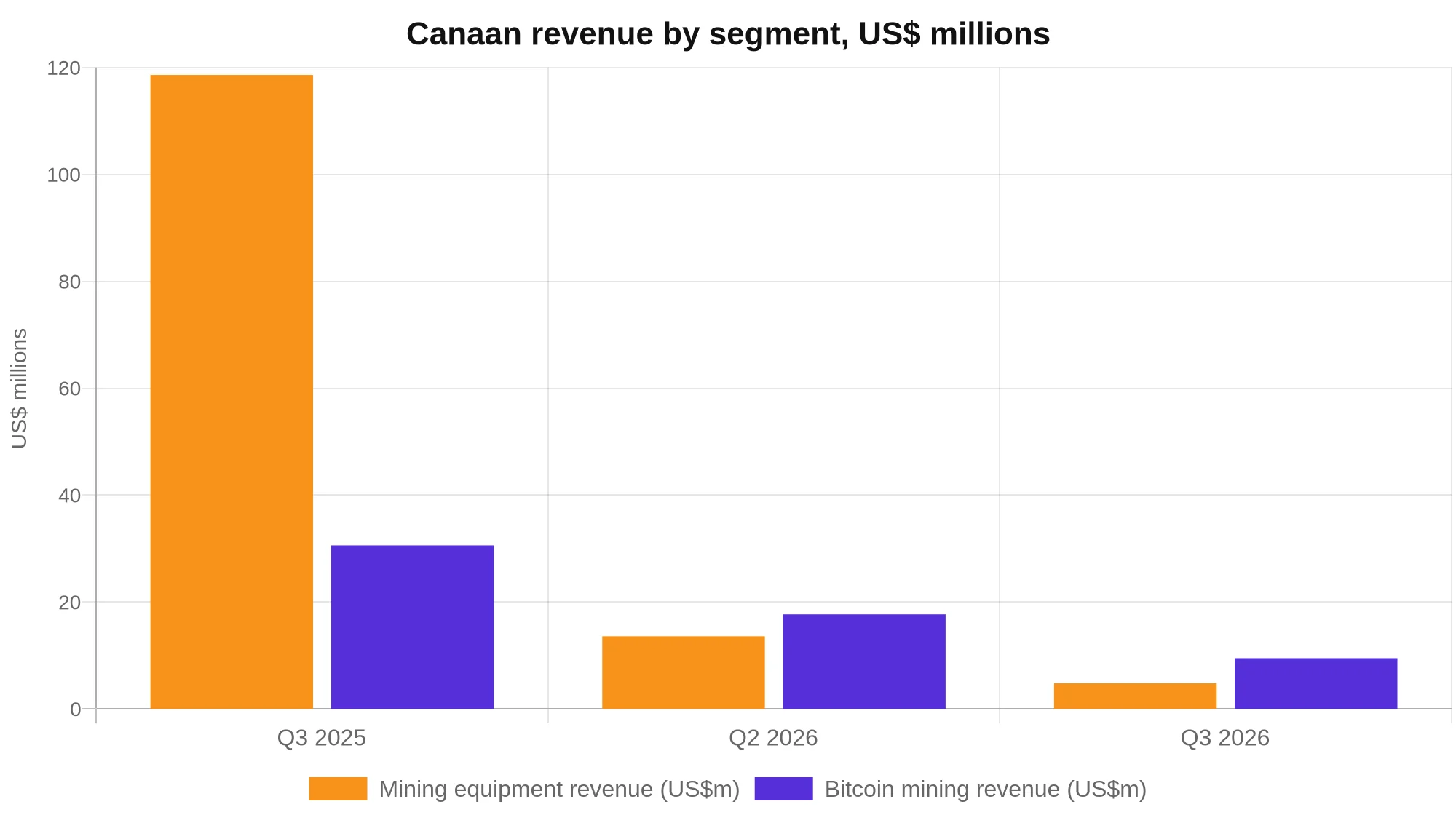
None of this is unique to Canaan. Canaan’s second quarter already showed product revenue falling to US$13.6 million. Across the sector, MARA sold 13,597 bitcoin at an average of US$81,039 to retire US$750 million of BTC-backed debt. Equipment orders depend on miners’ cash flow, and that cash flow falls with the coin price.
The “30% Margin” Claim, Checked Against the Cost Lines
Cheng said mining operations “achieved a gross margin of approximately 30% before depreciation.” The income statement supports that, and also shows what the qualification costs.
Mining revenue was US$9.465 million and mining cost was US$9.330 million, a GAAP gross margin of 1.4%. The release states that depreciation of deployed mining machines inside that cost line was US$2.7 million. Add it back and the margin becomes 29.9%, essentially the figure management cited. In other words, the entire spread between a near-breakeven mining business and a 30% one is the depreciation charge on rigs that are losing value faster than they are earning.
On a per-coin basis, Canaan booked US$71,165 of mining revenue per bitcoin produced across 133 coins, against a cash cost of about US$49,850 per coin before depreciation. Bitcoin traded at US$73,851 at 22:20 UTC on Nov. 10, per CoinGecko , which leaves the mining segment exposed to any further decline: at US$60,000 per coin, the same 133-coin quarter would produce about US$8.0 million of mining revenue against US$6.6 million of pre-depreciation cash cost.
Two-Thirds of the Bitcoin Treasury Is Collateral
Canaan held 1,875.5 bitcoin at quarter-end, a figure the release repeats in its highlights. The balance sheet breaks that holding into parts that behave very differently.
Cryptocurrency assets of US$43.7 million “primarily consist of 517.5 bitcoins owned by the Company.” The remaining 1,358 bitcoin sit in a cryptocurrency receivable valued at US$114.2 million: 1,258 bitcoin “pledged for secured term loans” and 100 bitcoin “transferred to a fixed-term product.” The release states that the receivable is classified as a current asset because the secured term loans are current.
Those loans are not small relative to the pledged collateral. The current portion of long-term loans rose to US$60.1 million from US$28.5 million at Dec. 31, 2025, with a further US$8.3 million classified as non-current. Total liabilities were US$167.5 million against US$301.4 million of shareholders’ equity.
The cash line needs the same reading. Canaan reports US$72.8 million of “cash and restricted cash,” but the balance sheet shows US$22.8 million of cash and US$50.0 million of restricted cash, pledged during the quarter as collateral for a letter of credit tied to “certain long-term infrastructure-related contractual arrangements.” Only the first number is spendable.
Even so, the market is valuing Canaan below the nominal value of its coins. At US$73,851, 1,875.5 bitcoin is worth about US$138.5 million, against a market capitalisation of US$123.2 million at the Nov. 10 close. That comparison is crude: it ignores US$68.4 million of loans, US$119.1 million of inventory and the fact that 1,258 of the coins are encumbered. It does explain why management argues that “current market valuation does not fully reflect its long-term potential.”
A US$20 Million Buyback Against US$22.8 Million of Spendable Cash
On Nov. 6, Canaan’s board approved a repurchase authorization of up to US$100 million over 12 months. The company is starting with a program of up to US$20 million of ADSs or Class A ordinary shares.
Measured against liquidity, the initial tranche is close to the whole unrestricted cash balance: US$20 million equals 87.7% of the US$22.8 million of unencumbered cash on the Sept. 30 balance sheet. The release acknowledges the constraint, saying Canaan intends to pursue repurchases “more actively” only “as additional funds become available,” and that repurchases are subject to “sufficient liquidity for ongoing operations and committed projects.”
Zhang framed the buyback as part of a shift in treasury policy. “We maintained our long-term digital asset holding strategy while adopting a more flexible capital allocation approach, selectively monetizing cryptocurrency holdings to fund share repurchases and enhance shareholder value,” he said. The company does not disclose how much bitcoin it has sold since Sept. 30, or at what price.
The 1-for-25 Reverse Split and the Nasdaq Bid Price
Canaan also disclosed a planned ADS ratio change: one ADS will represent 375 Class A ordinary shares instead of 15, a 1-for-25 consolidation, expected to take effect on or about Dec. 4, 2026. At the Nov. 10 close of US$0.1649, the post-consolidation equivalent is about US$4.12.
The release states the purpose directly. The adjustment “is intended to support the Company’s efforts to regain compliance with Nasdaq’s minimum bid price requirement.” Canaan had 690,594,191 ADSs outstanding at Sept. 30. The ratio change does not alter ordinary shares outstanding or proportional ownership, apart from fractional ADS adjustments, but it does not change the underlying business either: a US$123 million market value divided by 25 is still a US$123 million market value.
What changes is the arithmetic available to the company. A higher per-ADS price restores headroom under the exchange’s bid rule and widens the pool of funds that cannot hold sub-US$1 securities. It does not address the operating loss.
The Power Business Is the Only Line That Grew
The strategic case Canaan is asking investors to underwrite is no longer rig sales. It is electricity. The company says its 1 GW large-load project in Duval County, Texas, received a conditional “Studied Load – Firm” classification under ERCOT’s Batch Zero process, and that it is advancing a second 1 GW project in Zapata County that remains “in early-stage development and preparation for grid connection studies.”
Both statements carry the qualifiers that matter. The ERCOT classification is conditional and “subject to further studies and approvals,” and no capacity from either site is energized. What Canaan has spent so far is small relative to the ambition: US$3.3 million of project prepayments in Q3, a US$1.1 million land purchase in October, and the US$50 million letter of credit that sits behind the restricted cash.
The operating assets it does control generated modest returns. Installed mining computing power, excluding joint ventures, was approximately 10 EH/s at an all-in power cost of about US$0.043/kWh. Its 49% interest in Project ABC, with 4.87 EH/s installed, distributed more than US$1.2 million of cash to Canaan during the quarter.
For the quarter to be read as a turnaround rather than a mark-to-market event, three things would have to show up in the fourth-quarter report due before the end of March 2027: revenue inside the US$18 million to US$22 million range without a fresh inventory write-down, a mining margin that survives the depreciation line, and disclosure of how much of the 517.5 unencumbered bitcoin was sold to fund the buyback.
Data: Canaan Q3 2026 release , StockAnalysis , CoinGecko .
This article is not financial advice. Canaan figures come from the company’s unaudited third-quarter 2026 results published on Nov. 10, 2026, and from its prior quarterly releases. Bitcoin prices are CoinGecko snapshots at 22:20 UTC on Nov. 10, 2026. The ex-mark net result, per-bitcoin revenue and cash cost, mining margin reconciliation, guidance comparison, treasury-to-market-cap ratio and buyback-to-cash ratio are BlockchainReporter calculations from those filings.