



KULR Technology Group sold every bitcoin it held, 1,099.09 coins, for net proceeds of about $80.1 million in the third quarter, repaid the $20.0 million outstanding on its Coinbase credit facility and closed September with $54.5 million of cash and no digital assets. The Houston battery and energy-systems maker disclosed the exit in its third-quarter results on Nov. 10, about four months after it wound down bitcoin mining and roughly a year after the treasury position became the centre of its equity story.
The timing is the part worth reading twice. KULR finished selling into a quarter when bitcoin was recovering from its June lows, and it now holds no bitcoin at all while the asset trades at $73,981, an 11-week low, at 14:58 UTC on Nov. 10. A company that once presented coins on its balance sheet as a strategic reserve has become a cash-only battery manufacturer with a paused at-the-market programme and a smaller payroll. The filing explains the mechanics. It does not explain the timing, and the difference between those two things matters for anyone still treating corporate bitcoin treasuries as a single trade.
What KULR sold, and what it kept
The numbers are unusually clean for a company of KULR’s size. It sold 1,099.09 BTC for approximately $80.1 million of net proceeds, used part of that money to clear a $20.0 million loan under its Coinbase credit facility, and finished the quarter with $54.5 million in cash, no outstanding borrowings and no digital assets. The company said it exited bitcoin mining effective July 2026 and that it no longer holds, and does not intend to acquire or mine, digital assets.
Chief executive Michael Mo framed the sale as part of a wider balance-sheet reset rather than a market call. “We completed our exit from Bitcoin, repaid our only debt and ended the quarter with $54.5 million in cash,” he said in the release. The same statement notes the at-the-market equity programme is paused through Dec. 31, 2026, which removes one source of dilution for the rest of the year and also removes the cushion that programme provided.
The arithmetic of a $72,878 exit
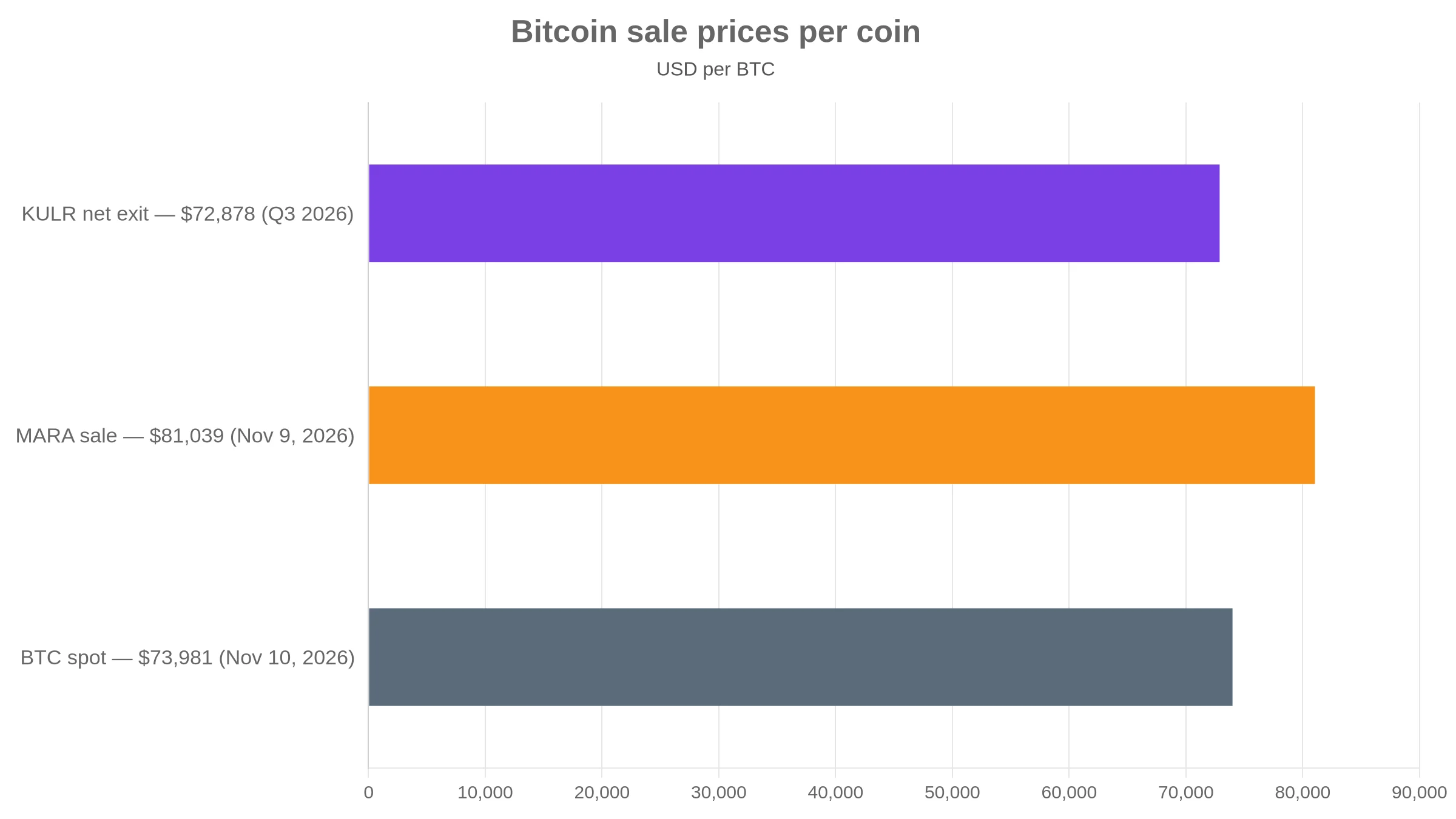
Dividing the net proceeds by the coins sold gives an average realised price of $72,878 per bitcoin. That is the figure the release does not print, and it is the one that makes the quarter comparable with other sellers. Two reference points frame it. Bitcoin traded at $73,981 at 14:58 UTC on Nov. 10 , about 1.5% above KULR’s realised average, which means the company left roughly $1.2 million on the table relative to holding the same coins to today’s price. And MARA sold 13,597 bitcoin at an average of $81,039 on Nov. 9 to retire $750 million of debt, about 11.2% above KULR’s exit price.
Those gaps are small enough that price timing does not explain either decision. What differs is the size of the obligation attached to the coins. KULR’s $20.0 million loan equalled 24.97% of its net proceeds, so a quarter of the sale went straight to the lender and the remaining $60.1 million stayed inside the business. MARA’s sale was roughly twelve times larger and retired a facility more than thirty times KULR’s. Both companies converted coins into cancelled debt in the same week. Neither described the sale as a view on where bitcoin goes next, and neither disclosure supports reading it that way.
A $4.5 million profit that came from the calendar
KULR reported third-quarter net income of $4.47 million, or $0.10 per basic and diluted share, against a $6.97 million loss a year earlier. The release attributes that swing to a $15.8 million non-recurring change in the fair value of digital assets, measured from June 30, 2026 to the dates of sale, and states plainly that the gain “does not reflect operating profitability.”
The fair-value gain also lets a reader reconstruct the carrying value the coins had on June 30. Subtracting $15.8 million from the $80.1 million of proceeds implies a mark of about $64.3 million, or $58,503 per coin, at the halfway point of the year. Bitcoin therefore rose roughly 24.6% between that mark and the sale dates, and that recovery, not battery sales, produced the quarter’s profit. Operating reality sits elsewhere in the same document: an $11.00 million operating loss, a gross margin of 4% that yielded about $296,000 of gross profit on $7.40 million of revenue, and research and development spending that rose to $5.02 million from $2.32 million.
The debt leg was the point
A treasury position financed with borrowed money behaves differently from one bought with spare cash, because the lender, not the holder, sets the deadline. KULR’s Coinbase facility put a $20.0 million claim against a bitcoin stack that was worth less than the loan plus equity for part of the year, and the company chose to end that arrangement rather than refinance it. The exit also removed the collateral, which means the remaining $54.5 million of cash is unencumbered.
That is a narrower story than the one playing out at larger treasuries, and the contrast is informative. Trump Media reported $409.7 million of quarterly net income built on $496.1 million of non-cash digital-asset gains while flagging that holders of its $1.0 billion of convertible notes can demand cash repayment on Nov. 30, 2026. KULR’s numbers are three orders of magnitude smaller, but the mechanism is the same: mark-to-market gains flatter the income statement in an up quarter, and the debt maturity decides whether the coins stay on the balance sheet in a down one. KULR resolved that question early by selling.
Why a battery company stopped being a bitcoin company
The operating business the sale is meant to fund grew quickly from a small base. Mo described the quarter on those terms. “In the third quarter, we delivered on the three measures that matter for 2026: product revenue growth, gross margin improvement and cost discipline,” he said. Revenue rose 197% to $7.40 million from $2.49 million, product sales rose 299% to about $6.49 million from $1.62 million, and the company served 22 product customers against 18 a year earlier. KULR ONE Max battery storage units shipped into Japan’s power-as-a-service market, and the company says it built an NDAA-compliant supply chain for cells, chargers and battery-management electronics ahead of an expected 2027 production ramp.
Mo tied the pivot to a plan he had already published. “In my June letter to shareholders, I laid out a straightforward strategy: build more batteries, sell more batteries,” he said. “Product sales nearly quadrupled year-over-year, and the growth came from our KULR ONE platform.” The company also implemented a November 2026 reduction in force that it expects to generate about $4 million of annualised savings, and it guided research and development lower from the fourth quarter.
Cash per share is the metric that ties the exit to the equity. The $0.10 of quarterly earnings on $4.47 million of net income implies roughly 44.7 million weighted shares, which puts the $54.5 million cash balance at about $1.22 per share. That is the buffer the bitcoin position used to occupy, now held in dollars and free of a lender’s claim.
What the disclosure does not say
Three gaps are worth naming. The release gives no cost basis for the 1,099.09 coins, so the realised profit against the original purchase price cannot be calculated from it; the $15.8 million gain is measured from the June 30 carrying value, a different number entirely. It also does not give the dates of the sales inside the quarter, which means the average $72,878 cannot be matched to a specific price range without the cash-flow statement in the full 8-K filing . And the size of the remaining at-the-market capacity is not quantified, only the pause through Dec. 31.
Those omissions are normal for an earnings release, and none of them changes the central fact: KULR no longer owns bitcoin, owes no debt, and has $54.5 million to spend on batteries. What they do change is how much can be inferred about management’s read on the market. Selling into a 24.6% fair-value recovery is consistent with a decision to take the gain while the loan was covered, and the release describes a strategic focus on the operating business rather than a forecast about bitcoin. The distinction is the difference between a company that called the top and a company that paid off a lender while it could.
What to watch next
The next four disclosures will settle whether the exit was a one-off balance-sheet repair or the start of a pattern among small treasury companies. KULR’s fourth-quarter gross margin will show whether the 4% print was a launch-cost artifact of new KULR ONE Max configurations, as the release suggests, or a structural problem in custom assembly contracts. The 10-Q will carry the sale dates and the cost basis the release omits. Any restart of the at-the-market programme after Jan. 1 would signal that the $54.5 million is not enough to fund the 2027 ramp. And the wider tell is whether other levered holders follow MARA and KULR into sales while bitcoin trades below its autumn range, because a deleveraging cycle is defined by the borrowers who sell, not by the ones who hold.
This article is not intended as financial advice. Bitcoin prices are CoinGecko snapshots at 14:58 UTC on Nov. 10, 2026, and the 11-week comparison uses CoinGecko daily data. KULR figures come from its third-quarter 2026 earnings release filed with the SEC on Nov. 10, 2026. Average sale price, carrying value, per-share cash and percentage comparisons are BlockchainReporter calculations from those figures.