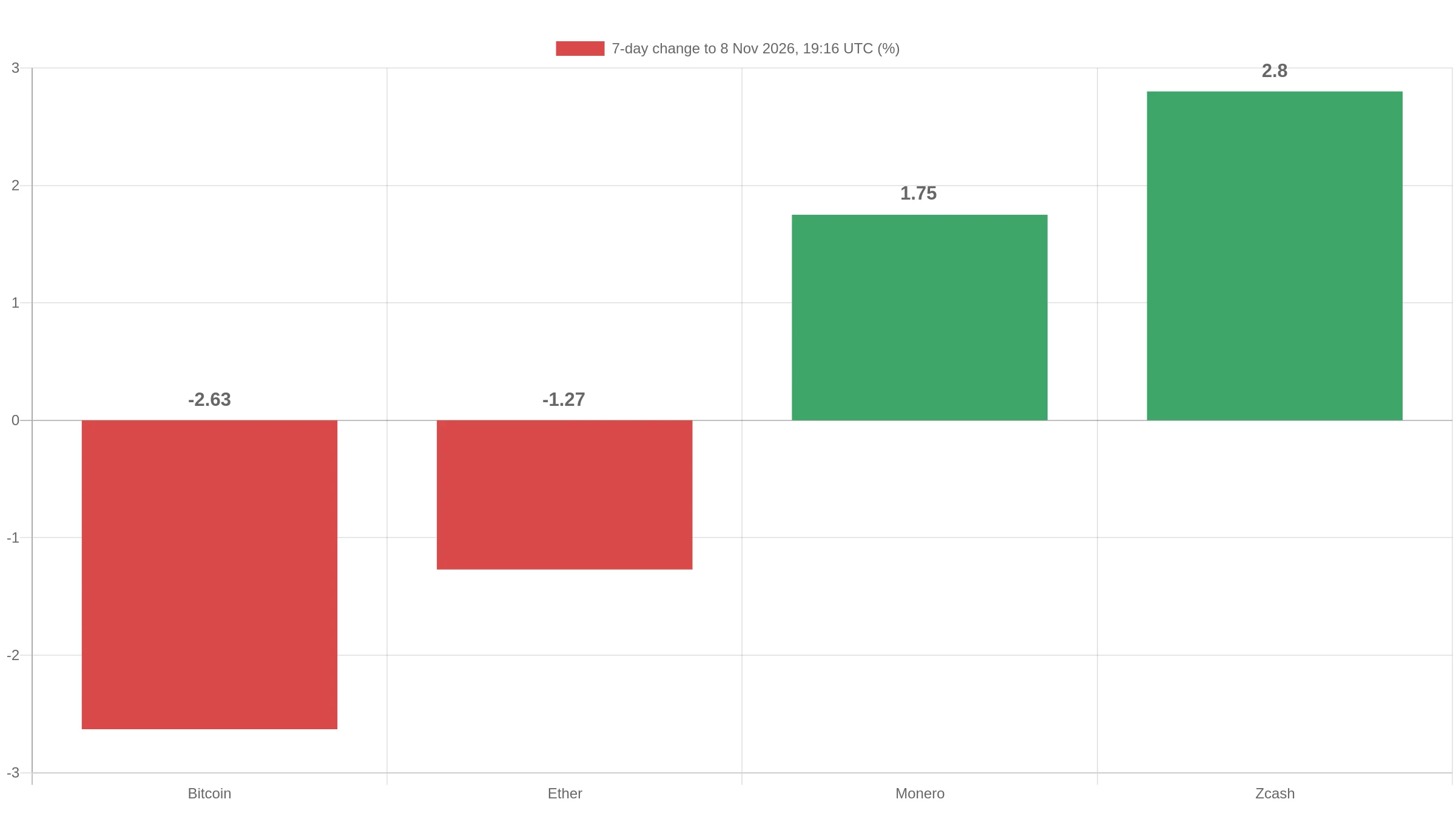
Zcash traded at $1,261.60 and Monero at $604.30 at 19:16 UTC on 8 November. ZEC is up 2.80% over seven days while Bitcoin is down 2.63% and Ether is down 1.27%, per CoinGecko’s ZEC market data . Monero is up 1.75%. In a week when the two largest coins lost ground, both privacy leaders gained, and the distance between them is now the whole trade.
The question readers keep asking is which one to own. The tape gives a split answer. If you want the coin with the bid, the volume and the upgrade story, it is Zcash at a $21.49 billion market cap. If you want the same sector at a discount, it is Monero at $11.39 billion , which is 53.0% of Zcash’s value. The discount is real. It is also priced for a reason, and the reason is liquidity and access, not a mispricing someone forgot to arbitrage.
Both coins are red on the day: ZEC -0.35% in 24 hours, XMR -0.93%. The weekly picture is where the divergence sits, and it is the only part of this market that has held through the November drawdown.
A 52-coin sector that is really two coins
CoinGecko classifies 52 tokens as privacy coins. Their combined market cap is $33.33 billion at the time of writing. Zcash is $21.49 billion of that, or 64.5%. Monero is $11.39 billion, or 34.2%. Add the two and you have 98.6% of the category. The third-largest name, Decred, is worth $217.4 million, which is 0.65% of the sector. Fourth is Zano at $63.8 million, or 0.19%.
That concentration changes what a privacy allocation actually is. There is no basket to buy, no index with a third leg, and no diversification inside the theme. Anyone who says they hold “the privacy sector” holds two positions, and one of them is doing most of the work. It also explains why the two charts move together on macro days and apart on project news: they share the narrative and compete for the same marginal dollar.
Seven days is enough to see the split. Zcash traded a $1,128.02 to $1,367.82 range and sits 7.8% below that peak. Monero held a $592.16 to $642.81 band and sits 6.0% below its own high. Neither is breaking down. ZEC is simply carrying more of the sector’s beta in both directions.
Why Zcash carries two-thirds of the sector
Zcash ranks 10th by market cap and Monero 12th, and the ranking is not a function of supply. ZEC has 17.03 million coins outstanding against Monero’s 18.83 million, so the smaller float carries 89% more market value. At Zcash’s current market cap, Monero’s supply would price each XMR at $1,141.10. It trades at $604.30, an 88.8% gap.
Part of that gap is drawdown. Zcash peaked at $3,191.93 and is 60.5% below it. Monero peaked at $797.73 and is 24.2% below it. ZEC has 36.3 points more damage on the chart and still commands almost twice the value. The market is paying for the Zcash upgrade cycle, and the project’s own documentation shows how much of that cycle is still paperwork rather than delivery. Checked on 8 November, the NU7 upgrade page opens with a flat statement: the page says “the activation height for NU7 has not yet been set” and describes NU7 as “planned to be the ninth major network upgrade for Zcash.”
What the same page does confirm is the migration. Node operators are told that “Zcashd is being deprecated and will be replaced by the Zebra full node,” and that to prepare “you will need to upgrade to the Zebra consensus node developed by the Zcash Foundation,” a Rust implementation the project describes as consensus-compatible with zcashd and due to co-exist with it in the run-up to the upgrade.
That is a migration, not a marketing beat. When a chain asks its node operators to change clients, the market tends to re-rate the asset before the work finishes and reassess after. Zcash has already shown how that trades: our 7 November coverage of the NU7 session recorded a 7% retrace after the rally, with 25-second blocks reported at target, and the coin has since rebuilt roughly half of that drop.
The discount on Monero is a liquidity discount
Here is the number that explains the gap better than any narrative. Zcash turned over $565.8 million in the last 24 hours. Monero turned over $82.5 million. Against their respective market caps that is 2.63% for ZEC and 0.72% for XMR, a turnover ratio of 3.6 to 1. In absolute terms Zcash trades 6.9 times Monero’s daily volume.
Thin books are why the discount exists and why it can persist. A fund that wants $20 million of privacy exposure cannot build it in XMR without moving the price several percent, and it cannot exit without doing the same in reverse. ZEC absorbs that order. XMR does not. The market charges Monero roughly a 47% discount to Zcash’s valuation for the privilege of holding something it can only buy in size at a worse price.
Access risk sits on top of the liquidity risk. Monero’s exchange footprint is narrower, and it narrows further every time a venue reviews its listing policy. The Kraken episode in late October , when the exchange’s co-CEO said the Monero KYC emails “were wrong” and confirmed XMR stays listed, is the pattern: a scare, a clarification, and a residual discount that never fully unwinds. Holders are paid for that risk with a cheaper entry, not for free.
What the market-cap arithmetic says about a 10x
Doubling from here is a $42.97 billion Zcash, which would be 81.5% of Solana’s $52.72 billion, and a $22.77 billion Monero, which is roughly where Zcash trades today. Ten times from here is a $214.85 billion Zcash, or 78.8% of Ether’s $272.56 billion market cap, and a $113.85 billion Monero, or 1.55 times XRP’s $73.23 billion.
Those are arithmetic, not forecasts. They matter because they set the ceiling on what the sector can absorb without a new class of buyer. Privacy coins remain the one category that most regulated venues will not custody at scale, so the marginal buyer has to come from self-custody wallets and offshore venues. That buyer base can double a mid-cap. It has not yet shown it can carry a top-five valuation.
Where this read breaks
Two levels invalidate the relative-strength case, and both come from the same seven-day series. If Zcash closes below $1,128.02, its 7-day low, while Monero holds above $592.16, the “ZEC is the strong leg” argument is gone and the sector is simply de-rating together. If Bitcoin loses $75,457.89, its own 7-day low, beta overwhelms everything below it and both privacy coins follow the larger market regardless of their individual stories. Bitcoin traded at $75,770 at the same timestamp, less than half a percent above that line.
The upside trigger is narrower. Zcash needs to reclaim $1,367.82 to confirm the upgrade bid is still intact, and Monero needs a session above $642.81 with volume above its recent $82.5 million daily average before the discount argument has anything to trade against. Neither condition is met today. Until one is, this is a two-coin sector marking time inside a drawdown, with the cheaper leg cheap for defensible reasons.
Frequently Asked Questions
Zcash carries the momentum: it is up 2.80% over seven days against Monero’s 1.75%, and it trades 6.9 times Monero’s daily volume. Monero is the cheaper expression of the same sector at 53.0% of Zcash’s market cap, but that discount reflects thinner liquidity and wider exchange risk rather than an obvious mispricing.
Zcash has 17.03 million coins outstanding to Monero’s 18.83 million, so supply does not explain it. The gap comes from demand: Zcash has the upgrade cycle, deeper order books and a larger regulated-adjacent investor base, while Monero’s market is smaller and harder to access in size.
At Zcash’s $21.49 billion valuation and Monero’s 18.83 million circulating supply, XMR would need to trade at $1,141.10, about 88.8% above its current $604.30.
The project’s own upgrade page, checked on 8 November, states that the activation height for NU7 has not yet been set and calls NU7 planned. Traders have been pricing the upgrade and the required move from zcashd to the Zebra node, which is why the token trades well above its pre-upgrade levels.
No. CoinGecko lists 52 privacy coins with a combined $33.33 billion market cap, but Zcash and Monero account for 98.6% of it. The third-largest, Decred, is worth $217.4 million.
Exchange access. Both depend on venues that continue to list privacy coins, and every review cycle produces headlines that hit price before they hit listings. Zcash additionally carries execution risk from its node migration to Zebra.
Data: CoinGecko ZEC , CoinGecko XMR , z.cash NU7 , getmonero.org , CoinGecko privacy-coin category. Prices, market caps, supply and 24-hour volume taken at 19:16 UTC on 8 November 2026.
This article is not intended as financial advice. Educational purposes only.