
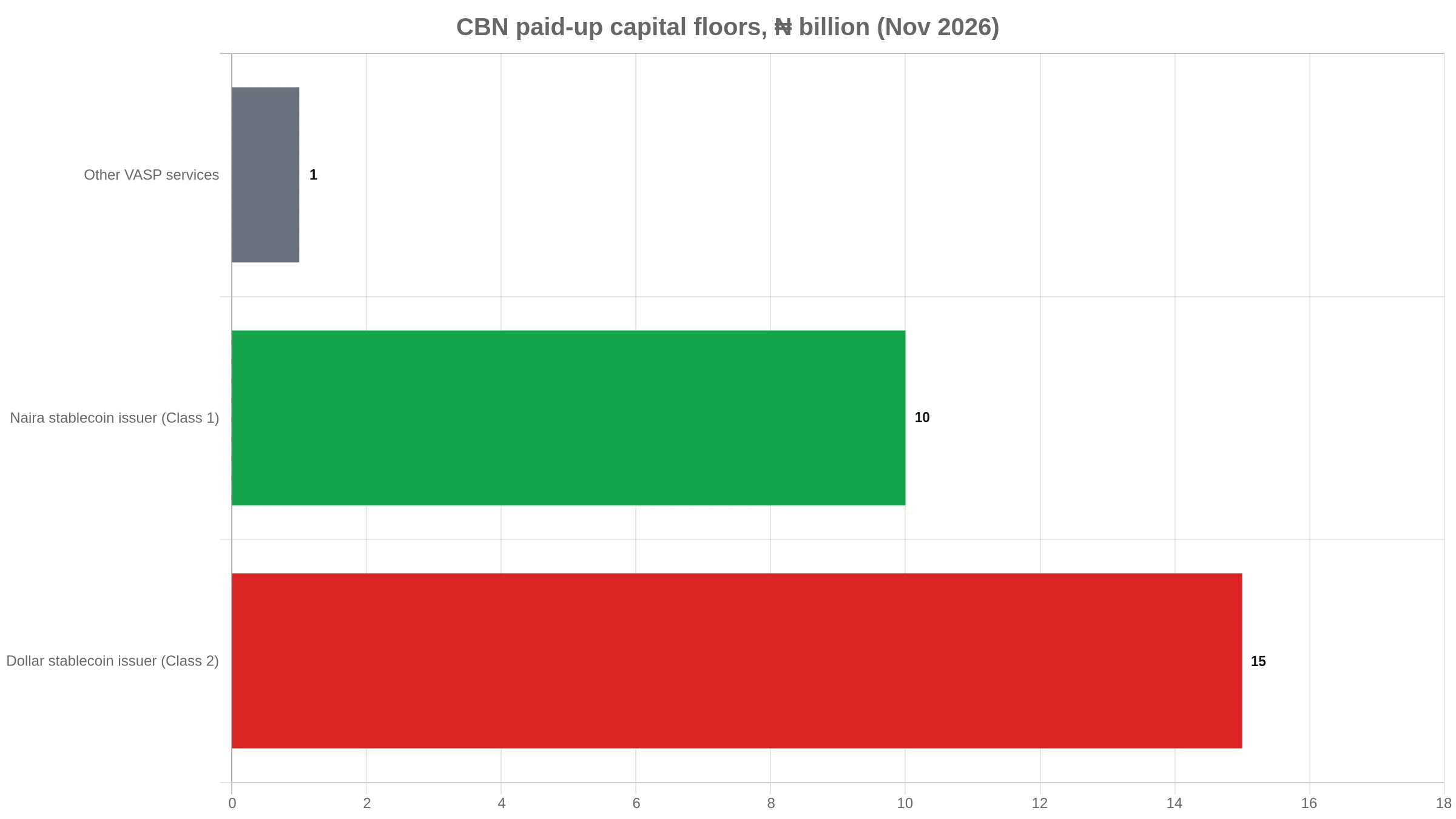
The Central Bank of Nigeria has issued a 169-page licensing regime for stablecoins, dated 5 November, and the entry price for a dollar token is ₦15 billion of paid-up capital. The Regulations for the Operations of Non-Security Virtual Assets in Nigeria , issued under reference PSP/DIR/PUB/CIR/001/004, require any foreign-currency-referenced stablecoin made available to Nigerian users to come through a company incorporated in Nigeria and licensed as a Class 2 issuer. Section 15.2 states the number without a qualifier: “A Class 2 Licensed Issuer shall maintain minimum paid-up capital of fifteen billion Naira (₦15,000,000,000), or such higher amount as the Bank may prescribe, on entry and at all times thereafter.” At ₦1,347.74 per dollar on 8 November, that floor is $11.13 million.
Two clauses decide who can stay. Section 15.3 removes the arrangement most dollar tokens have relied on: “There is no offshore issuer exemption from incorporation, licensing or capital.” Section 6.5 closes the same door from the licensing side, holding that “a foreign licence, registration, approval, regulatory status or arrangement with a Nigerian intermediary shall not substitute for that licence or for Token Approval.” A dollar token therefore needs a Nigerian subsidiary, a Nigerian issuer licence, and a separate approval of the token itself covering “its class, reference currency, reserve arrangements, name, ticker symbol and blockchain networks” (Section 7.1).
The reach is why this travels beyond Lagos. Section II of the scope applies the rules to Regulated Activities “when carried out in or from Nigeria, directed at persons in Nigeria”, and the applicability section adds a catch-all for anything with “a material effect on the Nigerian payments system, financial system, foreign exchange market or financial stability”. An overseas location, in the text’s words, “does not remove an activity directed at Nigerian persons” from scope. A stablecoin that is marketed into Nigeria but issued from Singapore or Delaware is inside the regime on the day it is offered, whatever its corporate structure.
Two issuer licences and four other ways in
The regime is a ladder rather than a single gate. Section 2.1.1 lists six instruments: the Naira-referenced Issuer Licence (Class 1); the Foreign Currency Issuer Licence (Class 2); the Other Services Licence; the Other Services Authorisation, for firms already holding a Nigerian securities licence; an Approval to Extend Permitted Activities, for banks and payment companies the CBN already supervises; and a Deposit Money Token Licence for banks that tokenise their own deposits.
The capital floors divide cleanly. Class 1, for naira-referenced tokens, carries ₦10 billion: “A Class 1 Licensed Issuer shall maintain paid-up capital of ten billion Naira (₦10,000,000,000)” (Section 15.1). Class 2 carries ₦15 billion, 50% more, for a token that references any currency other than the naira. A provider of other non-security virtual asset services, which covers exchanges, custodians, wallet providers, payment gateways and P2P platforms, carries ₦1 billion: “minimum paid-up capital of one billion Naira (₦1,000,000,000), or such higher amount as the Bank may prescribe” (Section 16.1).
Schedule 3 adds ₦10 million for an issuer application, non-refundable, and ₦5 million a year to renew either issuer licence, about $3,700 at the 8 November rate. Those fees are noise next to the capital. The clause that carries real cost is 17.3, which forbids double counting: capital “shall be separate from and additional to issuer reserves, the CBN reserve deposit, customer funds and assets and operational liquidity”, and capital already presented to the Securities and Exchange Commission cannot be used to satisfy the CBN requirement. For a group that already holds a Nigerian securities licence, the requirement is additive rather than substitutable. The CBN and the SEC divide the perimeter on economic substance, and the SEC’s published position on crypto assets still governs anything with a profit expectation attached to it.
What has to sit behind a dollar token
The capital is only the first layer, and the document keeps the layers separate on purpose. Section 24.4 requires overcollateralisation of “not less than two per cent (2%) of the par value of stablecoins in circulation”, held to absorb valuation losses and accrued liabilities. Section 24.12 requires at least 40% of the total reserve pool to sit in cash or assets qualifying as high-quality liquid assets, and for Class 1 issuers that 40% is additional to the CBN deposit rather than satisfied by it.
Class 1 issuers face the tighter ring-fence: Section 24.25 requires “not less than twenty per cent (20%) of its total Reserve Pool as a cash deposit at the Bank”, and Section 24.27 says the Bank may adjust that percentage but “shall not fall below twenty per cent”. Concentration is capped in two directions. No single CBN-licensed deposit money bank may hold more than 30% of an issuer’s reserve pool (Section 24.35), and no more than 50% of required operational liquidity may depend on one bank, custodian or liquidity provider (Section 11.3.6).
Class 2 issuers carry a second, dollar-denominated buffer. Operational liquidity must be at least the greatest of three numbers: US$10,000,000, 15% of aggregate Nigeria-linked outstanding liabilities, or the amount needed to meet “thirty (30) days of stressed Nigerian” redemptions (Section 11.3). On top of that, Section 17.6 requires liquid assets covering the higher of six months of projected operating expenses or the cost of an orderly wind-down, held from own funds and outside the reserve pool. Section 20.7 requires a monthly reserve attestation by an approved auditor, prepared under ISAE 3000 (Revised), published and filed within 15 business days of month-end.
Stack those on a $100 million Nigeria-linked float and the arithmetic is uncomfortable. Operational liquidity at 15% is $15 million. Overcollateralisation at 2% is $2 million. Paid-up capital at the 8 November rate is $11.13 million. That is $28.1 million of capital and buffer against a $100 million book, roughly 28% of the float, before a single dollar of the reserve itself is invested. The regulations do not permit any of those amounts to be counted against another (Section 11.3.11).
Five token designs that cannot be licensed at all
Section 2.2 does not regulate its way around weak designs; it bans them. The prohibited list has five categories: algorithmic stablecoins that hold value “solely or primarily through algorithmic adjustment of supply or demand rather than full backing by Eligible Reserve Assets”; tokens that reference a fiat currency but are “backed wholly or primarily by other virtual assets”; tokens issued by or for a sanctioned person or from a sanctioned jurisdiction; tokens “represented or marketed as stablecoins but [that] do not confer on their holders an enforceable right of redemption at par”; and anything else the Bank designates as an unacceptable risk.
The second and third prohibitions are the ones with structural consequences. A token collateralised mainly with bitcoin, ether or other tokens cannot be approved as a stablecoin in Nigeria at all, which removes the crypto-collateralised family of designs from the market regardless of how much capital the issuer can raise. The fourth turns marketing into a licensing fact: a product sold as a stablecoin without a legal right to redeem at par is not a weak licence application, it is a prohibited token. Section 2.7 adds that neither class may be “represented as bank deposits or as covered by NDIC deposit insurance”, and Section 13.3 bars an issuer from paying or facilitating “interest, yield, dividends, returns or other financial benefits to holders by reason of holding or depositing its stablecoin”, so the product cannot be sold on yield either. Section 13.4 goes further and forbids using reserves for operating expenses, lending, staking or collateral, while Section 13.5 requires redemption at par “within the prescribed period and without standard redemption charges”.
The 180-day clock, and the date still missing
Section 54.1 gives existing operators a staged runway: register with the Bank within 30 days of commencement, begin supervisory reporting within 60 days, and submit a complete application within 180 calendar days. During that window an operator “may continue only at its existing scale and subject to the Bank’s interim conditions”. Missing the 180-day deadline is not a reprimand: failure to submit “shall require cessation until the required licence or authorisation is obtained”.
None of those clocks is running yet, on the document’s own terms. Section 56.1 says the Bank “shall publish these Regulations and specify its commencement date in the issuing instrument”, and the transition period in Section 54 “shall run from that commencement date”. The published PDF names 5 November as its date and sets out the reference number, but it does not state a commencement date. Until the CBN issues that instrument, the 30, 60 and 180-day deadlines have no start point, and any operator telling users it has a fixed countdown is ahead of the text.
The register is the other gap. Section 8.7.1 requires the Bank to “maintain and publish a register of every licence, authorisation and approval granted”, including material conditions and status. The CBN’s published circular list , checked on 8 November, carries the regulations and no issuer register, so the market has no official view yet on who has applied.
What changes for USDT, USDC and the P2P market
Class 2 tokens keep their legitimate uses on paper. Section 3.9 permits “cross-border payments and remittances, trading through Licensees, international commerce and trade settlement”. What they lose is the domestic settlement role. Section 7.5 states that token approval “shall not permit its use to settle, price or discharge a domestic obligation denominated in Naira, except where expressly permitted under applicable foreign-exchange or other law”, and Section 3.10 routes any naira conversion back through the foreign-exchange rules.
Peer-to-peer trading stops being a workaround. Section 10.2.1 refuses a standalone P2P licence, and Section 10.2.2 requires both the underlying services licence and an express approval of the P2P service itself. Section 10.3.3 adds an identity test before any release of tokens: a provider may not credit a trade “unless it has verified that the name and the Bank Verification Number of the account from which the Naira payment was made” match the verified customer. Cross-border P2P needs a further approval under Section 9.14, and Section 10.6.4 bans structuring transactions to circumvent limits, reporting or foreign-exchange rules. The practical effect is that the naira leg becomes as supervised as the token leg.
Existing Nigerian distribution arrangements come under the same pressure. Section 9.13 bars anyone from facilitating a stablecoin “for payment, transfer, settlement, remittance, merchant-acceptance or stored-value purposes” unless the token is an approved payment instrument and the provider holds the relevant licence. Section 6.6 adds that no firm may hold both issuer licences without the Bank’s express written approval, which forecloses the obvious workaround of one entity issuing naira and dollar tokens side by side. The same pattern of licensed intermediation already runs through Nigeria’s securities side, where KuCoin Nigeria entered the SEC’s incubation programme on conditional approval rather than on a full licence.
What the regime does not settle
Three questions stay open. The first is commencement, which the document defers to an instrument that has not been published. The second is who can actually fund the floor. The naira has moved enough that a fixed naira number does not fix a dollar number: the ₦15 billion floor is $11.13 million on 8 November, and it falls in dollar terms every time the naira weakens, which is the opposite of how the reserve and liquidity tests are indexed. A dollar issuer sizing its capital in dollars is exposed to a moving target that the Bank can raise “by circular” at any time (Section 17.5).
The third is supervisory capacity. The regime asks for monthly ISAE 3000 attestations, 24-hour incident notification (Section 20.4) and a 72-hour follow-up report, plus quarterly counterparty reporting on the top ten counterparties by volume (Section 20.9). That is a reporting load the CBN has not previously run for virtual asset firms, and Section 8.7.1’s public register will be the first hard test of whether the licensing pipeline keeps pace with the transition deadlines.
For issuers, the sequence is now fixed: incorporate in Nigeria, deposit capital in a designated account at the Bank or in federal securities under lien (Section 17.1), obtain token approval, then apply for the service licences needed to move the token. The comparison point most dollar issuers already know is the European regime, where USDC became the EU’s first significant e-money token under MiCA in October. Nigeria’s architecture echoes that model, then prices entry at 15 times the capital it asks of a wallet provider and bans two entire design families outright. What differs is the order: Lagos has published the thresholds first and named the start date later.