



A $10,000 position in AERO a day ago is worth about $10,609 this morning. The same $10,000 in Bitcoin is worth roughly $10,086. The five-percentage-point gap is modest on its own, but the catalyst behind it is not: Aerodrome and Velodrome, two of the busiest decentralized exchanges in Ethereum’s ecosystem, merge into a single exchange called Aero on October 21, and the market has started pricing the consolidation ahead of the launch.
AERO traded at $0.8614 at 05:01 UTC on October 21, up 6.09% over 24 hours, per CoinGecko data. Bitcoin held $82,718 (+0.86%), Ethereum $2,442 (+1.31%), Solana $105.80 (+0.65%), and XRP $1.33 (+2.15%). The token is still 8% below its October 16 high of $0.9368, so the rally is a recovery rather than a breakout. The launch itself is scheduled for 8:00 p.m. Eastern on October 21, or 00:00 UTC on October 22, according to the project’s launch update .
Why the Majors Are Pinned in a Box
The backdrop for any altcoin call right now is a Bitcoin market that has stopped making decisions. Over the past seven days, BTC has traded between roughly $81,400 and $82,900, a band of barely 2%, while its 24-hour moves have rarely exceeded 1% in either direction. The Federal Reserve’s next policy decision lands on October 28, and rate expectations have done more to set the crypto tape this month than any on-chain development.
That is the regime a macro-minded buyer is working inside: risk assets are waiting on a central-bank date rather than chasing catalysts. Bitcoin’s $1.66 trillion market capitalization is now too large to move fast on a single product announcement. It needs a change in the flow of money, not a change in the news. Altcoins, by contrast, can still re-rate on a discrete, dated event, and that is precisely what the Aero merger offers. We last screened the money angle in our Monero-led privacy trade , where a shrinking float was the driver; here the driver is consolidation of trading volume, not scarcity.
What the Aero Launch Actually Consolidates
The merger has been in motion for ten months. Aerodrome and Velodrome — the leading decentralized exchanges on Base and OP Mainnet respectively — announced their combination in late 2025, and the resulting entity now has a final chain list: Base, Ethereum Mainnet, OP Mainnet, Arc, Ink, Robinhood Chain, and Arbitrum. The launch update describes the goal in its own words: “Aero will be the unified liquidity layer for all of Ethereum: one exchange built to power the future of onchain finance.”
The scale argument is specific, not rhetorical. The project states that “the chains Aerodrome and Velodrome serve account for about 17% of EVM spot trading volume. This launch is set to roughly triple that.” Triple from 17% lands near 50% of all EVM spot volume — a target that, if reached, would make Aero the single largest venue in onchain spot trading. The mechanics that carry the claim are Metaswaps for cross-chain trading, Slipstream concentrated-liquidity pools with dynamic fees, and an AER Engine that caps reward emissions against projected revenue.
The Market-Cap Math Between a 2x and a 10x
This is where the money angle gets concrete. AERO’s market capitalization sits at roughly $0.85 billion, ranked about 85th. A 2x to $1.7 billion would not require displacing anyone; it would merely lift AERO into the middle of the DeFi token field. A 10x to $8.5 billion is a different proposition — it would make Aero nearly twice the size of Uniswap’s UNI, which carries roughly $4.7 billion, and would demand that the exchange actually capture something close to the 50% volume share its own materials project.
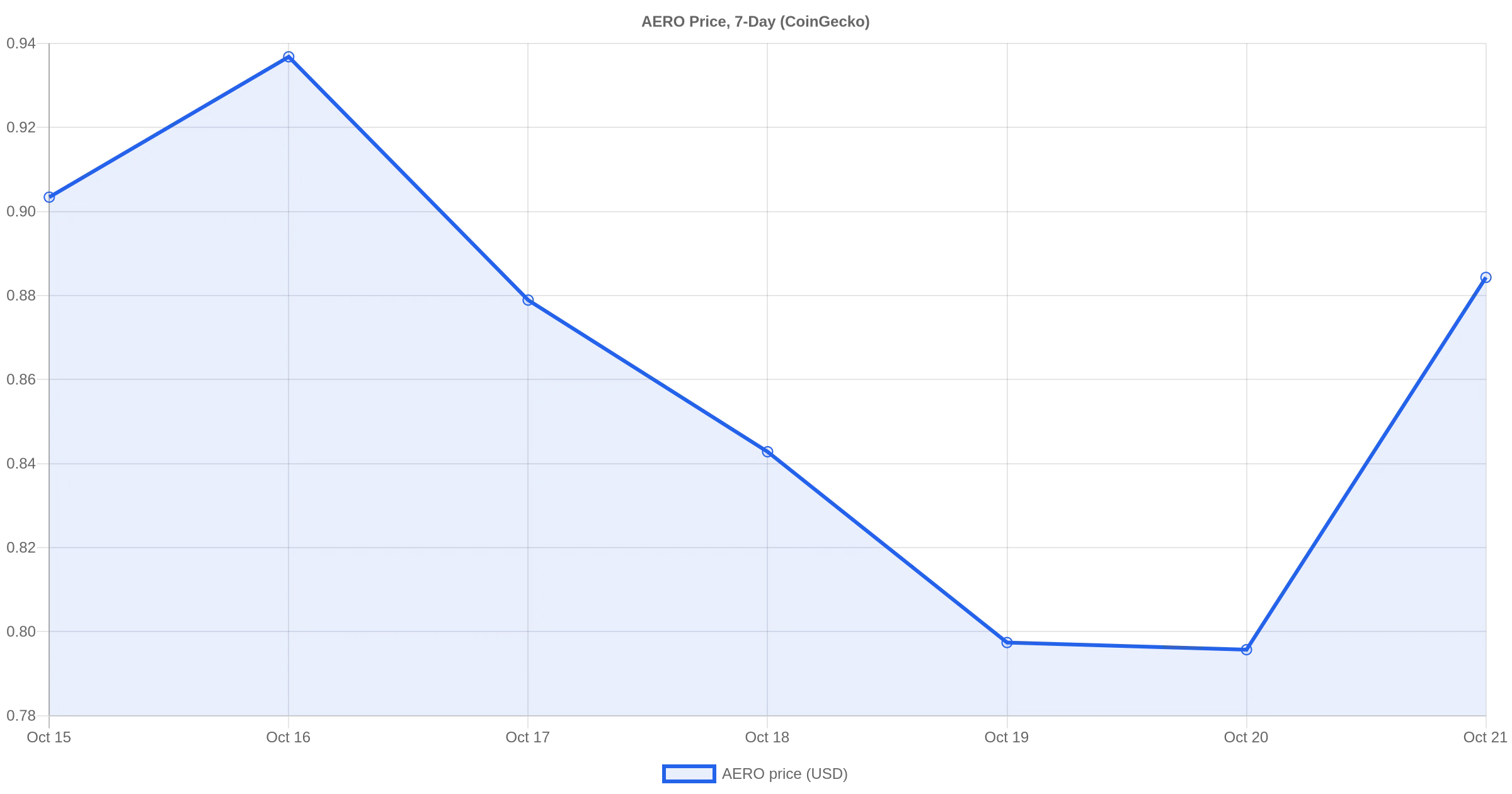
The seven-day chart shows the risk in that arithmetic. AERO peaked at $0.9368 on October 16, slid to $0.7957 by October 20, and has only now clawed back to $0.86. A buyer at the high is still underwater. Compare the Bitcoin side of the same calculation: a 2x on BTC means roughly $165,000, and a 10x means about $827,000 — numbers that require a repricing of the entire macro asset, not the execution of one product roadmap. That asymmetry, smaller base against larger required multiple, is the whole reason a catalyst-driven altcoin can be worth a look while Bitcoin grinds sideways.
Where the AERO Trade Could Break
The skeptical case is easy to assemble and worth stating in full. First, the launch is a going-live event, not a proven outcome: the update itself notes that final fixes were still being merged and the full application had yet to enter final quality assurance. A technical stumble on day one would hit the token harder than the anticipation has lifted it. Second, the AER Engine is designed to stream AERO rewards to liquidity providers, which means the token supply is set to expand — a dynamic that can dilute holders even as volume grows. Third, the token is down 5.18% over seven days despite the six-percent daily pop, so the trend is not yet established.
None of this is a reason to dismiss the event, but it is a reason to treat the multiple math as a scenario, not a forecast. The merger gives AERO a real, dated catalyst and a concrete share target; the market will judge by the volume Aero actually routes in its first weeks, not by the launch announcement. A buyer is not paying for the launch, but for the chance that a unified Base-plus-OP venue becomes the default onchain trading rail.
Frequently Asked Questions
Aerodrome and Velodrome, the leading decentralized exchanges on Base and OP Mainnet, are combining into a single exchange called Aero. It launches October 21 at 8:00 p.m. Eastern across seven chains, with the AERO token as its unified asset.
AERO is up about 6% in 24 hours as the market prices the launch of the merged exchange. The project says the chains it inherits handle about 17% of EVM spot volume and that the launch is set to roughly triple that.
A 10x from today’s $0.85 billion market cap would require about $8.5 billion, nearly twice Uniswap’s UNI. That depends on the exchange capturing close to its projected share of EVM spot volume, not on the launch announcement alone.
They are different trades. Bitcoin at $82,718 needs a flow-level repricing to double and has traded in a tight range ahead of the Fed’s October 28 decision. AERO is smaller, more volatile, and tied to a single dated catalyst.
Disclosure: This article does not represent investment advice. The content and materials featured on this page are for educational purposes only.