


Two days ago this column flagged a countdown: ether.fi had teased something for August 13 and its token was the only green name on a red board. The envelope opened on schedule. Inside was a bank. Tokenized stocks, metal trading, portfolio loans through Aave, fiat rails in more than thirty currencies. Good news, delivered on time, which is rarer in this industry than it should be. But while everyone read the press release, almost nobody checked the other page, the one where ether.fi’s own documentation shows it walking away from the thing that made it famous.
What actually shipped
The “Summer” release went live across web, iOS and Android on August 13, 2026, per the company’s own announcement . The list is genuinely substantial: trading in tokenized stocks and metals alongside crypto, an integrated Aave market on Optimism that lets users borrow against their entire portfolio, on and off ramps covering more than thirty currencies including Apple Pay and Cash App, and programmatic ETHFI buybacks built into the app itself.
CEO Mike Silagadze framed it as bridging decentralized finance and everyday financial needs. The app was deliberately rebuilt to be, in the company’s own words, less crypto-forward, aimed at a much broader audience. Tokenized stock and metals trading is not available in the United States and certain other markets, which is the sort of detail that gets buried and matters enormously to anyone reading this from Ohio.
On the plumbing side, ether.fi Cash moved its credit backend to an Aave V4 deployment on OP Mainnet, replacing an in-house system, with capacity targets in the hundreds of millions. That is a real infrastructure upgrade rather than a marketing bullet.
So: they promised something big and delivered something big. Credit where it is due.
The One Number That Matters
Less than 1%.
That is how much of ether.fi’s assets remain restaked with EigenLayer, according to ether.fi’s own slashing-risk documentation, down from roughly half in early 2026. The same page says the remaining share goes to zero in the third quarter of 2026, and that the company plans to remove EigenPod withdrawal credentials from its validators by Q4, eliminating the last structural link to EigenLayer entirely.
Understand what that sentence demolishes. Ether.fi became the largest business built on EigenLayer’s restaking model. The entire pitch through 2024 was one token bundling Ethereum staking yield with restaking exposure, and that bundle is why the protocol grew as fast as it did. Last week it separated them: weETH is now a plain liquid staking token, and anyone who actually wants restaking has to opt into a different token, weETHs, built on Symbiotic instead.
The wind-down happened on-chain before the announcement. As of this writing there is no blog post explaining the decision, and parts of ether.fi’s own documentation still describe weETH as automatically restaking on EigenLayer. When a company changes its founding thesis and updates the docs before it updates the story, the docs are the story.
The number the neobank launch is standing in front of
Now the context that makes the timing of a consumer app launch look less like a product roadmap and more like a pivot.
Ether.fi’s staking arm holds roughly $3.3 billion, per DefiLlama , still the largest liquid restaking protocol and third overall behind Lido and Binance staked ETH. Respectable numbers.
It peaked at $12.43 billion in August 2025.
That is a decline of roughly 73% in a year. The core business, the one that made this company, shrank by nearly three quarters, and this week the company launched a bank. Those two facts belong in the same paragraph, and I have not seen them there anywhere else.
The charitable reading is the correct starting point: a management team watching yield compress and restaking demand fade, deliberately building a second business on top of a card product and thirty currency rails before the first one becomes a problem. That is competent, and rarer than it sounds. Plenty of protocols ride a declining thesis into irrelevance rather than admit it.
The skeptical reading deserves equal space: consumer fintech is the hardest market in the world, ether.fi is now competing with actual banks and actual brokerages instead of other DeFi protocols, and the product is geofenced out of the largest consumer market on earth. Building a bank is easy to announce and brutal to run.
And the threat that has not gone anywhere
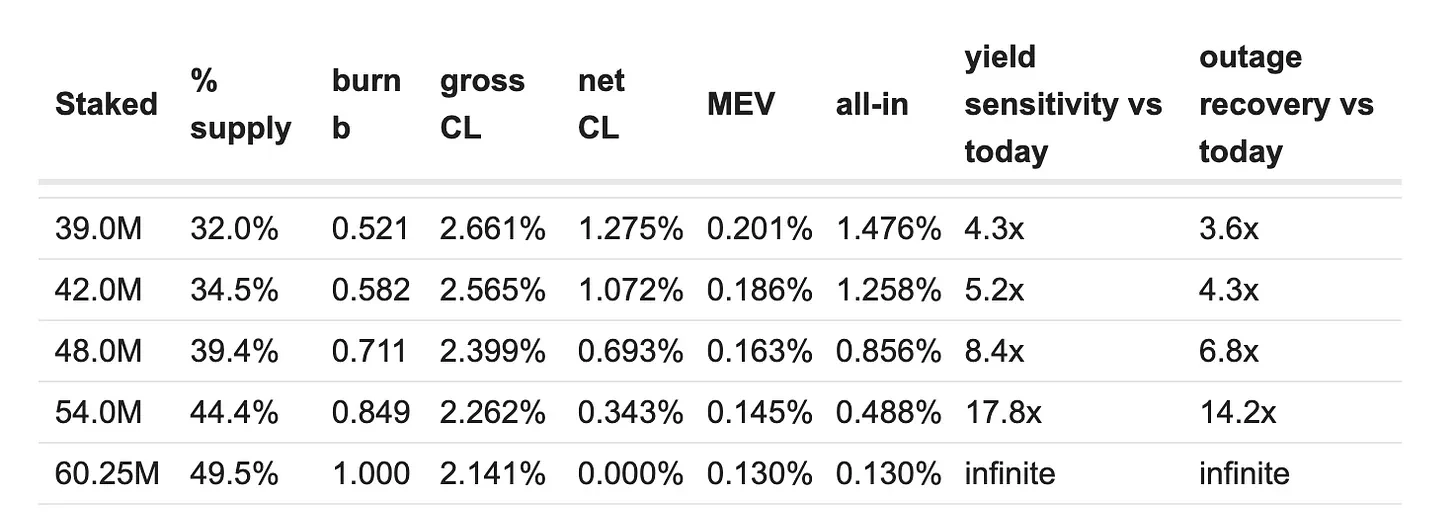
There is a draft Ethereum proposal, EIP-8363, sometimes called Tapered Issuance Burn, that would burn a portion of validator rewards as the staking ratio rises, potentially compressing net staking yield toward zero at high participation. The text and its discussion live in public at the Ethereum EIPs repository .
Read the pivot again with that in the background. If staking yield structurally compresses, a business whose product is staking yield needs another product, urgently. Nothing in the public record says the Summer release was built because of EIP-8363, and this site is not claiming it was. But a company diversifying away from validator economics at the exact moment validator economics face a structural draft proposal is not a coincidence worth ignoring either.
The Buyback, and What It Depends On
The ether.fi DAO has authorized up to $50 million in open-market ETHFI buybacks below $3 per token, funded by protocol revenue, and the Summer release wires those buybacks into the app itself. Against a market capitalization in the low hundreds of millions, that authorization is enormous in relative terms, far more aggressive than the roughly 1.2% of market cap per year that Chainlink’s reserve buys.
The same caveat as always applies, and it applies harder now: an authorization is a ceiling, not a schedule. Buybacks are funded by protocol revenue, protocol revenue mostly came from a staking business that just shrank 73%, and the replacement revenue comes from a consumer app that launched yesterday. Watch the executions on-chain via Etherscan , not the headline authorization.
Bottom Line
Ether.fi did what it said it would do, on the day it said it would do it, and shipped a genuinely ambitious product. It also quietly ended the arrangement that built the company, watched its core business fall from $12.4 billion to $3.3 billion, and is now betting its future on competing with retail banks in a market that excludes American users. Both stories are true. Only one of them was in the announcement. If you are trading this token, the bank is the headline and the exit is the thesis, and the second one will still matter long after the launch-day candle is gone.
This article is for information only and is not investment advice. Crypto assets are extremely volatile and you can lose your entire stake. Always do your own research.