
Binance is reasonably safe for active U.S. traders who use Binance.US, enable hardware-based two-factor authentication, and keep only trading-sized balances on the platform. That verdict comes with real caveats: Binance’s parent entity pleaded guilty to federal charges in late 2023, crypto assets on any exchange carry no FDIC or SIPC protection, and the gap between global Binance and Binance.US means U.S. users get a narrower asset list and different regulatory exposure.
Three things every U.S. reader should know before deciding:
- Custody tradeoff: Binance.US holds your assets on your behalf. You do not control the private keys. If the exchange freezes withdrawals or faces insolvency, your access depends on the platform’s solvency and compliance status, not a government guarantee.
- Trust signals exist but have limits: Binance publishes Proof of Reserves snapshots showing BTC and ETH reserves at roughly 100.25% of net user liabilities, backed by Merkle tree and zk-SNARK cryptography. That is a meaningful transparency step, not a full financial audit.
- Regulatory context: In November 2023, Binance and its founder pleaded guilty to federal charges and agreed to a $4.3 billion resolution with the U.S. Department of Justice. A federal monitor is now in place. That oversight adds compliance friction but also introduces a layer of external accountability most exchanges lack.
Key Takeaways
Binance.US is safe enough for active U.S. traders who apply hardware 2FA, withdrawal whitelisting, and self-custody for long-term holdings, but it carries custodial risk and a significant regulatory history that every user should understand before depositing funds.
| Point | Details |
|---|---|
| Verdict for U.S. users | Binance.US is usable with proper security settings; not suitable for passive long-term holders. |
| Top security step | Enable a hardware security key and withdrawal address whitelisting immediately. |
| Regulatory reality | Binance pleaded guilty to federal charges in late 2023; a $4.3B DOJ settlement and federal monitor are now in place. |
| Proof of Reserves | BTC and ETH reserves sit at roughly 100.25% backing per the latest PoR snapshot; useful signal, not a full audit. |
| Self-custody rule | Move any holdings not needed for active trading to a hardware wallet like Ledger or Trezor. |
Table of Contents
- What security measures does Binance use?
- Binance’s regulatory and legal record in the U.S.
- Past security incidents and how Binance responded
- Key risks you face as a Binance user
- Practical steps to reduce your risk on Binance
- How does Binance compare to Coinbase for U.S. users?
- What Binance’s Proof of Reserves actually proves
- Final verdict: who should use Binance and what to do now
- Useful primary sources
- Sources
What security measures does Binance use?
Binance runs a layered security model. Understanding both the platform-level and account-level controls tells you what the exchange protects automatically and what you have to configure yourself.
Platform-level protections
The majority of user funds sit in cold wallets, meaning they are stored offline and disconnected from the internet. A smaller portion stays in hot wallets to handle daily withdrawals and liquidity needs. Binance uses Threshold Signature Scheme (TSS) technology to split private key authorization across multiple parties, so no single server or employee can move funds unilaterally.
The Secure Asset Fund for Users (SAFU) is Binance’s self-funded emergency reserve. Binance allocates a portion of trading fees to SAFU to cover user losses in the event of a platform-level security incident. The fund is not government-backed insurance, and Binance retains discretion over when and how it is deployed.
According to Coin Bureau’s security analysis, Binance combines cold storage, hot wallet liquidity management, SAFU reserves, and multiple account-level controls into a platform model that is among the more thorough in the industry, though custodial risk remains.
Account-level controls
These are the protections you configure. Most users leave several of them disabled by default, which is where real exposure lives.
- Two-factor authentication (2FA): Binance supports authenticator apps (Google Authenticator, Authy), hardware security keys (YubiKey and compatible FIDO2 devices), and passkeys. Hardware keys are the strongest option; SMS-based 2FA is the weakest and should be avoided.
- Withdrawal address whitelisting: You can restrict withdrawals to a pre-approved list of addresses. New addresses trigger a 24-hour delay before they become active, which gives you a window to catch unauthorized changes.
- Anti-phishing code: A unique code you set appears in every legitimate Binance email. Any email without it is a fake.
- Device management and session controls: You can review all active sessions and authorized devices, and revoke access remotely.
- IP access restrictions: Binance lets you whitelist specific IP addresses for account access.
Proof of Reserves: what it shows
Binance’s Proof of Reserves (PoR) uses two cryptographic methods. A Merkle tree organizes all user balances into a verifiable data structure; you can check that your balance is included without seeing anyone else’s. zk-SNARKs (zero-knowledge succinct non-interactive arguments of knowledge) let Binance prove that the sum of all user balances matches on-chain holdings without exposing individual account data.
The most recent PoR snapshot shows BTC and ETH backing at approximately 100.25% of net user liabilities. That means reserves slightly exceed what users are owed, at least at the moment of the snapshot.
Pro Tip: You can verify your own inclusion in Binance’s Merkle tree directly through the PoR verification tool in your account settings. Use a blockchain explorer to cross-check the on-chain wallet addresses Binance publishes.
Binance’s regulatory and legal record in the U.S.
This is the section most safety guides underplay. The legal history directly affects your risk of account freezes, withdrawal delays, and reduced service availability as a U.S. user.
Key events in sequence:
- June 2023: The SEC filed 13 charges against Binance entities and founder Changpeng Zhao (CZ) , alleging unregistered exchange operations, unregistered securities offerings, and mishandling of customer funds.
- November 21, 2023: Binance and CZ pleaded guilty to federal charges brought by the DOJ, including violations of the Bank Secrecy Act and anti-money-laundering laws. The resolution totaled $4.3 billion, one of the largest corporate criminal penalties in U.S. history. CZ stepped down as CEO.
- Post-settlement: A federal monitor was installed under a DOJ/FinCEN compliance agreement. Binance committed to enhanced KYC/AML controls, compliance staffing increases, and ongoing reporting to regulators.
What this means for U.S. users in practice:
- Stricter identity verification requirements mean more documentation requests and potential account holds during review periods.
- The federal monitor adds external oversight, which reduces the probability of a repeat compliance failure but also means regulators have ongoing visibility into platform operations.
- Binance.US operates as a separate legal entity from global Binance, with its own compliance structure. The Investopedia review of Binance notes that U.S. users have access to a more limited asset selection as a direct result of this regulatory separation.
- If regulators determine that Binance.US is not compliant with U.S. law, they could restrict or suspend operations. That is a tail risk, not a daily concern, but it is real.
The compliance push across global exchanges following enforcement actions like Binance’s settlement signals a broader industry shift. Binance is not uniquely targeted; it was the largest and most visible case.
Past security incidents and how Binance responded
Binance’s most significant breach happened in May 2019. Hackers exploited a combination of phishing attacks and malware to steal approximately several thousand BTC from a hot wallet. Binance covered all user losses from the SAFU reserve. No individual user lost funds as a result of that breach.
That response matters for two reasons. First, it demonstrated that SAFU functions as intended for platform-level incidents. Second, it showed that Binance’s cold storage architecture worked: the breach was contained to the hot wallet, which held a fraction of total assets. The bulk of user funds in cold storage was never touched.
What the 2019 incident does not prove is that SAFU will always be sufficient. The fund’s size is not publicly disclosed in real time, and Binance controls the decision to deploy it. It is a discretionary reserve, not a government-backed guarantee. If a future breach exceeded the fund’s capacity, users could face partial or no reimbursement.
The more common threat is not a platform hack. Nation-state actors and organized criminal groups increasingly target individual users through phishing, SIM swapping, and social engineering. North Korean-linked groups alone have compromised crypto assets across dozens of countries . Those attacks bypass exchange security entirely by targeting the user’s credentials.
Pro Tip: SAFU covers platform-level breaches. It does not cover losses from phishing, SIM swap attacks, or you handing credentials to a scammer. Your account-level security settings are your only protection against those threats.
Key risks you face as a Binance user
| Risk | Severity for U.S. Users | Notes |
|---|---|---|
| Custodial risk | High | Exchange controls keys; no FDIC/SIPC equivalent for crypto |
| Account takeover (phishing, SIM swap) | High | Most common cause of individual user loss |
| Regulatory access restrictions | Medium | Binance.US has faced service suspensions; geo restrictions possible |
| Withdrawal freezes | Medium | Compliance reviews and KYC holds can delay access |
| Token availability gaps | Low-Medium | Binance.US lists fewer assets than global Binance |
| Platform insolvency | Low | SAFU exists but is discretionary; no government backstop |
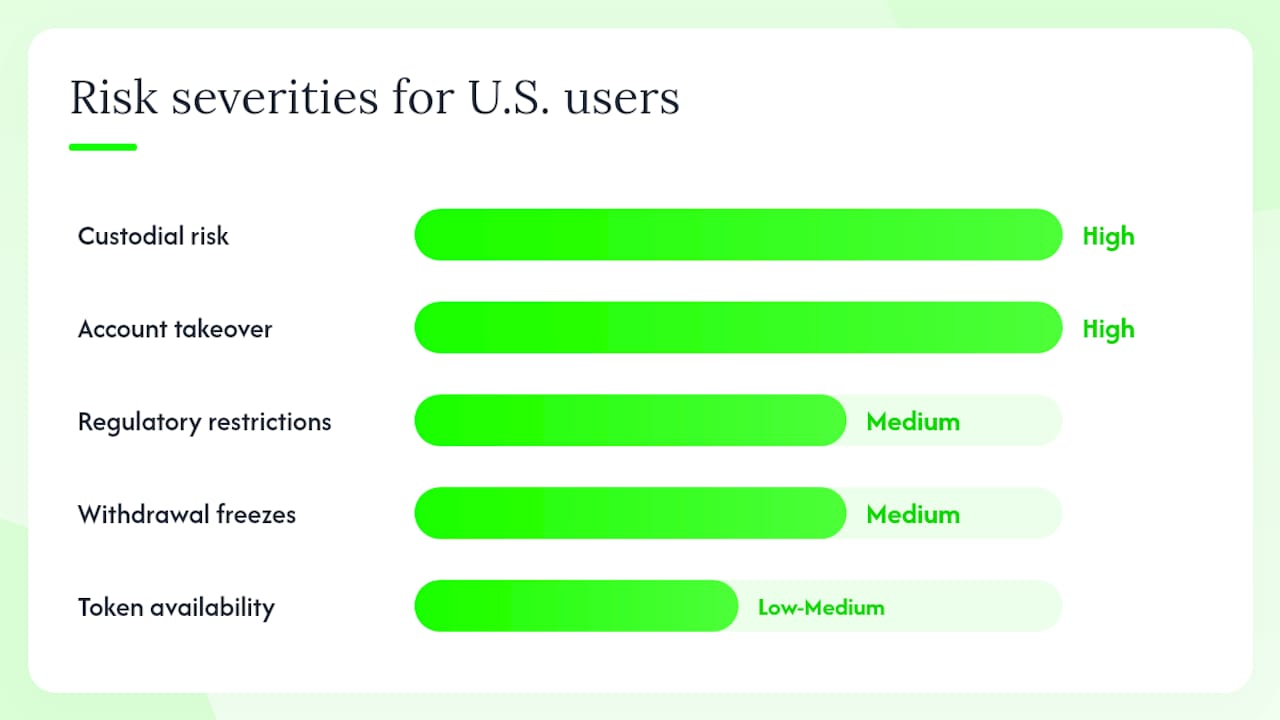
Custodial risk is the foundational issue. When you deposit crypto on Binance.US, you are trusting the exchange with your private keys. The platform can freeze withdrawals, restrict your account during compliance reviews, or face regulatory action that limits your access. None of those scenarios require a hack to hurt you.
No FDIC or SIPC protection applies to crypto. Cash held in a Binance.US USD wallet may carry some FDIC pass-through protection through partner banks, but crypto assets themselves are not covered by any government deposit insurance scheme. If Binance.US became insolvent, your crypto recovery would depend on bankruptcy proceedings, not an insurance payout.
Withdrawal freezes became more common after the 2023 enforcement actions. Enhanced KYC/AML checks mean accounts flagged for review can face temporary holds. This is not theft, but it can prevent you from accessing funds when you need them.
U.S. users also face a narrower asset selection on Binance.US compared to the global platform, a direct consequence of the regulatory separation described above.
Practical steps to reduce your risk on Binance
Security on Binance is largely what you make it. The platform offers the tools; most users never configure them.
- Switch to hardware 2FA immediately. A YubiKey or similar FIDO2 hardware key is the single highest-impact change you can make. Authenticator apps are a solid second choice. Delete SMS 2FA from your account entirely. Hardware keys and withdrawal whitelists are the most effective account-level protections available.
- Set your anti-phishing code. Go to Security settings and create a unique code. Every legitimate Binance email will display it. Anything without it is a phishing attempt.
- Enable withdrawal address whitelisting. Restrict withdrawals to addresses you have pre-approved. The 24-hour delay on new addresses is a meaningful friction layer against unauthorized transfers.
- Review active sessions and devices. Log out of any session you do not recognize. Remove devices you no longer use.
- Set a withdrawal limit. Binance.US allows you to configure daily withdrawal limits. A lower limit reduces exposure if your account is compromised.
- Move long-term holdings to a hardware wallet. Any crypto you are not actively trading belongs in self-custody. Ledger and Trezor are the two most widely used hardware wallets for this purpose. Keep only what you need for near-term trades on the exchange.
Pro Tip: When setting up a hardware wallet, write your seed phrase on paper and store it in a physically secure location. Never photograph it or store it digitally. The broader wallet security ecosystem has its own risks , so choose a well-audited device and verify firmware before use.
How does Binance compare to Coinbase for U.S. users?
For most U.S. users, the practical choice is between Binance.US and Coinbase. Here is how they stack up across the dimensions that matter most for safety and usability.
| Dimension | Binance.US | Coinbase |
|---|---|---|
| Custody model | Custodial (exchange holds keys) | Custodial (exchange holds keys) |
| Crypto deposit insurance | No FDIC/SIPC for crypto | No FDIC/SIPC for crypto |
| Regulatory status (U.S.) | DOJ guilty plea, $4.3B settlement, federal monitor | SEC lawsuit filed 2023; no criminal resolution |
| Assets available to U.S. users | More limited than global Binance | Broad selection, U.S.-compliant |
| Spot trading fees | Generally lower | Generally higher |
| Fiat withdrawal friction | ACH and wire; some delays post-enforcement | ACH, wire, PayPal; generally smoother |
| 2FA options | Authenticator, hardware key, passkey | Authenticator, hardware key |
| Proof of Reserves | Yes, Merkle tree + zk-SNARKs | Published attestations; methodology differs |
Coinbase carries a cleaner U.S. regulatory record. It has not entered a criminal guilty plea, and its compliance infrastructure was built with U.S. regulations as the primary constraint from the start. For users who prioritize regulatory certainty and smooth fiat on/off ramps, that matters.
Binance.US typically offers lower trading fees and, even with its reduced asset list, covers most major tokens. For active traders who are comfortable managing their own security settings and accept the custodial tradeoff, the fee difference is real money over time.
Neither exchange offers government-style deposit protection for crypto. That is the industry-wide reality, not a Binance-specific flaw. The practical implication is the same on both platforms: do not keep more on any exchange than you can afford to lose access to temporarily.
What Binance’s Proof of Reserves actually proves
Proof of Reserves is a meaningful step forward in exchange transparency. It is not a full financial audit, and treating it as one is a mistake.
Here is what the cryptography actually does:
- Merkle tree inclusion proofs let you verify that your specific account balance is included in the total that Binance claims to hold. You can run this check yourself. What it does not show is whether Binance has undisclosed liabilities elsewhere.
- zk-SNARKs allow Binance to prove that the aggregate sum of all user balances matches on-chain reserves without revealing any individual account. This is stronger than a simple third-party attestation because the math is verifiable without trusting an auditor’s word.
The most recent PoR snapshot shows BTC and ETH at approximately 100.25% backing. That figure is meaningful. It tells you that, at the moment of the snapshot, Binance held slightly more than it owed users in those assets.
What PoR does not tell you: off-chain obligations, the quality of collateral backing other reserve assets, governance risks, or whether the snapshot was taken at a moment that flatters the numbers. Independent analysis consistently notes that PoR is a useful transparency signal but not a substitute for a comprehensive financial audit covering liabilities, governance, and off-chain positions.
Use PoR as one data point in a broader custody decision. It is not a guarantee of solvency. You can cross-check the published wallet addresses using a blockchain explorer to confirm on-chain balances independently.
Final verdict: who should use Binance and what to do now
Binance.US suits you if:
- You are an active trader who wants lower fees and accepts that custodial exchanges carry inherent risks.
- You have configured hardware 2FA, withdrawal whitelisting, and an anti-phishing code.
- You keep only trading-sized balances on the platform and move long-term holdings to a hardware wallet.
- You are comfortable with the post-2023 regulatory environment and the ongoing federal monitorship.
Binance.US is a poor fit if:
- You need maximum regulatory certainty or prefer an exchange with no criminal enforcement history.
- You plan to hold large amounts on-exchange long-term without self-custody.
- You want access to the full global Binance asset catalog.
Immediate action checklist:
- Enable a hardware security key or authenticator app as your 2FA method. Remove SMS 2FA.
- Set an anti-phishing code in Security settings.
- Enable withdrawal address whitelisting.
- Review and clean up active sessions and authorized devices.
- Move any holdings you are not actively trading to a hardware wallet (Ledger or Trezor).
- Monitor your account for unusual activity and set up email/SMS alerts for withdrawals.
- If Binance.US announces regulatory-forced service restrictions in your state, withdraw funds promptly rather than waiting.
The $4.3 billion DOJ settlement and the federal monitor represent a meaningful compliance reset. That does not erase the history, but it does mean Binance is operating under more external scrutiny than at any point in its history. For U.S. users who apply the security steps above, the platform is usable. For those who do not, the risks compound quickly.
This article is general information, not financial or legal advice. Verify current regulatory status and platform terms directly with Binance.US and consult a qualified professional for decisions specific to your situation.
How we assess exchange safety at Blockchainreporter
Evaluating an exchange’s safety means looking at four things in parallel: the custody model (who controls the keys and under what conditions), the incident response record (what happened when things went wrong and how users were made whole), regulatory standing (what enforcement actions exist and what they changed operationally), and cryptographic transparency (what PoR methodology is used and what it actually proves). No single factor is decisive. An exchange can have strong cold storage and a terrible regulatory record, or a clean legal history and weak account-level controls. The Binance assessment above weighs all four, with particular weight on the post-2023 compliance changes and the practical account-level steps that most reduce individual user risk. For U.S. readers, the regulatory dimension carries extra weight because it directly affects withdrawal access and service continuity in ways that pure security metrics do not capture.
Useful primary sources
These are the primary documents and analyses that back the claims in this article. Reading them directly lets you verify the regulatory facts and PoR methodology rather than relying on any single summary.
- DOJ press release: Binance and CEO plead guilty, $4.3B resolution — The official DOJ statement on the November 2023 guilty plea and settlement terms. Read this to understand exactly what Binance admitted to and what compliance conditions apply going forward.
- SEC charges against Binance entities and founder — The SEC’s 13-count complaint. Relevant for understanding which alleged securities-law violations affect U.S. market access and what the ongoing litigation means for the platform’s U.S. operations.
Stay current on Binance regulatory developments, exchange security news, and crypto market analysis at Blockchainreporter , where real-time price data and expert coverage help you make informed custody and trading decisions.
Sources
- Justice
- Sec
Recommended
- Binance Introduces $BTC-Backed Lite Loan With 30-Day Fixed Terms
- Circle Renews Coinbase USDC Deal, Rules Out Quarterly Payouts
- RedotPay Vows To Fight $470M Binance Lawsuit Over Alleged Customer Poaching
- U.S. Stablecoin Delay Benefits Global Crypto Markets, Says Venom CEO