




Thirty of the XRP Ledger’s 35 trusted validators were backing the LendingProtocol amendment when it crossed the activation threshold at 14:22:02 UTC on Nov. 27. The threshold is 28 votes. The margin is two. If three validators withdraw support before the window closes, the amendment falls to 27 of 35, or 77.1%, drops under the 80% requirement, and the countdown restarts at zero.
The tally has to hold for 14 days. At the end of the window the ledger will either switch the feature on at 14:22:02 UTC on Dec. 11 or reject it and begin the countdown again.
How the 14-day window is enforced
The XRP Ledger activates amendments through validator support rather than a foundation release. An amendment needs more than 80% of trusted validators to keep voting yes for two weeks. Fourteen days is 1,209,600 seconds, or roughly 302,400 ledgers at the network’s four-second close. Support is measured continuously, not at the end, so a majority that slips on day nine cancels the run.
XRPScan’s amendment record for LendingProtocolV1_1 shows 30 yes votes against a threshold of 28, with 35 validations. The parent LendingProtocol entry carries the same count and the same majority timestamp: 14:22:02 UTC on Nov. 27. Both must activate for the feature to work as specified.
The upgrade path began with xrpld 3.4.0, which shipped the lending amendments in September . A second amendment in the same family is further along. SingleAssetVault, known as XLS-65, reached its own majority at 19:38:51 UTC on Nov. 25 with the same 30 of 35 votes. Its earliest activation is 19:38:51 UTC on Dec. 9, two days before lending.
Vaults first, then loans
The sequence follows from the design. XLS-66 requires XLS-65, and a LoanBroker draws its funding from a Single Asset Vault, so the vault type has to exist first. On Dec. 9 the vault becomes available as a ledger object. On Dec. 11, if support holds, the loan objects that draw on it follow.
The XRPL documentation describes the feature in one sentence: “The Lending Protocol is an XRP Ledger DeFi primitive that enables on-chain, fixed-term, uncollateralized loans using pooled funds from a Single Asset Vault.” That definition is published on xrpl.org .
The lifecycle the specification lays out is short. A loan broker creates a vault. Depositors add assets. The broker may deposit first-loss capital. A broker and a borrower then sign a loan in a single transaction using a counterparty signature, the terms are fixed at signing, and the principal moves. Payments are amortized; a missed payment opens a grace period, and once it expires the broker can declare the loan in default.
What the amendment actually permits
The design choice that separates this from Aave or Compound is stated plainly in the XLS-0066 standard : “Most DeFi lending protocols (e.g., Aave, Compound) require on-chain collateral and automated liquidation mechanisms. This protocol deliberately omits these in favor of uncollateralized loans with off-chain underwriting.”
There is no liquidation engine because there is no collateral to liquidate. Credit assessment happens off-chain, before a loan is signed, and the ledger enforces the terms afterward: principal, interest, late interest, a full-payment rate for early repayment, and a set of broker-configurable fees that include a management fee taken as a share of interest, an origination fee, a service fee, a late fee, and an early-payment fee.
Protection for depositors comes from first-loss capital, which the standard describes this way: “This scheme requires the Loan Broker to deposit a fund that can be partially liquidated to cover losses in the event of a loan default.” The fund sits in a broker pseudo-account, separate from the vault’s assets, and is drawn down when a borrower defaults.
The same section adds the qualifier that matters most: “The First-Loss Capital mechanism is optional rather than mandatory.”
The compliance layer is the part issuers will read
For a bank, a fintech, or a licensed issuer weighing tokenized credit, the collateral question is secondary to control. The standard answers it early: “The Lending Protocol supports the Clawback and Freeze controls of the Vault asset’s Issuer.”
The consequences are written into the loan objects. If an issuer freezes a borrower’s account, the borrower cannot make payments, but the obligation to repay does not disappear. A deep freeze on the broker’s pseudo-account stops new loans and also prevents existing loans from being paid, while an ordinary freeze on the same account only blocks new lending. An issuer can claw back funds from the first-loss capital pool. In each case the issuer keeps the asset-level control it already had, and the ledger applies that control to the credit position.
That is an unusual combination: uncollateralized credit, priced off-chain, with on-chain settlement and an issuer kill switch that reaches the loss buffer. It is closer to a permissioned credit rail than to the open liquidity pools most DeFi users know, and it explains why the specification spends a full section on freeze and clawback semantics before it describes the loan terms.
A two-vote cushion is thin
Thirty votes against a threshold of 28 leaves room for exactly two defections. At 27 of 35, support is 77.1%, below the 80% line, and the amendment is rejected. The countdown then restarts from the next majority, which pushes the earliest activation date back by another two weeks.
Validator counts move for operational reasons that have nothing to do with the merits of a feature: a validator goes offline, changes operators, or upgrades to a release that does not yet support the amendment. The LendingProtocolV1_1 entry lists its supporting validators individually on XRPScan, which makes the two-vote margin checkable rather than rhetorical. Anyone can count the names, and anyone can watch them change before Dec. 11.
XRP is trading 29% below its Oct. 28 close
XRP traded at $0.9368 at 00:46 UTC on Nov. 29, continuing a slide that began in early November , down 1.7% in 24 hours, 25.1% over 30 days, and 57.3% over a year, according to CoinPaprika. Its market capitalization was $59.5 billion. Bitcoin, for scale, traded at $59,185 with a $1.19 trillion market cap.
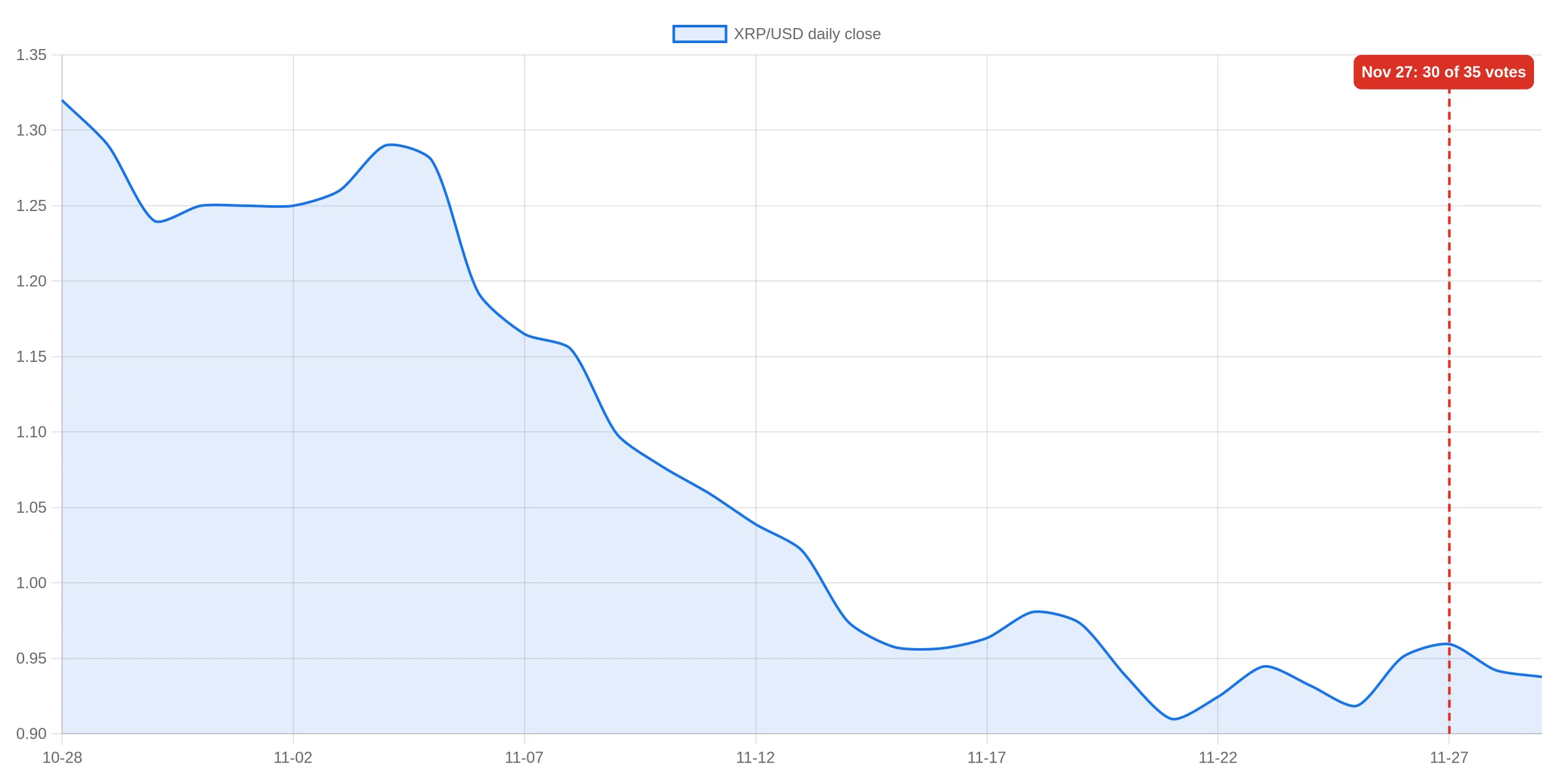
The token closed at $1.32 on Oct. 28. It bottomed at $0.9098 on Nov. 21 and has recovered 3.0% from that low, which still leaves it 29.0% below the October close. The chart above plots those daily closes and marks Nov. 27, the day the amendment crossed 28 votes.
The market-cap arithmetic is worth doing because it sets the scale of any recovery claim. At a $59.5 billion cap and a $0.9368 price, roughly 63.5 billion XRP are in the float, so each one-cent move is worth about $635 million in market value. A return to $1.00 requires a 6.8% gain, or about $4.0 billion of added value. A double to $1.87 would add $59.5 billion. A tenfold move to $9.37 would require a $595 billion valuation, about half of bitcoin’s current $1.19 trillion.
What the chart does not show is causation. XRP traded near $0.96 on Nov. 27, the day the amendment crossed, but the decline from $1.32 began in early November, before the vote was close. The available evidence does not establish the amendment as a price driver in either direction. It is a protocol event with a fixed date.
What changes on Dec. 11, and what does not
What changes: the ledger gains native loan and loan-broker objects, the vault created on Dec. 9 gains a credit use, and issuers gain an enforceable way to apply freeze and clawback to a lending position.
What does not change: XRP does not become borrower collateral, because a loan is still unsecured and the vault’s asset only supplies the funding. No smart contract is required to use the feature, and no loan can exist without a broker willing to underwrite it off-chain. A vault created before the amendment records the rules in force at creation through its LEXVersion field, and keeps those rules for its whole life, so early vaults will not automatically inherit later accounting fixes.
The near dates are now fixed on the ledger’s own calendar. Dec. 9 at 19:38:51 UTC for vaults, Dec. 11 at 14:22:02 UTC for lending, both conditional on 28 of 35 validators staying in place. Between now and then, the only number that matters is the vote count.
Frequently Asked Questions
The earliest activation is 14:22:02 UTC on Dec. 11, 2026, two weeks after the LendingProtocol amendment reached 30 of 35 validator votes on Nov. 27. Support must stay above the 28-vote threshold for the full window.
If support falls to 27 of 35, or 77.1%, the amendment is rejected and the 14-day countdown restarts from the next majority, pushing activation back by at least two weeks.
No. Loans, brokers, and vaults are native ledger objects and transactions, so the credit terms are enforced by the ledger rather than by a deployed contract.
No. The protocol is built for uncollateralized, fixed-term loans underwritten off-chain. First-loss capital posted by the loan broker is an optional buffer, not collateral pledged by the borrower.
SingleAssetVault, or XLS-65, reached its majority on Nov. 25 and activates no earlier than 19:38:51 UTC on Dec. 9. The lending protocol draws its funds from those vaults.
There is no established mechanism linking the amendment to the token’s price. XRP fell 29% from its Oct. 28 close while the vote advanced, and the decline began before support neared the threshold.
Sources: XRPScan amendment records for LendingProtocolV1_1, LendingProtocol, and SingleAssetVault; XRPL documentation for the Lending Protocol; XLS-0066 specification. Data: CoinPaprika , XRPScan , Coinbase .
This article is for information only and is not investment advice. Prices and market data are from CoinPaprika and Coinbase as of 00:46 UTC on November 29, 2026, and change continuously.
The post XRP Ledger Lending Activates on Dec. 11 Unless Three Validators Switch Their Votes appeared first on Blockchainreporter .