



At 09:33:11 UTC on Saturday, block 977,920 confirmed a transaction that took 7,500 BTC out of Binance’s Secure Asset Fund for Users. Six inputs, every one of them from the SAFU bitcoin address that Binance named in its October 31 recovery update, produced a single output of 7,500.00000000 BTC to a wallet with no earlier history, plus 0.00009049 BTC of change. The fee was 19,380 satoshis, about $11.47 at the day’s price.
Binance had published the intention at 06:00:02 UTC in a notice titled “SAFU Update: Adjusting Fund Holdings”. The gap between the notice and the transfer is three hours, 33 minutes and nine seconds. Whether the decision predates the notice cannot be established from either document.
The bitcoin that moved is worth about $443.8 million at $59,173, the CoinGecko rate at 11:15 UTC. The dollar leg Binance promised is $500 million. That $56.2 million difference is the part of the transaction the announcement does not price, and it sets the terms of what changed for the users the fund exists to protect.
What the notice actually commits Binance to
The announcement is short and specific about the mechanics. It states: “7,500 BTC will move out of the SAFU address back to Binance’s own treasury account. In exchange, 500 million USDC from Binance’s own treasury account will be added to SAFU.”
It then closes the obvious question about market selling in one sentence: “This is an internal reallocation, not a sale. No BTC will be sold or traded on the market.” The notice repeats the point in different words, calling the transfer “an internal transfer between SAFU and Binance’s own funds” with “no market impact”.
The stated reason is a compliance obligation, and the notice is careful not to identify it. “This change meets a regulatory requirement. In addition, a larger stablecoin share makes SAFU more stable and immediately usable if it is ever needed,” it reads. No regulator, jurisdiction, rule number or deadline appears anywhere in the text. For a document whose stated trigger is a legal requirement, the omission matters: a reader cannot check the requirement, only the transfer.
Custody is addressed in one paragraph: “SAFU remains held and managed by Nest Clearing and Custody Limited, an ADGM-regulated Recognised Clearing House.” The Abu Dhabi Global Market maintains a public register of recognised clearing houses, so the description is checkable independently of Binance, though the notice gives no registration number. The exchange also directs readers to verify the movement itself: “You can verify the movements on-chain at the SAFU addresses.”
What the chain recorded between 06:00 and 09:33
The on-chain record is more granular than the announcement. Three timestamps matter.
At 06:00:02 UTC the notice went live on Binance’s support site. At 08:03:07 UTC, block 977,912 carried 0.0006 BTC, about $35.50, from the SAFU address to a native SegWit address, bc1qxrtgwsdx4ezxjadratn3nj56d9e8leacfxchf9. That is a dust-sized amount relative to the fund and it moved to the same destination that received the balance 90 minutes later, which reads as a control test before a large transfer rather than a payment.
At 09:33:11 UTC, block 977,920 spent six SAFU inputs and sent 7,500.00000000 BTC to that address. The SAFU wallet now holds 0.00052818 BTC, roughly $31, on a lifetime funded total of 32,918 BTC. The receiving address holds 7,500.0004 BTC. No spend has left it since the transfer.
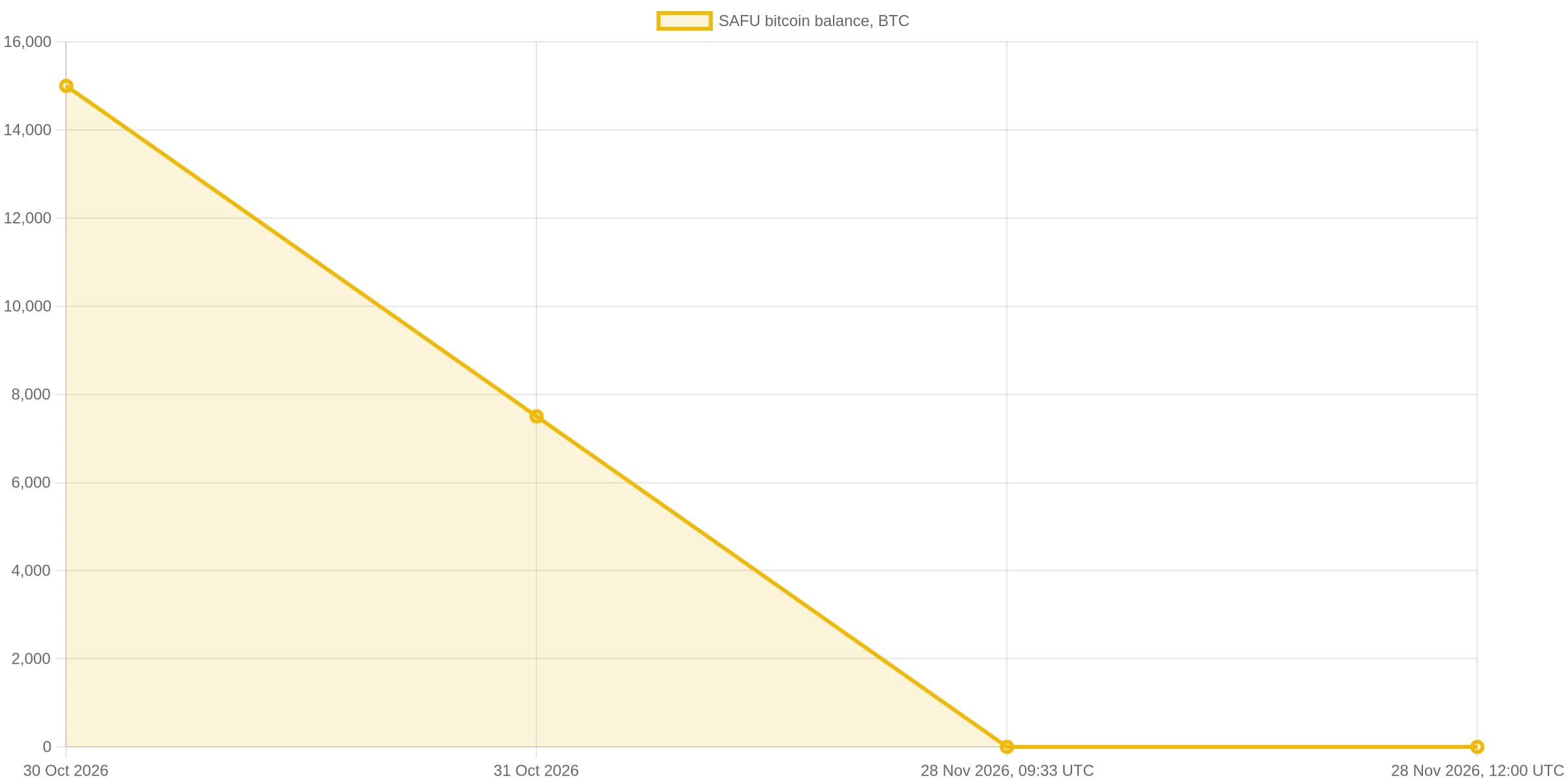
That the address belongs to SAFU is not an inference. Binance’s Recovery Update #3 on October 31 stated: “The SAFU wallet address is at: BTC: 1BAuq7Vho2CEkVkUxbfU26LhwQjbCmWQkD”. The same update said Binance would use part of the fund to acquire the last 10% of assets owed after the October 29 breach, a commitment our earlier reporting on the $6.34 billion earmark covered at the time. On October 31 the same wallet moved a net 7,500 BTC out in two transactions, which cut its balance from 15,000 BTC to 7,500. Saturday’s transfer removed the remainder.
The exchange rate the announcement left out
Binance describes the swap as an exchange of 7,500 BTC for 500 million USDC. It does not state the price implied by those two figures. The arithmetic is 500,000,000 divided by 7,500, which gives $66,666.67 per bitcoin.
At $59,173, the price at 11:15 UTC, that is 12.66% above spot. Put the other way, $500 million buys 8,447.9 BTC at today’s rate, which is 947.9 BTC more than the fund gave up. The stablecoin leg is therefore not a like-for-like substitution at market: Binance is adding roughly 12.7% more dollar value than the bitcoin it is withdrawing, and that difference is the closest thing to a valuation the notice provides.
The scale also changes. Before October 31 the fund held 15,000 BTC, worth about $887.6 million at today’s price. After Saturday it holds $500 million in a dollar token and effectively no bitcoin. Against the “approximately US$1 billion” target that Binance restated in the October 31 update, the fund sits at half its stated size, entirely in dollars. The replenishment promise carries no schedule.
What a dollar-heavy fund can and cannot do
The practical consequence is about what the fund can do on the day it is needed. A bitcoin reserve is deployed by selling bitcoin, which is slow in a stressed market and adds to the selling that triggered the claim. A dollar reserve can be paid out without a market sale, which is the rationale Binance gives.
The cost is on the other side of the ledger. A bitcoin reserve gains when bitcoin rises and the fund grows without a top-up. A dollar reserve does not. With bitcoin down 3.9% over 24 hours at 11:15 UTC, a fixed-dollar fund reads as protection against further decline. It is also a permanent decision about the fund’s upside, and the notice frames it as a requirement rather than a preference.
The second cost is issuer exposure. USDC is a redeemable dollar token, and a reserve held in it depends on the issuer honouring redemptions at par, which is a different risk from holding a bearer asset in a wallet the fund controls. The notice does not address redemption terms, custody of the USDC leg, or whether the token sits with Nest Clearing or elsewhere.
The fund’s role in the October recovery is the relevant precedent. Binance said it would draw on SAFU, part of its futures insurance reserve and corporate funds to cover the breach, at a moment when deposits and withdrawals were the pressure point . A fund that can pay immediately is more useful in that scenario than one that must first find a buyer.
The countercase: what “no market impact” does not cover
Binance’s assurance is precise and narrow. It says no BTC will be sold or traded on the market as part of this reallocation. The chain confirms the first half: 7,500 BTC moved from one address to another in a single transaction at 09:33, with no exchange deposit pattern visible in the transfer itself.
It does not establish what happens next. The coins now sit in a single address that Binance has not labelled publicly, and the notice does not publish an address for the “treasury account” it names as the destination. A later sale from that address would be consistent with the notice as written. The label is Binance’s, and the only document that would independently confirm treasury ownership is one the exchange has not published.
There is also a narrower reading of the compliance claim. A requirement that an insurance fund hold a larger share in stablecoins is a plausible custody or capital rule, but the notice does not say which one. Without that, readers cannot distinguish a rule that binds Binance from an internal preference presented as an obligation. Both are possible; only one is verifiable, and it is not the one in the text.
What the record still does not show
Four things remain open. The regulator and the rule are unnamed. The USDC leg has no published address, so the second half of the swap cannot be verified on-chain at all; the bitcoin side is verifiable and the dollar side is not. The destination wallet’s ownership rests on Binance’s description. And the fund’s total value after the change depends on a USDC balance the exchange has not disclosed beyond the $500 million figure.
Binance’s proof-of-reserves snapshots are the disclosure that would close part of that gap. The exchange published a new snapshot on November 12 when it said it had completed coverage of assets affected by the breach. A snapshot that shows SAFU’s composition after this swap would be the first document to test the announcement against the balance sheet.
What to watch next
The clearest signal is any spend from bc1qxrtgwsdx4ezxjadratn3nj56d9e8leacfxchf9. A transfer to an exchange deposit address would indicate the coins are being prepared for sale; a long dormancy would support the treasury explanation. The mempool record is public and updates in real time.
The second signal is the next SAFU notice. Binance has now issued two in five weeks, and the October 31 update included an address, a target and a use of funds. A follow-up that names the regulatory requirement, or publishes the USDC address, would settle the questions this notice leaves open.
The third is price. At $59,173 the fund’s remaining bitcoin exposure is 0.0005 BTC, so the value of SAFU no longer moves with the market. Whatever protection the fund offers from here is fixed in dollars, which is the substance of the change and the part of it that no announcement can reverse.
Data: Binance announcement , mempool.space , transaction record , CoinGecko .
Disclosure: This article does not represent investment advice. The content and materials featured on this page are for educational purposes only.
The post Binance Empties Its SAFU Bitcoin Wallet: 7,500 BTC Out at 09:33 UTC appeared first on Blockchainreporter .