




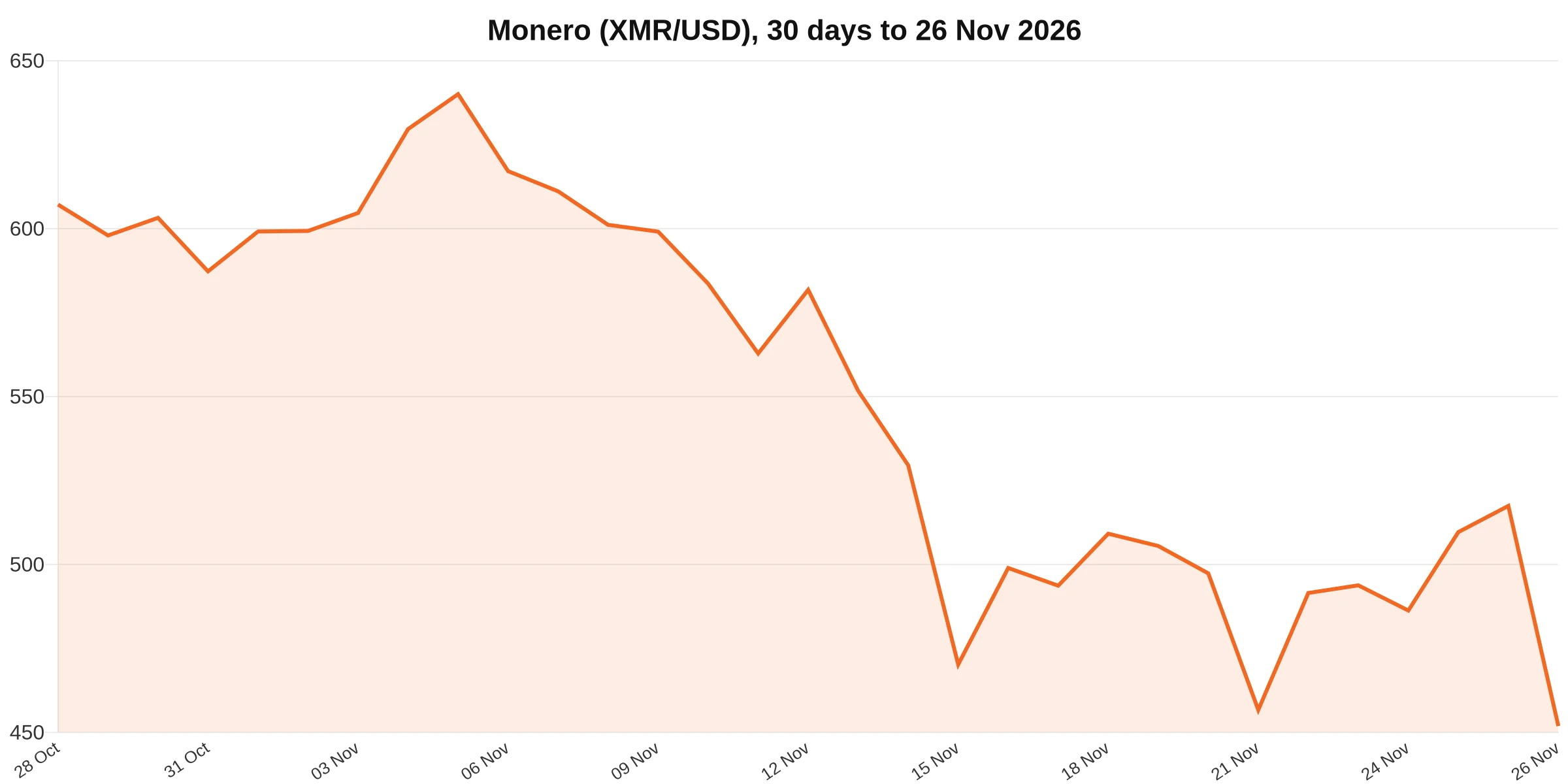
Monero changed hands at $455.45 at 00:10 UTC on 27 November, down 10.9% in 24 hours, after KuCoin published a notice that puts every XMR spot pair on a 30 November deadline. At that price the 18.84 million circulating coins are worth $8.58 billion, and the day’s move removed roughly $1.05 billion of that, measured against an implied prior price of $511.17.
The KuCoin announcement is administrative rather than explanatory: four trading pairs, a bot shutdown, an Earn product, a collateral rule and a withdrawal cutoff. It gives no reason for the decision. The price response is the sharpest single-day fall in the 30-day window, 12.0% from the 00:00 UTC open on 26 November and a little deeper than the 11.2% drop on 15 November, and it lands while bitcoin was flat over the same 24 hours.
What the notice actually commits KuCoin to
The headline instruction is unambiguous. In the exchange’s own words: “In accordance with the platform policies, KuCoin will delist Monero (XMR) at 8:00 on November 30, 2026 (UTC).”
The pairs affected are XMR/USDT, XMR/USDC, XMR/ETH and XMR/BTC, all four ending at the same minute. Open orders are removed automatically once trading stops in each pair, which means a resting limit order will not survive the deadline. KuCoin’s advice is to cancel or update spot orders before 08:00 UTC on 30 November.
The deposit clause is the part with the longest tail. “The deposit service for XMR will remain closed and will not be resumed,” the notice states. That wording describes a channel that is already shut, and it rules out the obvious workaround of topping up a balance so it can be sold into the final hours of trading.
The deadlines, in the order they arrive
Measured from 00:10 UTC on 27 November, spot trading stops in roughly 3 days and 8 hours. The withdrawal window runs 34 days and 8 hours beyond that.
| Service | Deadline (UTC) | What stops |
|---|---|---|
| Earn | 27 Nov, 12:00 | XMR Flexible Savings; principal and accrued earnings move to the funding account |
| Convert | 30 Nov, 03:00 | Monero conversions; open convert limit orders are cancelled |
| Trading Bot | 30 Nov, 06:00 | Spot Grid, AI Spot Trend, Spot Martingale, Infinity Grid, DCA, Spot Grid AI Plus, Smart Rebalance |
| Spot trading | 30 Nov, 08:00 | XMR/USDT, XMR/USDC, XMR/ETH, XMR/BTC |
| VIP Loan | 30 Nov | XMR stops counting as loan collateral |
| Withdrawal | 31 Dec, 08:00 | XMR withdrawals; KuCoin says it may close earlier for project-related reasons |
Read together, the schedule leaves a holder four days to trade and five weeks to move coins. It also means the first constraint is not the trading halt but the collateral rule, which takes effect the same day and can force a position before any withdrawal decision is made.
One venue carries most of the reported XMR volume
The size of the reaction is easier to read next to the venue’s share of liquidity. CoinGecko’s ticker table for Monero showed $164.4 million of reported 24-hour volume across stablecoin, bitcoin and ether pairs on 26 November. KuCoin’s four pairs accounted for $98.9 million of that, or 60.2%. XMR/USDT alone reported $80.2 million, close to half of the total.
The next largest venues are a fraction of the size: HTX at $22.8 million (13.8%) and Kraken at $15.0 million across its two USD pairs (9.1%), followed by Poloniex at $7.8 million and Bitfinex at $7.5 million. Venue-reported volumes are supplied by the exchanges themselves and are not audited, so the ratios are indicative rather than exact. Even with that caveat, no other single venue is within a factor of two of KuCoin’s reported XMR book.
Converted into coin, the $98.9 million of reported KuCoin volume equals roughly 217,000 XMR at the current price, or about 1.15% of circulating supply trading on a venue that stops quoting in four days. That is the pool of liquidity that has to find another home, and the reason a single notice can move an asset with an $8.6 billion market capitalisation.
The deposit clause changes the exit arithmetic
Because deposits stay closed, holders cannot move coins onto KuCoin to sell them there. Anyone with a balance already on the exchange can trade out or withdraw, but the notice’s withdrawal instruction is blunt: “If you are currently holding any such token, please withdraw them before the closing time.”
The consequence of missing that date is written into the same paragraph. KuCoin says it may convert a delisted token left in an account into stablecoins on the user’s behalf, and adds: “Such conversion is not guaranteed, and market conditions may cause the value of a delisted token to fall sharply or become worthless.” The exchange also reserves the right to close withdrawals ahead of 31 December for project-related reasons, including a stop in block generation or fund transfers.
For someone holding XMR on KuCoin, the practical order of operations is: cancel open orders, decide whether to sell into the pair or withdraw, and start the withdrawal early rather than on the last day. The 31 December date is a ceiling, not a guarantee.
Monero was already lower before the notice
The 24-hour decline extends a trend rather than starting one. XMR is down 8.4% over seven days and 25.0% over 30 days, from $640.02 on 5 November, which puts the coin 28.8% below that peak and 42.9% below its all-time high of $797.73 set on 14 January this year.
The 24-hour range covered $527.97 to $429.91, an 18.6% span from high to low. Against a flat bitcoin, XMR/BTC sits at 0.00751, so the move that requires explanation is specific to privacy coins rather than a broad altcoin rotation.
What the data supports is narrower than the headlines suggest. The notice and the drop are same-day events, and the timing is consistent with the market repricing venue access. It does not prove the delisting caused the whole move, because XMR had already lost 8.4% in the week before the notice and was 25.0% lower over the month. A second venue closing its book widens the gap between buyers and sellers; it is not the only force in the price.
Collateral and bots: the clauses few readers reach
The collateral line is the one with the shortest fuse for accounts that borrow against collateral. From 30 November, XMR is no longer accepted as margin collateral for KuCoin VIP Loans, and the notice warns: “please add other supported cryptocurrencies as collateral as soon as possible to avoid an excessively high LTV ratio, which may trigger liquidation.”
An account that borrowed against XMR therefore faces a margin call on a coin that has fallen 10.9% in a day and 28.8% from its November peak. The combination of a lower collateral value and a hard cutoff is the mechanism by which a delisting can produce selling that has nothing to do with the holder’s view of Monero.
Automated strategies hit a separate wall two hours earlier. Trading bots are removed at 06:00 UTC on 30 November, and any grid or DCA bot left running is shut down by the system rather than by its owner. Positions opened by those bots do not close themselves; they simply stop being managed.
Where XMR still trades after 30 November
Monero remains listed elsewhere, and the notice is venue-specific rather than a market-wide removal. Kraken carries two XMR pairs in the CoinGecko table, and it kept the listing after an October episode in which its co-CEO said customer KYC emails “were wrong” and confirmed XMR stays available, as BlockchainReporter reported . HTX, Bitfinex, Poloniex and WhiteBIT all still quote XMR against stablecoins.
The contrast with eleven days ago is stark. On 15 November, XMR traded at $497 and held 13% above its 200-day average, a level this publication flagged as support rather than a forecast. The coin has since lost that cushion and the venue that reported the largest share of its volume.
Zcash, the other large privacy asset, fell 11.3% over the same 24 hours. Some coverage has framed that as the next delisting candidate. KuCoin’s announcement feed on 26 November contains no ZEC notice, and a price correlation is not a listing decision. Until another exchange publishes one, the Zcash question has no documentary answer.
What to watch over the next four days is mechanical: whether XMR spreads widen on the remaining venues as market makers rebalance, whether the reported volume share shifts toward HTX and Kraken, and whether any other exchange follows with its own notice. The Monero project has not published a statement on the delisting, and the notice does not cite a compliance finding.
Frequently Asked Questions
XMR fell 10.9% to $455.45 in the 24 hours to 00:10 UTC on 27 November, hours after KuCoin published a delisting notice for all four of its XMR spot pairs. The coin was already 8.4% lower over the previous week, so the notice landed on an existing decline rather than starting one.
Spot trading in XMR/USDT, XMR/USDC, XMR/ETH and XMR/BTC ends at 08:00 UTC on 30 November 2026. Trading bots stop at 06:00 UTC the same day, the Convert product at 03:00 UTC, and XMR Flexible Savings on 27 November at 12:00 UTC.
Yes, until 08:00 UTC on 31 December 2026. KuCoin says the withdrawal service may close earlier for project-related reasons, and deposits will not be reopened, so withdrawals should be started well before the deadline.
No. The notice applies to KuCoin only. Kraken, HTX, Bitfinex, Poloniex and WhiteBIT still quote XMR pairs, and Kraken confirmed in October that it keeps the asset listed.
KuCoin says it may convert remaining delisted tokens into stablecoins on the user’s behalf. The notice states that such conversion is not guaranteed and that market conditions may leave a delisted token sharply lower or worthless.
The post Why Is Monero Down Today? XMR Falls 11% as KuCoin Ends Spot Trading on Nov. 30 appeared first on BlockchainReporter .