



Ether traded at $1,616.30 at 14:44 UTC on November 25, down 4.5% in 24 hours, 67.3% below its August 2025 record of $4,946.05 and the lowest price it has printed in 90 days. The asset that two listed treasury companies spent nine days selling to repay debt is now cheaper than the average price either of them achieved.
Bit Digital sold 29,825 ETH between November 15 and November 23 at an average of roughly $1,676, raising about $50 million to halve its Galaxy Digital borrowings. BTCS sold roughly 27,300 ETH for about $43.8 million after the November 20 sell-off, repaying Aave. Together, 57,125 ETH and $93.8 million, at a blended average of $1,642.01, which works out to 1.6% above today’s spot.
That is the case for looking at Ether now: the forced sellers of the past week exited above where the market sits, and one of them is still sitting on 134,532 ETH. It is also the warning. Leverage unwinds are mechanical. They end when the collateral math allows them to end, not when sentiment improves.
The short answer, with the numbers
Nothing below is a forecast. These are the figures a buyer is pricing at 14:40 UTC on November 25, 2026, with the distance to each asset’s all-time high and the multiple required to reclaim it.
- Ether: $1,616.30, down 4.5% over 24 hours, 67.3% below its $4,946.05 high of August 24, 2025. Reclaiming the high requires 3.06x.
- Bitcoin: $57,543, down 4.7%, 54.4% below its $126,080 high of October 6, 2025. Reclaiming the high requires 2.19x.
- Solana: $66.34, down 5.0% over 24 hours.
- Aave: $90.23, down 4.6%, 86.4% below its May 2021 high of $661.69. That is a 7.3x to the old peak.
The arithmetic a first-time buyer actually runs: $1,000 buys 0.6187 ETH at today’s price. If Ether merely revisited its 2025 record, that position would be worth $3,060. The same $1,000 in bitcoin buys 0.01738 BTC and would be worth $2,191 at the bitcoin record. Ether carries the larger drawdown and the larger recovery multiple, which is the whole of the bull case and the whole of the risk in one number.
What changed this week is not the price. It is who was selling and why.
Bit Digital sold 29,825 ETH at $1,676 to halve Galaxy debt
Bit Digital (Nasdaq: BTBT) said in a press release dated November 25, filed with the SEC as an exhibit to a Form 8-K, that it repaid $50 million of principal under its secured borrowing arrangement with Galaxy Digital LLC. The repayment cut outstanding Galaxy borrowings from $100.0 million to $50 million, a 50% reduction, and was funded entirely from ETH sales.
The sales ran between November 15 and November 23 at an average price of approximately $1,676 per ETH for net proceeds of approximately $50 million. Dividing the two figures gives $1,676.45 per token, consistent with the company’s stated average.
After the transactions, Bit Digital held approximately 134,532 ETH and ETH-equivalents as of November 23, including 36,811 ETH natively staked. Against that, the remaining $50 million of Galaxy borrowing is collateralized by 69,089 LsETH, a liquid staking receipt that the company counts inside its ETH-equivalent holdings.
Two details matter more than the headline repayment. First, the loan was never an Ether bet in isolation: the Galaxy facility funded Bit Digital’s $100 million bridge to WhiteFiber for its NC-1 data center, and WhiteFiber has since secured a $300 million project financing facility that includes a $100 million delayed-draw tranche subject to conditions. Bit Digital says it expects the bridge loan to be fully repaid during the second quarter of 2027. A $100 million bridge into a data-center build does not repay itself on the next green candle, which is why the company chose to cut secured leverage rather than wait.
Second, the sale was 18.15% of the position. Bit Digital held 164,357 ETH before the sales (134,532 retained plus 29,825 sold) and still holds 81.85% of it. This was a leverage decision, not an exit.
“We remain confident in Ethereum’s long-term role in digital finance and in WhiteFiber’s opportunity in AI infrastructure,” said Sam Tabar, Chief Executive Officer of Bit Digital. “By reducing our Galaxy borrowings, we are lowering secured leverage while retaining meaningful exposure to both assets.”
Tabar added: “We recognize that shareholders expect disciplined execution and tangible results, and our focus remains on making capital allocation decisions that balance long-term opportunity with responsible risk management.”
Run the collateral test at today’s price: 69,089 LsETH multiplied by $1,616.30 is $111.7 million of collateral against $50 million of remaining debt, a coverage ratio of 2.23x. At the $1,561 intraday low BTCS cited for November 20, the same collateral would be worth $107.8 million, or 2.16x. The position is not close to a margin event, which is precisely why the company could choose the timing of its sale rather than have it chosen for it.
BTCS took the other exit at $1,604
BTCS Inc. (Nasdaq: BTCS) disclosed its own repayment two days earlier, in a press release dated November 23 and filed as an 8-K exhibit. The trigger it names is specific: on Friday, November 20, the Nasdaq Composite fell 5.3% and the S&P 500 fell 3.7%, bitcoin traded below $60,000 for the first time since July, and ether fell approximately 12% from its intraday high to a low of approximately $1,561.
BTCS sold approximately 27,300 ETH for total proceeds of approximately $43.8 million and used the proceeds to repay $43.8 million of borrowings on the Aave protocol, leaving approximately $10.5 million outstanding at a loan-to-value ratio of approximately 32%. The implied sale price is $1,604.40 per ETH, $11.90 below today’s spot and 4.3% below Bit Digital’s average.
The balance sheet after the sales, on a preliminary and unaudited basis and using an ether price of $1,722 as of November 22: approximately 24,245 ETH, cash and digital assets with a total fair value of approximately $61.0 million, the $10.5 million Aave balance, and approximately $17.9 million aggregate principal of senior secured convertible notes maturing in May 2027 and July 2027.
At today’s $1,616.30, the 24,245 ETH are worth $39.2 million. The remaining Aave debt is 26.8% of that, comfortably inside the 32% figure the company reported on its own mark. The convert maturity schedule is the harder constraint: two notes come due inside 20 months, and the company has $61.0 million of liquid assets against them.
This is the same trade the earlier BlockchainReporter analysis of the BTCS filing identified: an 81% paydown of the Aave position in a single weekend, with the realised loss on the ether left out of the headline. The BTCS 8-K confirms the paydown, not the cost of it .
Two exits, one average: what 57,125 ETH says about the bid
Stack the two sales. 57,125 ETH, $93.8 million raised, a blended average of $1,642.01. Against today’s $1,616.30, the two treasuries collectively beat the current market by $1.5 million on the tokens they sold. Against the $1,561 low of November 20, they beat it by $4.6 million.
That is a useful but narrow observation. It does not mean the sales marked a bottom. It does mean both sellers executed into demand rather than into the worst print of the week, which is what a forced liquidation usually looks like and what this was not.
The supply math argues for restraint in the other direction. 57,125 ETH is 0.047% of Ether’s 122.25 million circulating tokens. A 0.047% supply removal, spread over eight days, cannot explain a 35.6% decline over 90 days, and it would be dishonest to present it as a bottom signal. What it can do is remove a specific kind of seller from the book: the borrower who has to sell to satisfy a lender.
Bit Digital’s remaining secured debt is $50 million against $217.4 million of ETH holdings, or 23.0%. BTCS’s is $10.5 million against $39.2 million, or 26.8%. Neither company is one candle away from a collateral call at current prices. The mechanical pressure those two balance sheets were generating has largely been discharged.
What the sales do not tell you is whether the next treasury does the same. BitMine, the largest corporate ether holder, has been the marginal buyer for most of this year, and its capacity to keep buying depends on its own financing terms. The earlier read on Ether’s $1,619 low and BitMine’s approach to 5% of supply set out why the cohort’s behaviour, not any single sale, is the variable that matters.
Aave is where one of those loans lives
BTCS repaid $43.8 million on Aave, which leaves $10.5 million outstanding on a market that settles on-chain. The repayment is a real reduction in borrow demand on that pool and a real reduction in the protocol’s interest revenue from that account. It is not a growth event for AAVE, and treating it as one would be a mistake.
The asset’s own numbers are what matter for a buyer. AAVE at $90.23 with a $1.40 billion market cap sits 86.4% below its May 2021 high of $661.69. A 10x from here is $902.30 and a $13.99 billion market cap, which is roughly where the token traded in 2021 on a much smaller DeFi loan book. The recovery multiple is the largest in this article and so is the execution risk: AAVE’s revenue depends on borrowers who, as this week showed, repay when volatility spikes.
That is the honest version of “coin to watch”. AAVE is not cheap because of a catalyst. It is cheap because the lending cycle it earns from is contracting, and this week produced two data points on how fast that contraction can run.
What would change this read
Three reference prices are worth carrying into next week. Each has a basis, and none of them is a target.
- $1,619.51 is the 90-day closing low, set on November 25 on CoinGecko daily data. A daily close beneath it would mark a lower low and put the November 20 intraday print of $1,561, cited in BTCS’s release, back in play.
- $1,722 is the ether price BTCS used to mark its balance sheet as of November 22. A move back above it would mean the market has absorbed the sales that were priced at that level, and would put the two sellers’ blended average of $1,642 back in the money.
- $1,561 is the November 20 intraday low. A break of it, with a daily close beneath, would reprice both remaining loan-to-value ratios and make a third treasury sale the base case rather than a tail risk.
The invalidation for the constructive read is simple: a close under $1,561 accompanied by another disclosed treasury repayment. That would mean the deleveraging is still in progress, and the average sale price of the next seller will be lower than $1,642, not higher.
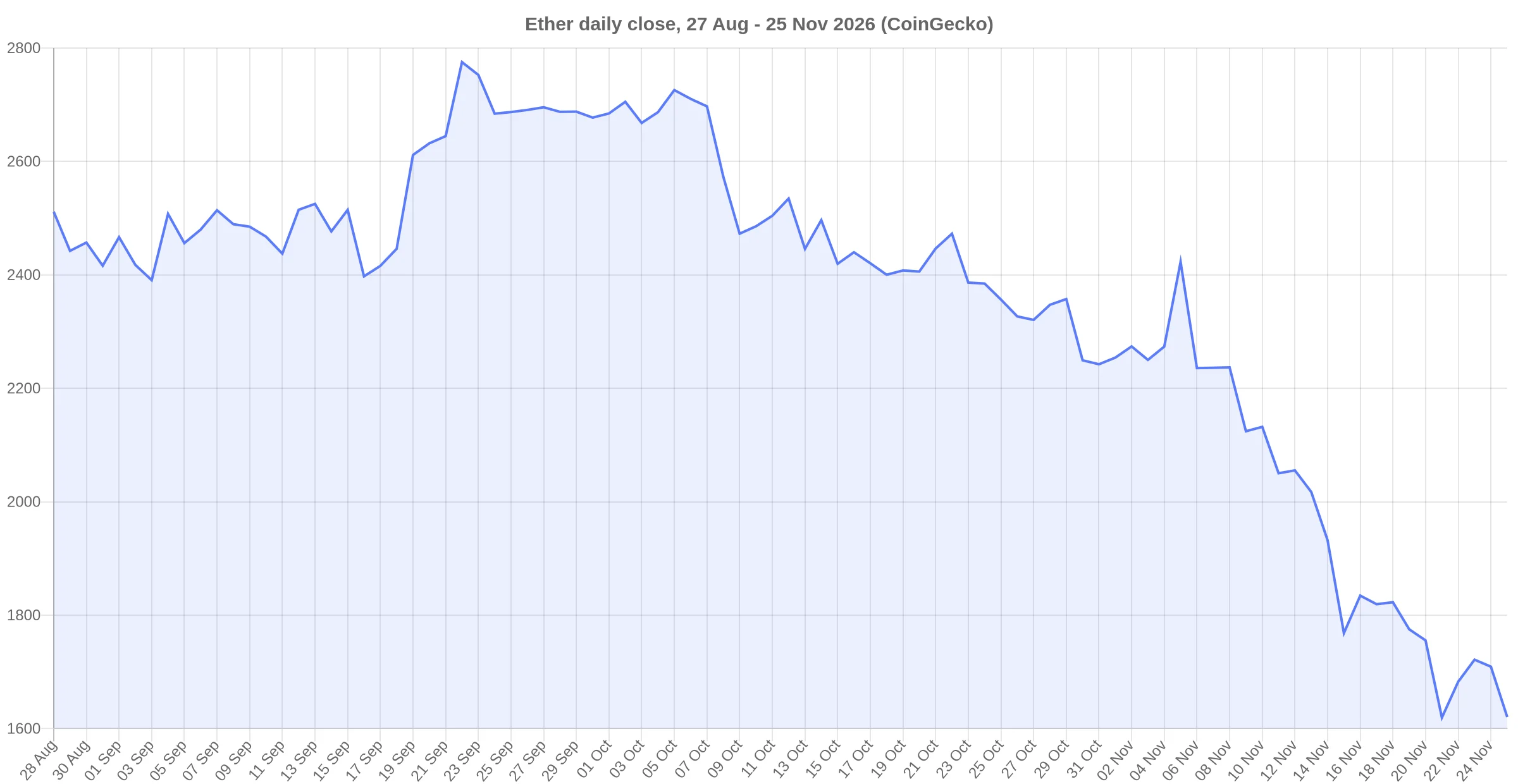
Data: CoinGecko (prices and 90-day series, 14:44 UTC), Bit Digital Form 8-K exhibit 99.1 , BTCS Form 8-K exhibit 99.1 .
Frequently Asked Questions
There is no single answer, but the inputs are measurable. Ether is 67.3% below its record and trades near a 90-day low while two large corporate holders have finished selling to reduce debt. The remaining $50 million and $10.5 million loan balances at Bit Digital and BTCS are covered 2.23x and 3.7x by their ether holdings at today’s price, so forced selling from those two names is unlikely in the near term. A close below $1,561 would change that calculation.
To repay $50 million of principal on its secured borrowing arrangement with Galaxy Digital, halving the balance from $100 million to $50 million. The facility had funded a $100 million bridge loan to WhiteFiber for its NC-1 data center, and Bit Digital says it expects that bridge to be fully repaid in the second quarter of 2027.
The evidence does not support that claim. BTCS sold after a November 20 sell-off in which the Nasdaq fell 5.3% and ether dropped about 12% intraday, and the combined 57,125 ETH sold equals 0.047% of circulating supply. The sales added sell-side pressure during a decline that was already underway; they did not start it.
Approximately 134,532 ETH and ETH-equivalents as of November 23, 2026, including 36,811 ETH natively staked. Of that total, 69,089 LsETH are pledged as collateral against the remaining $50 million Galaxy borrowing.
Bit Digital averaged about $1,676 across 29,825 ETH, and BTCS averaged $1,604.40 across roughly 27,300 ETH. Blended, the 57,125 ETH and $93.8 million of proceeds imply $1,642.01 per token, which is 1.6% above ether’s $1,616.30 spot price at 14:44 UTC on November 25.
This article is for information only and does not constitute investment advice. Prices are quoted at 14:44 UTC on November 25, 2026 and change continuously.
Not investment advice. Asset prices are volatile and can fall as fast as they rise. Read our editorial policy . Educational purposes only.
The post Best Crypto to Buy Now: Ether at a 90-Day Low as Treasury Debt Shrinks appeared first on BlockchainReporter .