




Coinkite published the full account of the COLDCARD seed-generation failure on November 24, 2026, and the document reads less like a product apology than like an accident report for an industry that rarely writes them. Its central finding is not that a random-number generator failed. It is that for 1,949 days, from March 29, 2021 until July 30, 2026, the firmware selected a different generator than the one everyone involved believed it used, and every control in place answered a question adjacent to the one that mattered.
The report, published on Coinkite’s blog , is an 18-page public incident report structured like an NTSB accident file: facts, analysis, findings, recommendations. It confirms that attackers regenerated affected private keys offline and needed no physical access to any device. It also puts a number on what those keys were worth in entropy terms, and that number is the part hardware vendors should read twice.
A Symbol That Resolved to the Wrong Generator
The mechanism is a build-integration defect, not a broken chip. In March 2021 Coinkite moved its embedded cryptographic stack onto libsecp256k1 through an internal wrapper called libNgU, a change that also removed the firmware’s remaining GPL dependency. Somewhere in that integration, the firmware configuration set MICROPY_HW_ENABLE_RNG to zero. An ineffective guard inside the pinned libNgU code accepted that configuration, and the symbol rng_get() resolved to MicroPython’s Yasmarang general-purpose software generator instead of the board-specific STM32 hardware generator.
Nothing failed at runtime. Both implementations exposed a compatible interface, the build produced well-formed seed words, and the device had no error to report. The hardware generator was present in the firmware and never reached by the seed path. Coinkite’s own summary of why five years of scrutiny missed it is blunt: “Every check Coinkite ran answered a nearby question rather than the critical one,” the report states. Release checks confirmed the hardware RNG code was present, not that seed generation entered it. Functional tests confirmed the words were well formed, which they were.
Hashing the output before use changed its form without adding entropy, which is why the report treats the defect as reachable by brute force rather than by theft of a device. The failure was a silent substitution, and silent substitutions are exactly what release gates exist to catch.
What 72 Bits Buys an Attacker
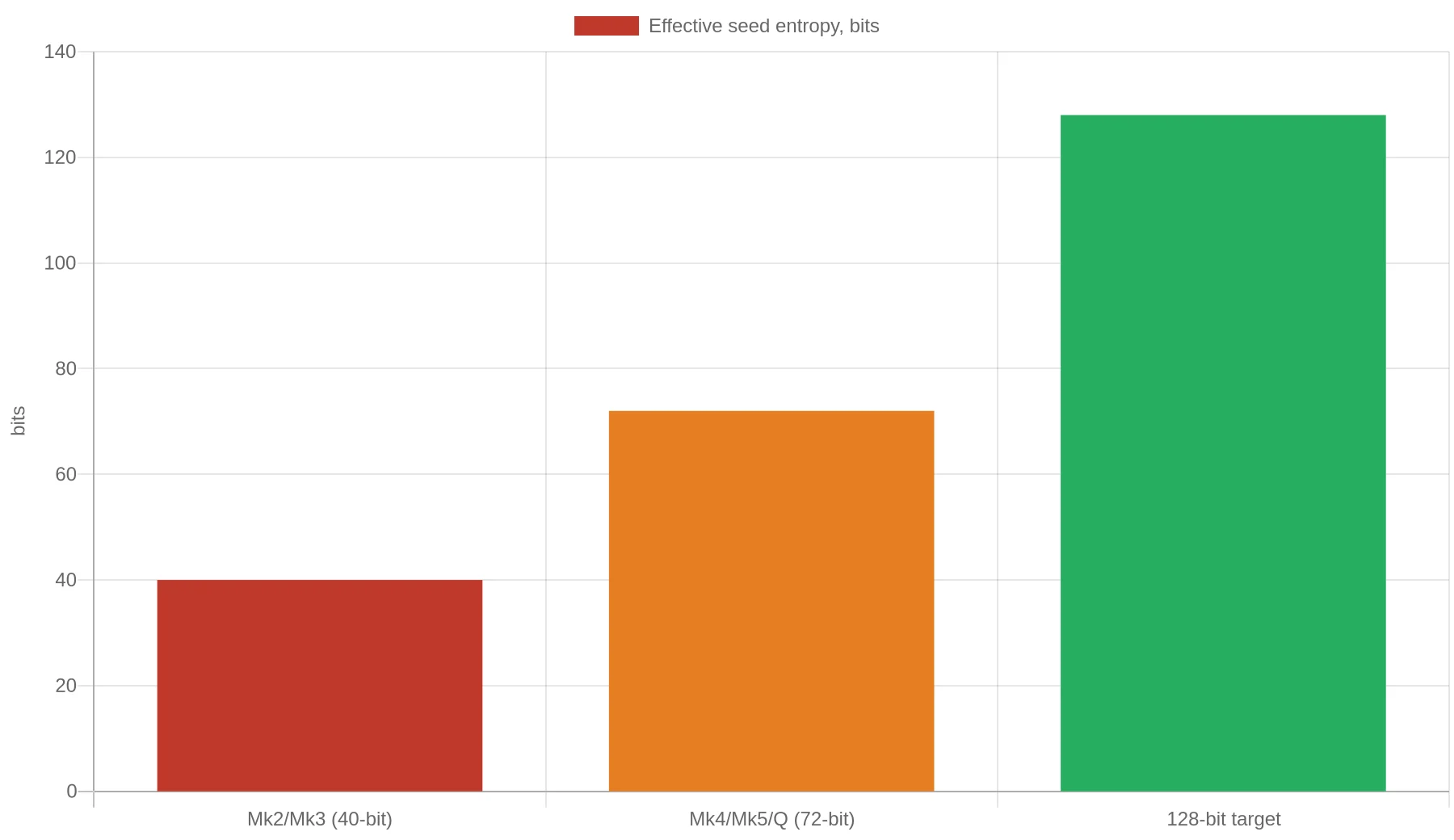
Coinkite estimates that affected seeds carried roughly 40 bits of effective entropy on Mk2 and Mk3 hardware and roughly 72 bits on Mk4, Mk5 and Q, against a 128-bit design target. Those figures are internal estimates; the report states plainly that the 72-bit number has not been independently established.
The arithmetic still explains the attack. A 72-bit seed sits 56 bits short of the target, which is a search space smaller by a factor of about 7.2 × 10 16 . The 40-bit Mk2/Mk3 case is smaller by a factor near 3.1 × 10 26 . Entropy is logarithmic, so the gap between “hard” and “feasible” is not linear, and a reduction of that size turns an offline key-regeneration campaign into an engineering task rather than a research project.
Two mitigations existed before the incident and both are documented in the report. Seeds generated with at least 50 fair, independent, private dice rolls entered through Add Dice Rolls were never weakened, because that entropy did not depend on the device generator. A strong BIP-39 passphrase or a multisig setup added a barrier the weak seed did not. Neither was the default path, and Coinkite notes it has received reports that some influencers and educators charged customers for wallet mentoring while advising single-signature setups without passphrase, dice rolls or multisig.
Fifteen Reviews in Five Years, None on the Shipping Path
Between 2021 and 2026 Coinkite documented at least 15 independent review and security-research efforts across its hardware, firmware, entropy tooling and release controls, including two commissioned third-party product reviews. That averages roughly 2.8 external reviews a year over the affected period. The source code was public throughout, with 54 contributors to the firmware repository.
Two of those efforts deserve particular attention because they went looking in roughly the right place. A review by Nick Farrow, dated June 17, 2026, expressly included weak random-number generation in its scope, concluded the path was sound, and did not identify the defect. From May 1 to June 26, 2026, security researcher Rob Hamilton ran COLDCARD firmware through the OpenAI Cybersecurity Harness, producing 85 candidate findings across security-sensitive areas, several of which led to fixes. It did not identify the integration defect.
The report is careful about why. Statistical output-health tests cannot distinguish a defective generator from a properly seeded one, because a finite sample of output does not reveal which entropy source produced it. Reproducible builds proved the binary matched the source, not that the source reached the hardware. One prior concern exists in the record: in May 2025 independent Bitcoin developer James O’Beirne raised general quality concerns about libNgU and recommended removing it. He did not identify the integration defect, and the report notes the defect was in Coinkite’s integration rather than in libNgU itself.
The lesson generalizes beyond one vendor. A review is only as strong as the path it is tied to, and none of these was tied to verifying which implementation the shipping seed-generation flow actually entered in specific signed artifacts.
242 Accounts, 328 Seed Roots, 8,865 Addresses
The loss figures are where the report is most careful, and where most coverage will be least careful. As of November 18, Coinkite had matched 300 loss-related support tickets to 242 requester accounts, which it describes as approximately 0.21% of the estimated COLDCARD user base. That ratio implies a base near 115,000 users, though Coinkite does not publish the denominator and cannot produce a complete count, because it is non-custodial and sees only what customers report.
Three other numbers measure three other things. A public Wave 1 analysis reported reconstructing 328 seed roots. Galaxy Research reported more than 8,600 attributed addresses, a figure the report dates to August 24 at 8,865, and separately reported 1,778.84 BTC stolen as of August 14. The stolen coins have not stayed still: BlockchainReporter documented in September how the third-wave exploiter moved funds through CoinJoin , a detail that matters for anyone still hoping for recovery. Dividing 8,865 addresses by 242 accounts gives roughly 36.6 addresses per reporting account, which is not a finding about victims; one seed derives many addresses, one person can hold several seeds, and reports can duplicate the same loss.
“The loss figures in 1.5 measure different populations and cannot be combined into a victim count,” the report states, adding that the true affected population is likely larger than 242 accounts because not every victim files a ticket. The per-root average works out to about 5.42 BTC if the Galaxy total were spread evenly across the 328 reconstructed roots, a comparison the report does not make and that no party should treat as a per-victim estimate.
Two Days Between Open Weights and the First Theft
The report does not attribute the thefts. It does assemble a timeline that raises a question the industry will keep asking. Kimi K3 became publicly available on July 16, 2026, and its full model weights were released on July 27. Unexpected transactions involving affected seeds began on July 29. Coinkite calls the interval short enough that AI-assisted discovery is a plausible hypothesis, and explicitly not an attribution.
The surrounding evidence shows capability, not identity. The Bitcoin Red Team campaign, which began after public disclosure, reported 7,958 candidate findings across 501 projects after 108 hours of human-guided, multi-model review, with 24.7% then carrying reproducible proofs of concept and Kimi accounting for 74% of the group’s model spending. Post-disclosure reproductions came quickly: Claude Code found the already-public defect in eight minutes, and other researchers reported hits and misses across several models. None of that establishes who found it first, and law enforcement is investigating the thefts while the Canadian Centre for Cyber Security runs a separate case.
The institutional read is uncomfortable but useful. Hardware vendors now face a permanent disclosure load generated by tools that can read a call path faster than any human review queue, and the same tools that surface defects also bury them in false positives. Coinkite’s own review process since the incident is built around that: findings are reproduced against complete call paths, rejected findings record the guard that defeats them, and fixes receive focused regression tests.
Thirteen Recommendations Closed, Two Open
Of the fifteen numbered recommendations in the report, thirteen are implemented or closed and two remain open. The implemented set goes well past correcting a single symbol. Current releases require user-supplied entropy for every newly generated seed, at least 65 physical key presses with unpredictable timing, 50 six-sided die rolls or 128 coin flips, combined with the STM32 hardware RNG and fresh entropy from both secure elements. libNgU’s general-purpose generator was replaced with SHA-256 Hash_DRBG instead of Yasmarang. A build-time check rejects a binary whose random-byte path resolves to the wrong implementation, and a boot-time check stops the device before normal operation if the running build enters the wrong path.
Independent verification exists for part of that. Keylabs reviewed the repaired seed path in source and in four signed standard-release binaries, using a pre-fix binary as a negative control, and concluded the defect is fully closed within its stated scope. Edge releases were outside that scope, and recommendation C-12, which calls for further independent reviews tied to specific release artifacts including Edge, remains open.
The other open item is money. Coinkite says it is evaluating all possible options to support customers who suffered losses, and that any program will be announced only once its scope and terms are settled. Recommendation C-15, to decide on and publish any compensation plan, is listed as open with no decision. “No report or firmware update can undo that. We are sorry,” the report states, and that sentence is about as far as the document goes toward the question every affected holder is actually asking.
What the Fix Does Not Reach
The defect shipped on five release tracks: Mk2/Mk3 from 4.0.1 through 4.1.9, Mk4/Mk5 before 5.6.0, Mk4/Mk5 Edge before 6.6.0X, Q before 1.5.0Q and Q Edge before 6.6.0QX. Fixed firmware exists for all of them, and none of it helps a seed that already exists. BlockchainReporter reported in August that Coinkite was already warning the patch was not a cure , and the postmortem confirms that reading. A seed generated on affected firmware remains affected after being restored, imported, backed up or moved, and the required remedy is a new seed plus migration, including for passphrase wallets. The security status page carries the current release list, and the full report as a PDF carries the sections Coinkite tells owners to read first.
One nearby event sharpens the supply-chain point. On October 13, 2026, Ledger reported an unauthorized hardware implant in a device sold through an authorized reseller that read recovery words from the display path and transmitted them over LTE, leaving the secure element and operating system unchanged. That incident is unrelated to COLDCARD’s firmware defect, but the two share a lesson Coinkite states directly: no signature, secure element or tamper-evident package proves the integrity of an entire device and distribution chain on its own.
For self-custody, the practical conclusion is narrower than the headlines suggest and harder to sell. The part of the stack that failed was not cryptography but configuration, and the controls that would have caught it are the same controls custodians already demand of each other: path-level verification tied to signed artifacts, independent review scoped to the exact binary that ships, and a public record that states what was tested and what was not. Coinkite has now published that record for one incident, 116 days after the fix. Two items on its own list are still open, and the second one is compensation.
This article is for informational purposes only and is not financial or investment advice. Verify firmware and migration guidance on the vendor’s own security status page before acting.
The post Coinkite’s COLDCARD Postmortem: 1,949 Days, One Missing Check appeared first on BlockchainReporter .