




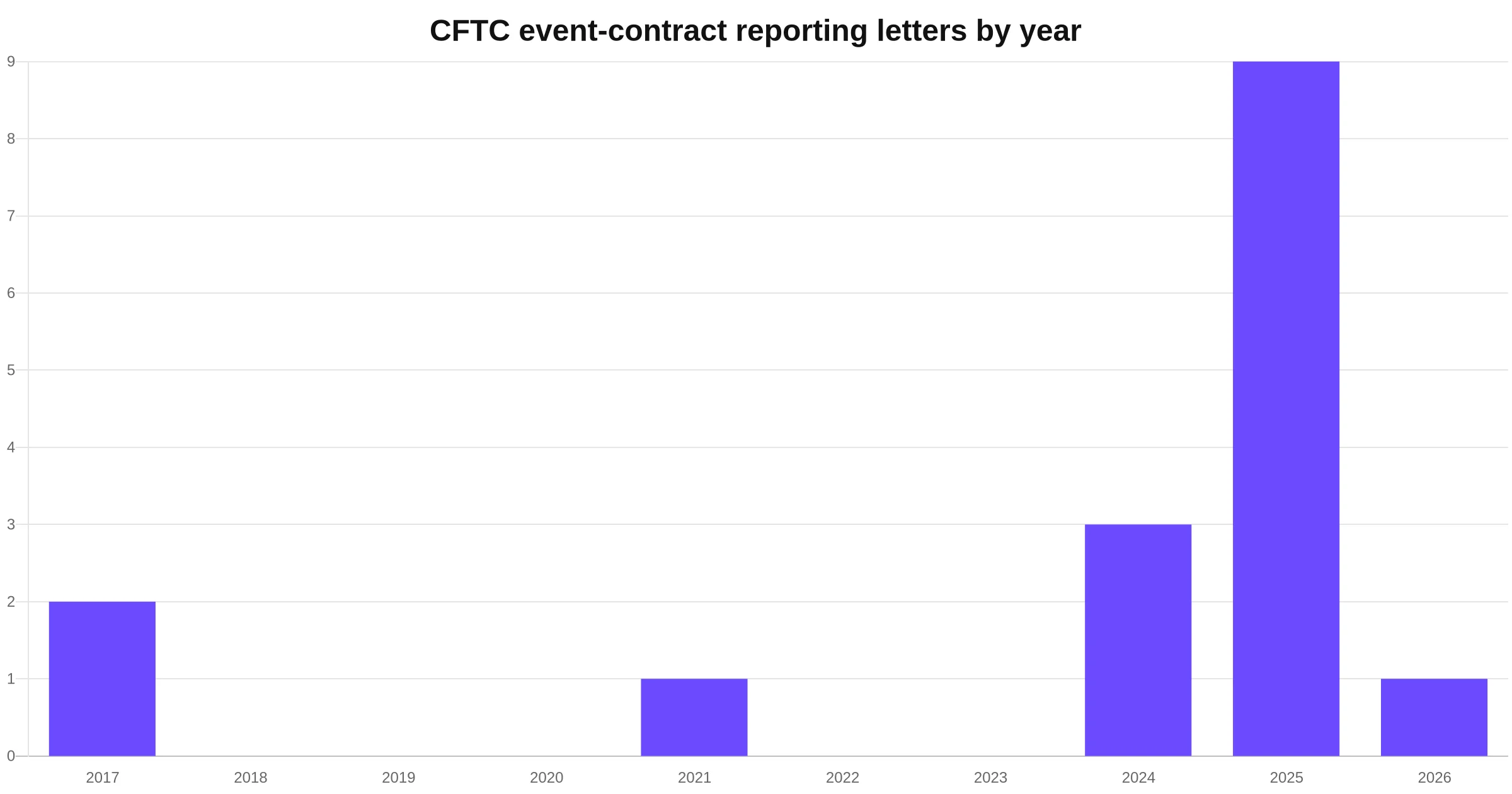
The Commodity Futures Trading Commission counted 17 staff no-action letters when it wrote the rule that replaces them. Its footnote dates 16 of them between June 30, 2017 and May 1, 2026, and separately cites a May 13, 2026 letter that streamlined how staff grants such positions.
The final rule approved on Nov. 23, 2026 swaps that paperwork for a new Part 16 section, § 16.03, covering fully collateralized event contracts. It also sets three compliance clocks that do not all start on the same day, and one of them cannot begin before July 26, 2027.
For anyone trading crypto-price or macro-outcome contracts on a US derivatives venue, the practical result is a two-stage change. Price and transaction reporting arrives first, roughly two months after the Federal Register prints the text. Large-trader reporting, trader identification and position limits arrive later, on a calendar the Commission has capped at 2027.
What the Rule Replaces: Sixteen Dated Letters
The letters were not one policy. They were a sequence of carve-outs granted case by case to designated contract markets that wanted to list small, fully collateralized outcome contracts without reporting them to a swap data repository.
The footnote that documents them lists Number 17-31 and 17-32 (both June 30, 2017), 21-11 (April 22, 2021), 24-09 (July 12, 2024), 24-12 (September 3, 2024), 24-15 (October 4, 2024), 25-02 (January 31, 2025), 25-23 (July 22, 2025), 25-26 (August 7, 2025), 25-28 (September 3, 2025), 25-35 (September 30, 2025), 25-44, 25-45, 25-47 and 25-48 (all December 11, 2025), and 26-12 (May 1, 2026).
The rule’s own preamble also records the conditions attached to those positions: the contracts must be fully collateralized as defined in § 39.2, must be cleared, and must be published by the exchange with trade timestamps, contract name, quantity and price in US dollars promptly after execution. Requesters also had to supply the transactional data described in § 16.02 and keep records open to the CFTC, the Department of Justice and the Securities and Exchange Commission.
Those conditions explain the scope. The Commission writes that the contracts subject to the letters are limited to contracts that “look and trade similarly to the historical HedgeStreet Contracts addressed in the Commission’s 2006 Market and Large Trader Reporting rulemaking.” HedgeStreet, the first designated contract market dedicated to trading event contracts, listed markets on mergers, weather and economic indicators, and renamed itself the North American Derivatives Exchange in June 2009.
Nothing in that history was written for a venue listing a hundred short-dated crypto price buckets. That gap is what the rule now tries to close, without defining the product itself. The Commission states plainly that § 16.03(a) “is not intended to and should not be construed to define ‘event contract’ for any other purpose.”
Four Prongs Decide Whether a Contract Is Covered
Coverage turns on structure, not marketing. A contract falls inside § 16.03 only if it satisfies all four prongs below, and each prong carries a consequence for crypto venues that list outcome markets.
| Prong | Requirement | What it excludes |
| One | A swap under CEA § 1a(47)(A)(i) or (ii) | Contracts that are options on futures, or instruments under SEC jurisdiction |
| Two | Listed on a designated contract market and cleared through a derivatives clearing organization | Offshore venues and foreign boards of trade |
| Three | A fully collateralized position, per § 39.2 | Margined or partially collateralized contracts |
| Four | Binary or variable payout at settlement | Contracts paying both sides on a settlement price spread |
The first prong is the narrowest part of the design. The Commission chose prongs (i) and (ii) of the statutory swap definition so that contracts already reported to a swap data repository, including those under prong (iii), keep reporting there. Event contracts that are swaps only under prong (iv) remain swaps in law but stay outside this reporting regime.
Where a contract is covered, the reporting duty shifts to four types of registrant: the reporting market, futures commission merchants, clearing members and foreign brokers. They report under Parts 15 through 18 instead of the swap-data rules in Parts 38, 39, 43 and 45. For a clearing member already running Part 17 large-trader files for futures, that is familiar plumbing. For a retail-heavy prediction market, it is new infrastructure.
The Threshold Jumps From 25 Contracts to 125,000
The rule amends § 15.03(b) to add a reporting level of 125,000 contracts for “Event Contracts (1 USD),” or the equivalent notional value where the contract size differs. It also deletes the old “Hedge Street Products” level, which the Commission says no exchange still uses.
Until now, event contracts fell under the default level for other commodities: 25 contracts. At a $1 payout, that meant a position worth $25 could require a large-trader report. The new level moves the trigger to $125,000 of notional on the same contract, a threshold 5,000 times higher.
The Commission gives the reasoning directly. It says it is impractical to set a common level capturing 70 to 90 percent of open interest because of “significant retail participation” and low contract size, and that such a level “could capture retail traders that will not typically be considered large traders.” It also repeats an older observation: “Since the default contract reporting level is strict and set at 25, its application to some newly listed contracts is (on occasion) inefficient from a regulatory surveillance perspective.”
The trade is visible in that sentence. The agency gives up granularity on small retail positions and gains a filing population it can actually surveil. Whether that leaves a blind spot in markets where a single wallet can hold a six-figure position across dozens of contracts is a question the rule does not answer.
Three Clocks, and the Floor Under July 26, 2027
The compliance schedule is where the rule’s structure becomes a calendar problem. Different obligations start at different times, and the longest runs a full year past publication.
| Provision | What it governs | Compliance date |
| § 16.03(a), (b)(2), (b)(3), (f) | Covered-contract definition, market and transaction data, real-time public dissemination | 60 days after Federal Register publication |
| § 16.03(b)(1), (c), (d), (e) | Large-trader reporting, reports by traders, reporting levels, reportable trading volume | Later of 60 days after publication or July 26, 2027 |
| § 16.03(g) | Collection of trader-identifying information by the exchange | 12 months after publication |
The middle row carries a floor, not a deadline. If the Federal Register prints the rule in December 2026, the 60-day date lands in February 2027 and July 26, 2027 governs. If publication slips to mid-2027, the 60-day date only becomes operative after the floor has already passed.
The last row is the one that stretches furthest. Twelve months after publication puts exchange-level identity collection in late 2027 or early 2028 depending on the print date, while the reporting levels for the same contracts must be live by July 2027 at the earliest. A market can therefore be filing trader-level data to the Commission before its own onboarding forms collect the identity fields the rule requires.
For a group already moving through the Commission’s clearing gates, the sequencing matters. Binance.US’s perpetuals application reached materially complete status with clearing still pending, and its own filing pointed to March 2027 for the operational build. That is the same window in which the second clock here stops being theoretical.
What a Retail Trader Hands Over, and For How Long
Section 16.03(g) is the part retail users will feel. It requires the exchange listing a covered contract to obtain, for each trader, a name, physical address, email address, phone number, occupation and employer. Where another person guarantees the account or holds a financial interest of 10 percent or more in the trader or the account, the exchange must also obtain that person’s name.
The retention period is longer than most traders would guess. The exchange must maintain the data throughout the life of the contract and for at least five years after the contract’s final termination. Public price data has a shorter life: § 16.03(f) requires real-time dissemination and public availability for at least one year, and the Commission declined to mandate a file format so exchanges can keep their current systems.
Read together, the two provisions create an asymmetry worth stating plainly. The market’s prices must stay public for a year. The identity of the person who traded them can be held for five years after the contract dies. The Commission says the collection exists to supply information it would not otherwise receive under Part 17 or § 16.02, which is accurate: § 16.02 requires trade and supporting data but not trader identity from the exchange.
Occupation and employer are the fields most likely to surprise users of crypto-native venues, where onboarding has historically stopped at name, date of birth and a proof of address. Exchanges have twelve months from publication to change those flows, and the Division of Data guidebook sets the content, timing and format for what gets submitted.
Where Digital-Asset Swaps Fall
The rule does not use the phrase digital assets to describe the products it covers, but the question came up in comments and the answer is instructive. One commenter argued that § 16.03(a) leaves out fully collateralized swap contracts with binary or bounded outcomes that are economically similar to event contracts but legally distinct, citing a subset of “binary and bounded swaps referencing digital assets, economic indicators, and financial outcomes” addressed in CFTC Letter No. 26-01.
The Commission’s response is that the definition is clear enough. Whether a digital-asset-referencing contract is a covered event contract depends on the four prongs, not on what the venue calls it. It notes that the CEA never defines “event contract” and that contracts marketed under other names can still fall inside § 16.03 if they meet the test.
The same day, a separate staff advisory addressed a different question: whether swap execution facilities, designated contract markets and clearing organizations can count bitcoin, ether and payment stablecoins toward the financial resources covering at least 12 months of operating costs. That advisory applies haircuts and explicitly states it creates no rules, no enforceable rights and no no-action position. It is context for how the agency is treating crypto collateral, not part of the reporting rule.
The State Fight Is Untouched
Nothing in the final rule decides whether an event contract is a lawful product in a given state. That dispute is being litigated, not drafted. The CFTC has sued multiple states to defend its exclusive jurisdiction, and the reporting framework applies to federally regulated venues regardless of how those cases resolve.
The Louisiana action is the clearest example: a state court order against dozens of firms, a federal agency arguing the order cannot stand, and no ruling yet on which regulator controls the market. A reporting rule does not answer that question, and the Commission does not claim it does.
The rule also declines to extend the regime to foreign boards of trade, which matters for offshore venues that list similar contracts for non-US users. The Commission writes that it “declines, at this time, to extend the alternative reporting regime to FBOTs absent further consideration.”
Two limits should be stated before the calendar is treated as fixed. The rule text still carries the placeholder “[INSERT DATE 60 DAYS AFTER DATE OF PUBLICATION IN THE FEDERAL REGISTER]” and is marked as approved subject to pre-publication technical corrections, so neither the Federal Register date nor the final wording is settled. The guidebook is issued under delegated authority and can be revised by staff.
The first real signal is the Federal Register print date, because all three clocks hang off it. The second is whether exchanges file the § 16.02 account reference data the guidebook specifies before the July 26, 2027 floor. The third is the data itself: once large-trader reports start arriving, the Commission will know for the first time how concentrated these markets are, and the 125,000-contract level can be tested against what the filings show.
Disclosure: This article does not represent investment advice. The content and materials featured on this page are for educational purposes only.
The post The CFTC’s Event-Contract Rule Replaces 17 Letters. Most Reporting Starts in 2027 appeared first on BlockchainReporter .