



The European Commission’s 22nd sanctions package against Russia extends the EU’s transaction ban to “some 60 Russian banks” and says all 60 will be removed from the SWIFT system, President Ursula von der Leyen said in Strasbourg on 23 November 2026. The same passage commits the bloc to “cracking down on the crypto and payment networks” and to reaching beyond Russia to third countries that help it evade sanctions.
The statement the Commission published with the announcement carries no annex, no entity list and no article numbers, and it names neither a crypto platform nor a country. The one institutional detail attached to the crypto section is that a Crypto Sanctions Task Force will support the work; the Commission announced that body on 6 November without a published mandate, budget or start date.
Ninety-three words cover banks, crypto and the task force
Read the statement as a dataset and the shape is clear. The full text runs to 466 words. The financial-services passage, from “First, on financial services” to “support this work,” runs to 93 words, or 20% of the whole. The word crypto appears twice in those 466 words, once in an eleven-word sentence and once in the name of the task force.
The eleven-word sentence is the policy: “And we are cracking down on the crypto and payment networks.” It sits between the bank measure and the geographic one, and it carries no measure specific to exchanges, custodians, stablecoin issuers or wallet providers.
The geographic sentence is where the operational weight sits: “We will focus on Russia but also include third countries that help Russia to evade our sanctions.” Von der Leyen called that “a major focus of our new package” and linked it to alignment with international partners, which is the function she assigned to the task force.
The rest of the statement is energy, visas, board seats and sport. None of that is filler, but none of it tells an exchange compliance team what to change on 24 November.
July’s package is the baseline the new one has to beat
The comparison is the 21st package, which EU member states adopted on 23 July 2026, 123 days before this one. The Commission’s release for that package is a different kind of document: a list of measures with numbers attached.
It added 218 listings, 48 individuals and 170 entities, which the Commission called the highest number since the war began. Entities were 78% of that batch. It listed 94 banks and major financial institutions, brought the total number of Russian banks under a transaction ban to more than 100, and attached a prohibition on the use of financial messaging services to that ban. It added four designations tied to the A7 cross-border payment network, including its new links to Africa, and put the cumulative count of individual listings close to 3,000.
On crypto, the July package did four things. It created “a dedicated third-country ban for crypto-asset services,” which the Commission described as a deterrent against countries that host platforms facilitating circumvention. It imposed transaction bans on “additional third-country crypto platforms and crypto-linked firms.” It extended the prohibition on Russian nationals owning, controlling or serving on the boards of any company offering crypto-asset services. And it mirrored the board prohibition in the Belarus regime.
High Representative Kaja Kallas summarised that round as hitting “over a hundred banks and crypto operators.” The November statement, by contrast, gives a bank count and a task force but no crypto count.
Where the EU has already reached outside Russia
The third-country language is not new machinery. The July package added 51 entities to the anti-circumvention list, and 27 of them were outside Russia: 14 in China, including four in Hong Kong, four in Türkiye, three in Kyrgyzstan, two in India, two in Kazakhstan and two in the United Arab Emirates. The remaining 24 were Russian. That works out to 53% of the batch sitting in third countries, with 18 of those 27, or two-thirds, in China and Türkiye alone.
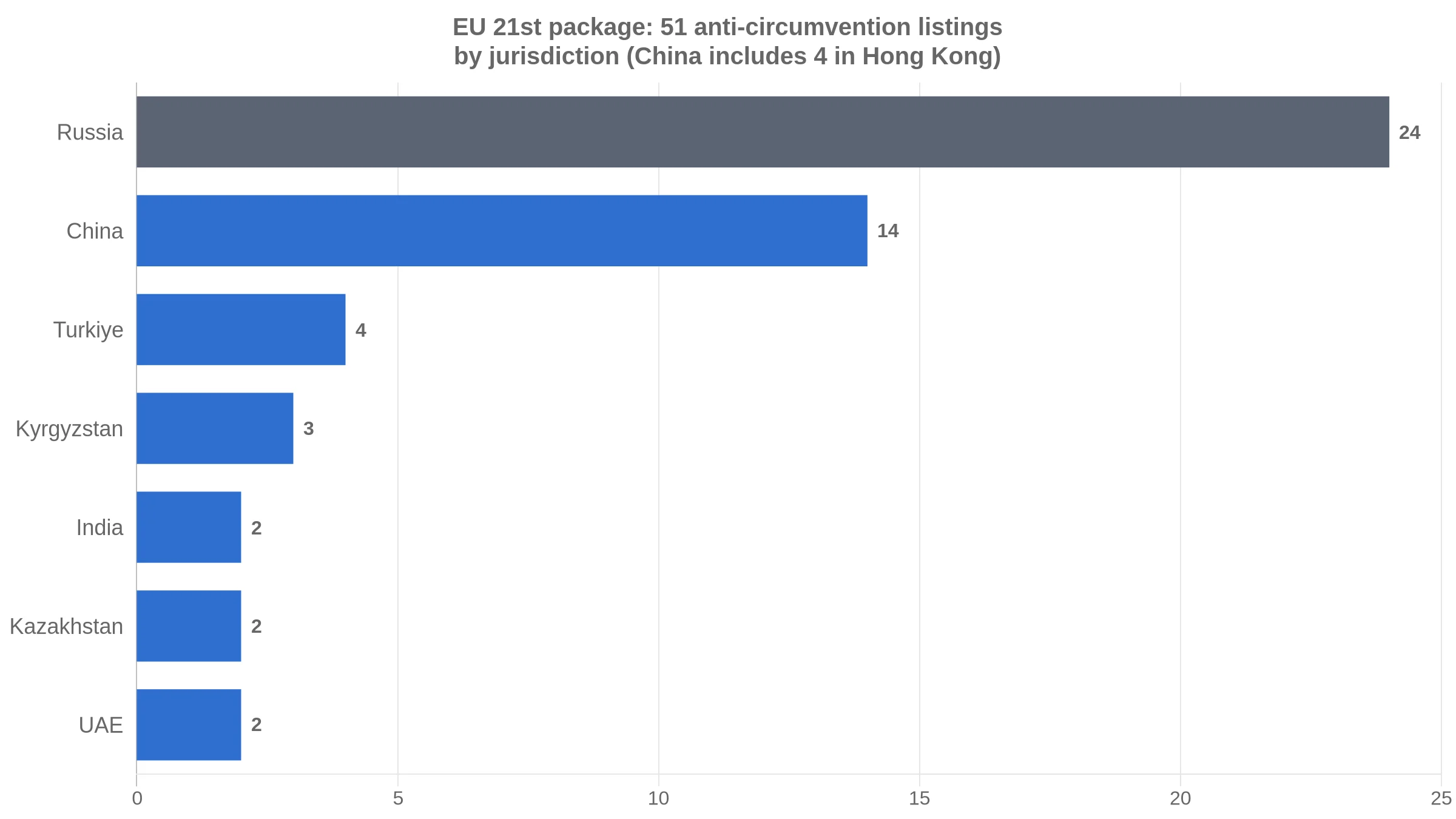
Those are trade and financial entities, not crypto platforms, but they show how the EU applies pressure outside its jurisdiction: named legal persons, published in an annex, with EU operators barred from transacting with them. A country-level crypto ban would work one level up, at the jurisdiction rather than the company, and would be far harder to reverse once applied.
Sixty banks against a stock of a hundred
The bank number is the package’s clearest escalation. More than 100 Russian banks were already under a transaction ban after July. If the 60 in the new package are additions rather than a re-scoping of existing listings, coverage rises by about 60% to more than 160 institutions. The Commission has not said which reading applies, and the statement does not distinguish between asset-freeze listings and transaction bans.
The SWIFT line needs the same care. July’s measure was framed as a prohibition on the use of financial messaging services, which binds EU operators rather than the messaging network itself. The November statement describes the result from the other end, saying the 60 banks “will be removed from the SWIFT system.” Both describe the same pressure point, but only one of them is a legal instrument.
For crypto businesses the bank measure is not background. Exchange accounts, over-the-counter desks and payment processors settle through banks, and a Russian bank under a transaction ban cannot be used by an EU operator to move money for a client, whether the client is buying bitcoin or paying a supplier.
Why the third-country clause matters more than the platform clause
Russian crypto flows do not need SWIFT. That is the reason the EU built the country-level tool in July and the reason the November statement puts third countries at the centre of its crypto paragraph. Listing individual platforms has produced a moving target: the Commission can name firms faster than those firms can be replaced, but a jurisdiction-level ban changes the cost of hosting them.
What the statement does not do is name a candidate. Neither of the two Commission documents cited here identifies a country under the mechanism, and the statement does not say which jurisdictions the Commission is examining, what evidence it would need, or how much notice platforms would get before a listing took effect. Those are the details that determine whether the tool functions as a deterrent or as a headline.
There is also a sequencing problem. A country-level ban would need a Council decision, and the Commission’s statement does not put a date on when the first designation will be proposed. Until one exists, the practical obligation on an EU platform is unchanged: screen counterparties against the July entity list, check ownership and board exposure for Russian nationals, and keep records that survive an audit.
What is still undecided
Four things will decide how much of this lands. The first is the Council: the package is a proposal, and member states have not adopted it. The second is the annex, which will say whether the 60 banks are new names and whether any crypto platform is listed. The third is the third-country mechanism, which has existed since July without a named jurisdiction. The fourth is the task force, which currently has a sentence of announcement and no published operating mandate.
BR’s coverage of the July package treated the third-country crypto ban as its headline measure. Four months later neither Commission document names a jurisdiction under the mechanism, and the November statement moves the focus onto it without supplying the names that would make it operational.
The post EU’s 22nd Russia Sanctions Package Extends Bank Bans and Turns to Crypto Abroad appeared first on BlockchainReporter .