




The Securities and Exchange Commission unsealed a 39-page complaint on Nov. 20 against an Indianapolis fund manager, its two founders and a man who the agency says supplied them with fake audit reports, alleging a Ponzi scheme that took in more than $560 million from at least 2,000 investors while most of the money went back out to earlier investors or to the founders themselves.
The complaint was filed on Nov. 17 in the U.S. District Court for the Southern District of Indiana and unsealed three days later, together with a temporary restraining order, an asset freeze and expedited discovery. It names Backward Hat Capital Management LLC, TPC MC LLC (which does business as Traders Point Capital), Phillip P. Williams, Devin A. Johnson and Joseph Anderson. The SEC’s announcement describes the alleged fraud as ongoing from about July 2022 through the present.
The headline number in the filing is a share, not a total. The SEC says more than $470 million, which it puts at over 83% of the money raised during the relevant period, went to Ponzi-like payments to previous investors (more than $250 million) or to the founders and their entities (more than $220 million). A further $50 million went to general partners and promoters. The agency’s own arithmetic leaves roughly 7% of the $560 million unaccounted for in those three buckets, which is the part that could plausibly have been used for the trading investors were sold.
What the court froze and who is named
The U.S. District Court for the Southern District of Indiana entered the restraining order on Wednesday, Nov. 18, two days before the SEC’s press release. The CFTC’s parallel release says the same court appointed Kevin B. Duff as temporary receiver for the company defendants, certain relief defendants and the individual defendants’ assets. The FBI arrested Williams and Johnson the same day, and the U.S. Attorney’s Office for the Southern District of New York has filed criminal charges against both, according to the CFTC.
The SEC complaint charges the corporate defendants, Williams, Johnson and Anderson with violations of the antifraud provisions of the Securities Act of 1933 and the Securities Exchange Act of 1934. Williams and Traders Point Capital face additional counts under Sections 206(1) and (2) of the Investment Advisers Act of 1940, which matters because part of the money came from Williams’s own advisory clients at a former employer. The full complaint also lists nine relief defendants: Backward Hat Capital Fund LP, BHC V LLC, KMAP Inc., Allen Johnson Group LLC, William Harvey Group LLC, Traders Point Capital FX Fund I LP, TPC FX AMF LP, Droplight LLC and William Cody Harvey.
The SEC seeks permanent injunctions, disgorgement with prejudgment interest and civil penalties. None of that has been adjudicated. The filing is a set of allegations, and no defendant has answered it in the record unsealed on Friday.
The 83% breaks into three buckets
Read as an accounting exercise, the complaint’s own figures are unusually specific, which makes the flow easy to reconstruct. Of the $560 million raised, $250 million went out as payments to earlier investors, $220 million went to the founders or their entities, and $50 million went to the partners and promoters who brought money in. Those three lines sum to $520 million, or 92.9% of the raise. The residual is about $40 million, or 7.1%.
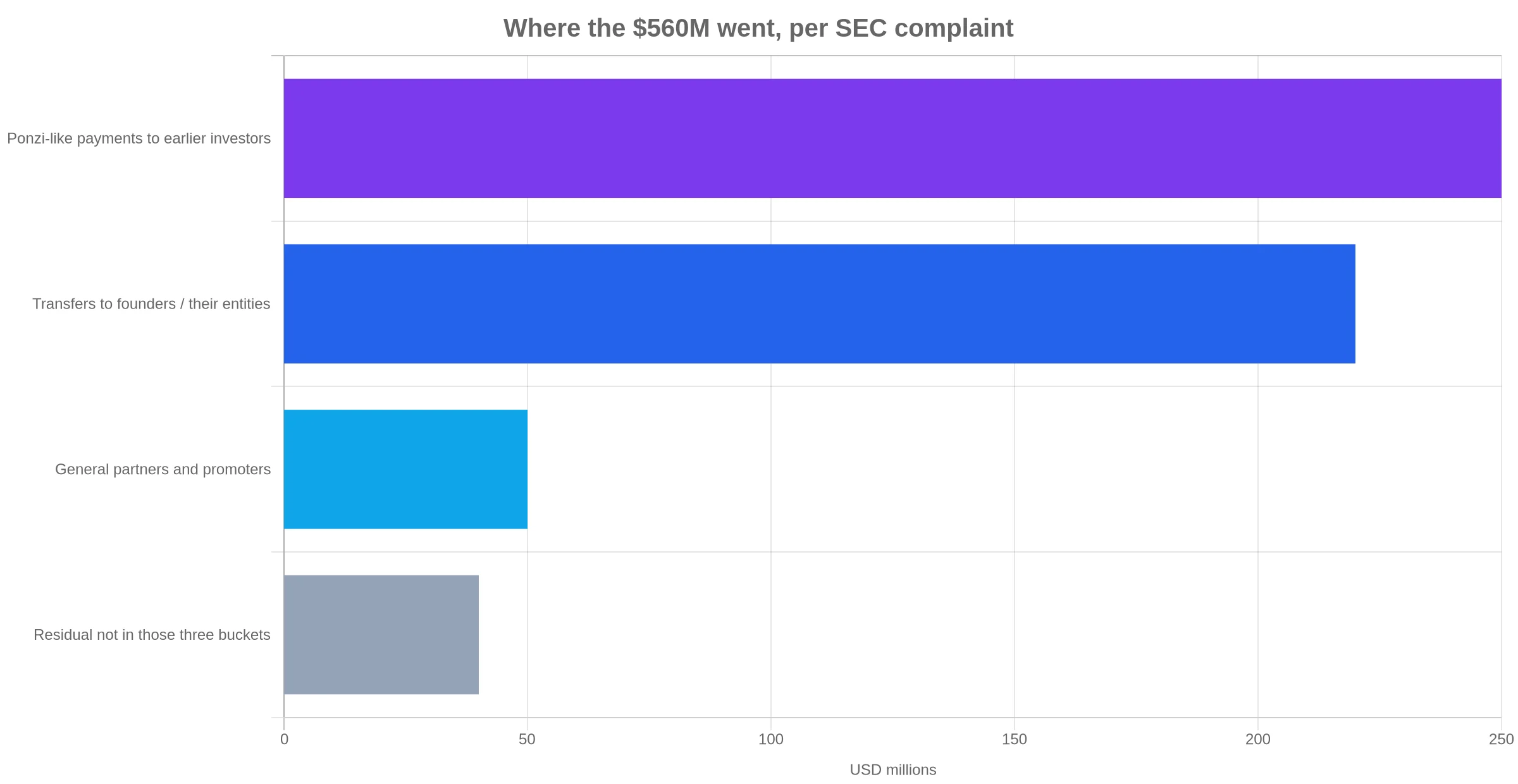
That residual is the number to hold on to. If the SEC’s figures are right, the enterprise that told investors it ran high-frequency FX arbitrage with a proprietary algorithm had at most about 7 cents of every dollar left over for the activity it described. The agency goes further in the body of the complaint, alleging that the funds “engaged in little to no FX trading” and that “little to no money or crypto assets were used to trade FX.”
Williams and Johnson did not split the founder bucket evenly, according to the complaint. It says Williams “misappropriated more than $147 million” and that Johnson “misappropriated over $45 million of investor funds.” Those two figures total $192 million, about $28 million short of the $220 million the SEC attributes to founders and their entities, a gap the complaint fills with transfers to entities rather than to the two men personally.
The crypto step that never reached a trading desk
The crypto angle is not decoration in this case. Investors were told their money would be converted into a crypto asset as the intermediary step before FX trading, and the complaint follows that conversion with bank and exchange records. From July 2022 to September 2025, about $109 million of the more than $210 million raised was sent to Backward Hat Fund’s Coinbase account and converted to crypto assets.
Of that $109 million, more than $56 million went to the personal crypto accounts of Williams, Johnson and relief defendant Harvey, and about $18 million was converted back to dollars and returned to Backward Hat Capital’s corporate bank account. A further $40 million ended up at three platforms where some of it was used to buy and sell other crypto assets. Those three figures add to about $114 million against a stated $109 million, a discrepancy the filing absorbs with “approximately” and “more than” qualifiers; the categories may overlap, and the complaint does not say they do not.
The second period is the more damaging detail for the sales pitch. From October 2025 to Oct. 9, 2026, the scheme raised roughly $350 million, and the complaint states that “no investor funds whatsoever were transferred from Backward Hat accounts to Coinbase for conversion to crypto assets.” In other words, the crypto step that investors were told preceded trading stopped happening entirely while the fund kept raising at a faster rate than in the first three years.
Johnson’s own written sales language is quoted in the filing. In a Feb. 24, 2026 email to an existing investor, he described a strategy running “successfully for five years with consistent returns” and wrote: “We do not put all assets at risk; only a controlled percentage is in active trades.” The complaint calls that description false and says the funds were “primarily being misappropriated by the principals.”
The audit reports came from a firm that did not audit
Anderson’s alleged role explains why the fraud survived investor due diligence. The complaint says he drafted at least two “audit reports” and a “quality of earnings” document attributed to the audit division of the Institute for Process Excellence, known as IpX, where he was president and chief executive for much of the period. The documents told investors that returns had been confirmed and verified against bank and brokerage records.
In reality, the SEC alleges, IpX “does not perform financial audit work,” had no audit division, and was not independent. Anderson had a financial interest in the funds and received about $2.5 million of investor money through relief defendant KMAP, according to the complaint. That $2.5 million is roughly 0.4% of the total raise, a small line that carried a large share of the credibility.
What 6% a month compounds to
The promise itself is the tell, and it is worth running the arithmetic the complaint does not. At 6% a month compounded, $1 grows to $2.01 in a year, a gain of 101.2%. Over 40 months, roughly the period from July 2022 to November 2026, the same dollar becomes $10.29. If every dollar of the $560 million had stayed invested and compounded at the promised rate for four years, with no investor withdrawing anything, the book value would exceed $5.7 billion.
Per investor, the average is $280,000 across the 2,000 people the SEC cites, and 6% a month on that average account is $16,800 of promised income every month. For comparison, the CFTC’s version of the same scheme cites more than $550 million from at least 2,100 participants, an average of about $262,000. The two regulators are describing one enterprise with slightly different bases and slightly different totals, and both figures are floors rather than counts.
Investor money also carried a promoter layer. The complaint says general partners and promoters received more than $50 million, paid partly as a share of the 20% performance fee on capital they raised, which gives the sales network a reason to keep recruiting while the fund’s real returns were negative.
CFTC and the criminal case
The CFTC’s complaint , filed in the same court on Nov. 20, names 11 company defendants operating as what it calls the Backward Hat Common Enterprise: Backward Hat Capital Fund LP, BH Capital Fund I LP, BH Capital Fund III LP, BH Capital Fund IV LP, BHC V LLC, BH Capital Fund VI LP, BH Capital Fund IX LP, Backward Hat Group LLC, BH Capital Fund X LP, BH Capital Fund IX – 2 LP and Backward Hat Capital Management LLC. It charges Williams and Johnson individually, names four relief defendants, and says the defendants “touted historical returns exceeding 6% monthly without a single losing month.”
“This action reflects the CFTC’s continuing commitment to policing fraud, including ongoing schemes, and securing assets for victims,” said David I. Miller, the agency’s director of enforcement. The CFTC is seeking restitution, disgorgement, civil monetary penalties, trading and registration bans and a permanent injunction. Its complaint says the defendants kept soliciting money through at least October 2026. Forex fraud cases of this shape are not new to the agency’s docket, which is why the Cash FX Group case from September, a claimed $950 million forex scheme, reads like a template.
The SEC complaint adds a fund-level detail the CFTC action leaves out. It says Traders Point Capital raised at least $5.5 million in October 2026 and amended one offering on Oct. 9, 2026 to a $300 million raise, with $4,482,000 sold as of that date. Eight other Traders Point funds were created in October 2026, which is the newest vintage of money in the scheme and the one a receiver will have to trace first.
The SEC’s enforcement staff framed the case as a warning about return promises. “The promise of a low-risk, high rate of return on a purportedly complex investment should make all potential investors stop and think before investing their money,” said Anne McKinley, acting associate director for the SEC’s Chicago Regional Office.
What the filings do not establish
Several things that will decide the outcome are not in either release. Neither agency states how much money remains for investors, and the receiver’s appointment is the first step in finding out; the complaint asks for disgorgement but does not quantify what can be recovered. The criminal case in New York is described only in passing, and no charging document from the U.S. Attorney’s Office is cited in the SEC release. The action also lands a day after the SEC’s case against eight entities accused of using fake crypto trading platforms to take $37 million, a reminder that the same week produced two very different sizes of the same allegation.
The complaints also do not identify individual investors or losses. The $560 million and $550 million totals are gross amounts raised over four years, and because $250 million was paid back out as Ponzi-like distributions, the net figure owed to investors is smaller than the headline and larger than the residual the SEC leaves unaccounted. That reconciliation is a receiver’s job, and it will take months.
What the record does support is narrower and harder to argue with: a fund that told investors an algorithm returned at least 6% every month, an exchange account that received $109 million and sent $56 million of it to the principals’ personal wallets, and a period of more than a year in which $350 million came in and nothing went to the crypto conversion step investors had been promised.
Frequently Asked Questions
The SEC alleges Backward Hat Capital, Phillip Williams, Devin Johnson and Joseph Anderson ran a Ponzi-like scheme from about July 2022, raising more than $560 million from at least 2,000 investors for claimed algorithmic FX trading while more than $470 million went to earlier investors and to the founders. The CFTC filed a parallel complaint alleging the same enterprise took in more than $550 million from at least 2,100 participants.
The SEC complaint alleges the funds engaged in “little to no FX trading” and that “little to no money or crypto assets were used to trade FX.” It says about $109 million of $210 million raised through September 2025 was converted to crypto, of which more than $56 million went to the principals’ personal accounts and about $40 million reached three other platforms.
The SEC says Anderson drafted at least two “audit reports” and a quality of earnings document attributed to the Institute for Process Excellence, or IpX, where he was president and chief executive. The agency alleges IpX did not perform audits, was not independent and that Anderson received about $2.5 million of investor money through relief defendant KMAP.
They are separate civil actions filed in the same court, the Southern District of Indiana, against overlapping defendants. A criminal case filed by the U.S. Attorney’s Office for the Southern District of New York is also pending, and the FBI arrested Williams and Johnson on Nov. 18, 2026. The court appointed Kevin B. Duff as temporary receiver.
Neither agency has published a recovery figure. The SEC is seeking disgorgement with prejudgment interest and civil penalties, and the CFTC is seeking restitution alongside a receivership. Because about $250 million was already paid out to earlier investors, the amount owed and the amount recoverable have to be reconciled by the receiver, and that process has not produced public numbers yet.
The funds were sold as a route into an “AI-driven” FX algorithm, with investor money converted to crypto assets at Coinbase as an intermediary step. The complaint tracks that conversion, including more than $56 million sent to the principals’ personal crypto accounts and about $18 million converted back to dollars, and notes that from October 2025 through October 2026 no new money was sent to Coinbase at all.
The primary documents behind this article are SEC press release 2026-116, the 39-page complaint in Case 1:26-cv-2482 and CFTC release 9328-26, all linked above. Every figure in this article is an allegation contained in those filings.
Disclosure: This article does not represent investment advice. The content and materials featured on this page are for educational purposes only.
The post SEC Says Backward Hat Moved 83% of $560 Million Into Payouts and Founders’ Pockets appeared first on BlockchainReporter .