



The Commodity Futures Trading Commission released the agenda on 17 November for the roundtable it will hold on 15 December on whether US derivatives markets can trade around the clock. The session runs from 1 p.m. to 4 p.m. Eastern at the agency’s headquarters at Three Lafayette Centre in Washington, is open to the public and will be livestreamed.
The document is one page long and never mentions bitcoin. The word “crypto” does not appear in it, nor do “digital asset,” “perpetual” or “exchange.” The only reference to blockchain technology sits inside one bullet in the middle session, which deals with clearing. That placement is the substance of the release: the CFTC has set up 24/7 trading as a margin, collateral and operations question rather than a crypto-product question, and the firms that run clearing and settlement are the ones being asked to answer for it.
What the 15 December Agenda Actually Lists
The agenda allocates three hours, of which 145 minutes are working sessions, and each session is built from two to four specific questions rather than general themes. The full list, as published:
- 1:00 p.m. to 1:10 p.m. Opening remarks from Emma Johnston, senior agriculture, energy and Indian affairs advisor at the CFTC, and from Chairman Michael S. Selig.
- Session One, 1:10 p.m. to 1:55 p.m., titled “Asset Class Evaluation: What is Ready for 24/7 Trading and What is Not?” It asks “what asset classes may be well suited for it now, for it in the next 1-2 years, further in the future, or never,” and what the agency should weigh when judging suitability, naming physical delivery, regionality and commercial needs.
- Session Two, 2:05 p.m. to 2:55 p.m., “Risk Management Needs for 24/7 Clearing.” It covers access to capital and clearing, collateral and margin; asks how “tokenization, stablecoin adoption, and other emerging technologies, like blockchain technology,” could address “current roadblocks to 24/7 clearing”; and raises “pre-funded models and separate weekend trading sessions” as a structure whose risks need naming.
- Session Three, 3:05 p.m. to 3:55 p.m., “Market Structure Needs for 24/7 Trading.” It covers price discovery, liquidity and manipulation concerns over the weekend, volatility controls “such as position limits and circuit breakers,” staffing and personnel, and cybersecurity, including system updates, monitoring and maintenance.
- 3:55 p.m. to 4:00 p.m. Closing remarks from Selig.
Two breaks of ten minutes separate the sessions. No industry panelists are named in the agenda. When the roundtable was first announced on 28 October, the CFTC said in release 9318-26 that “information regarding the agenda, speakers, and registration will be posted at a later date.” The agenda has now been posted. The speakers have not.
The Only Three Blockchain Words Sit Inside the Clearing Question
Count the terms. “Tokenization” appears once. “Stablecoin” appears once. “Blockchain” appears once. All three are in the same Session Two bullet, and the sentence they sit in is about what stands between the industry and round-the-clock clearing, not about which products should list.
That reads as a deliberate framing. A roundtable about crypto market structure would lead with the assets. This one leads with asset classes in general and treats distributed-ledger technology as a possible answer to a funding problem: how a clearing member meets a margin call at 3 a.m. on a Sunday, when the banking system that normally moves the cash is closed. Tokenized money-market fund shares and stablecoins are the two candidates the question implies, and both carry their own unresolved issues around redemption, bankruptcy remoteness and whether the token actually settles in central-bank money.
The products where the clock already matters most are live. Selig said on 3 November that “perpetual futures contracts on individual equity securities (the ‘Equity Perps’) can begin trading for the first time on CFTC-registered exchanges,” a step the agency described in release 9319-26 . Two weeks later the Commission cleared Backpack to clear margined crypto perpetuals in the United States, a decision this publication covered in detail when the clearing approval landed on 17 November . Equity perps and crypto perps now sit inside the same regulatory perimeter, and both are pitched at traders who expect a market that does not close. Brokers have already tested the demand offshore: Coinbase launched stock perpetuals with 24/7 trading for eligible traders outside the United States in April, months before the CFTC cleared the same structure for US venues.
Pre-Funded Weekend Sessions Are the Only Concrete Design in the Document
Of everything in the three sessions, one phrase names an actual architecture: “pre-funded models and separate weekend trading sessions.” That is not the same thing as extending the trading week to 168 hours. It describes a distinct weekend session in which collateral is posted before it is needed, so that a clearing house is not chasing cash through closed banks while positions move.
The distinction matters for anyone planning around a 24/7 future. A pre-funded weekend session keeps the existing five-day risk engine and bolts a supervised window onto it. Full continuous trading would instead require intraday margin calls, round-the-clock settlement staff and a collateral asset that can be transferred on a Saturday. The agenda puts both on the table without endorsing either. The question it asks about the pre-funded route is narrow and pointed: what risks may arise.
Two Years of Bitcoin Weekends Show a Tail Problem, Not a Noise Problem
The Session Three questions about weekend price discovery and circuit breakers have an empirical answer available, at least for the largest crypto asset. Using Kraken’s XBT/USD daily closes from 29 November 2024 to 18 November 2026, a window of 721 daily closes that yields 720 close-to-close moves, the average absolute daily move breaks down by weekday like this:
| Weekday | Mean absolute daily move | Median absolute daily move |
|---|---|---|
| Monday | 1.680% | 1.162% |
| Tuesday | 1.755% | 1.324% |
| Wednesday | 1.814% | 1.272% |
| Thursday | 1.899% | 1.518% |
| Friday | 1.816% | 1.330% |
| Saturday | 0.725% | 0.428% |
| Sunday | 1.459% | 1.179% |
Saturday is the quietest day of the week, not the wildest. Its average move of 0.725% is 38% of Thursday’s 1.899%, the loudest day. Weekend days as a group average 1.092% against 1.793% for weekdays. Measured across 103 Friday-close-to-Sunday-close blocks, the mean absolute move was 1.733% and the median 1.320%. Because that covers two calendar days, the weekend runs at roughly 0.87% per day, about half the weekday rate.
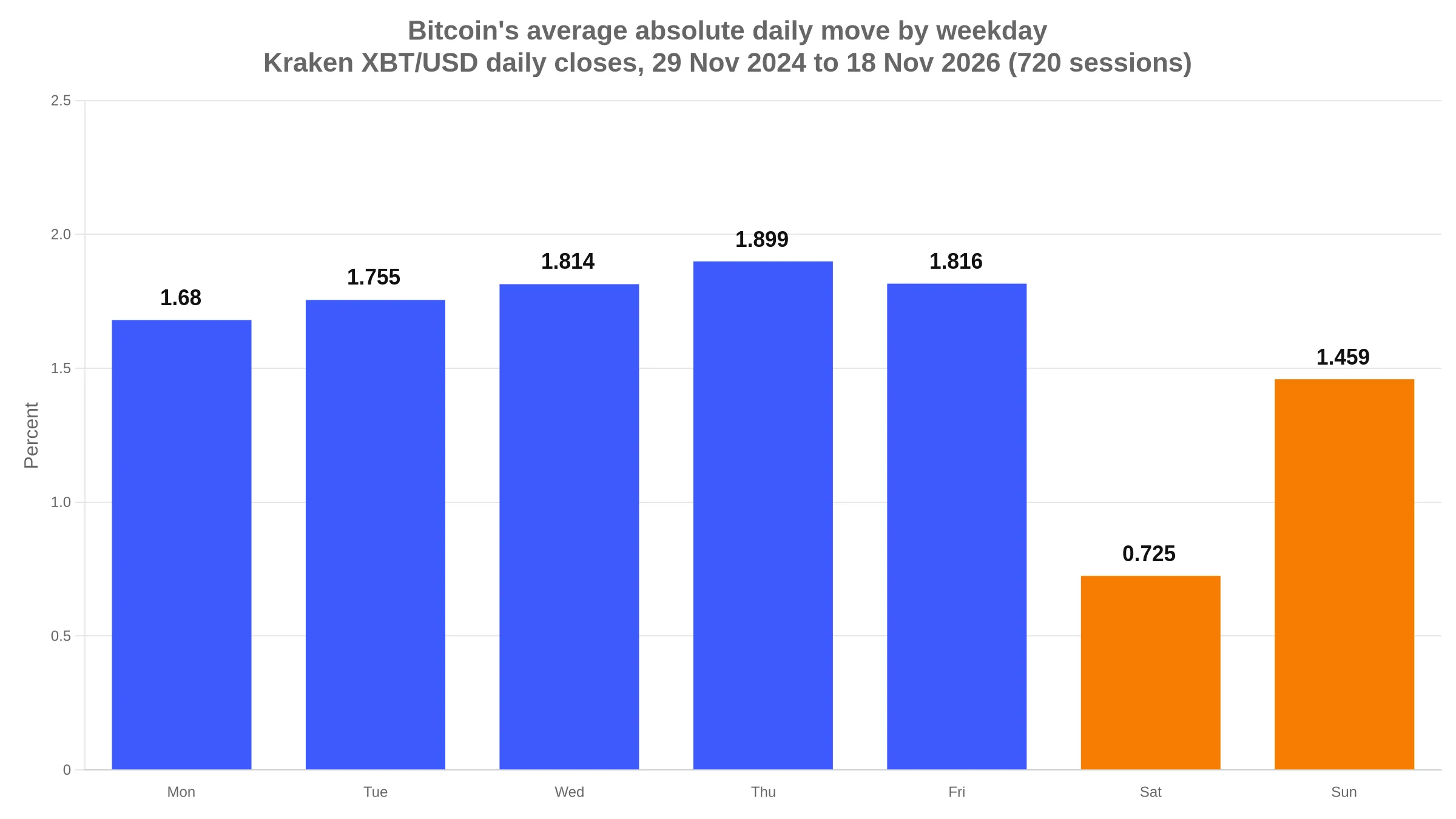
The tail is where the agenda’s questions land. Of those 103 weekends, 35 produced a move larger than 2%, or 34.0%, and 15 produced a move larger than 3%, or 14.6%. The largest was 11.83%, from the Friday close on 28 February 2025 to the Sunday close on 2 March 2025. Direction was almost even: 49 weekends closed lower, 54 higher. Five of the twenty largest single-day moves in the window fell on a Saturday or Sunday, 25% of the sample against the 28.6% of calendar days that weekends represent.
Read plainly, the data does not support the intuition that weekends are systematically more volatile for bitcoin. It supports a narrower claim: weekends are usually quiet and occasionally violent, and the violent ones happen while the regulated US market is shut. That is a gap-risk argument for circuit breakers and position limits rather than an argument that Saturday trading is inherently disorderly. The available data here cannot establish what causes the quiet, and the thinner weekend book is a plausible contributor rather than a proven one. Bitcoin traded at $64,601 at 07:02 UTC on 18 November, down 0.03% over 24 hours, with a market capitalisation of $1.30 trillion on $32.5 billion of volume, per CoinGecko.
Why the Agenda Asks What Continuous Trading Would Cost
One question in the document is about money and it is not about margin. Under cybersecurity and technology, the agenda asks “how much time does industry need to update its technology to operate and update continuously? What will this cost?”
That is an unusual thing for a regulator to put in an agenda, and it points at the constraint that does not show up in a chart. Continuous operation removes the maintenance window. Exchanges, clearing houses and futures commission merchants currently use weekends and overnight gaps for patching, surveillance review, reconciliation and staff rotation. Move to 168 hours and those tasks either happen live or require duplicate systems and second shifts. Selig’s framing in the release stays deliberately open: “I look forward to hearing directly from industry stakeholders on the ways 24/7 trading would impact their respective business models to ensure the Commission is appropriately tailoring its regulatory regime for all market participants.”
What 15 December Will Not Decide
A roundtable is not a rulemaking. The agenda contains no proposed text, no effective date and no timeline for a proposal, and the Commission has not published a draft rule on 24/7 trading. The October announcement described the December meeting as building on a request for comment issued earlier in the summer, which makes 15 December a stage in a consultative sequence rather than a decision point.
Three things remain unknown after the agenda. The industry participants have not been named. The Commission has not said whether it favors a separate weekend session over continuous trading, which is the choice the Session Two language circles. And no one has published an estimate of what continuous clearing would cost, which is precisely why the agenda asks the question. Selig’s earlier formulation on 28 October set the boundary: “under my leadership, the CFTC will not take a one-size-fits-all approach to 24/7 trading.”
Frequently Asked Questions
It is a public industry roundtable on whether US derivatives markets can operate around the clock. The Commodity Futures Trading Commission scheduled it for 15 December 2026 and published the agenda on 17 November. Three sessions cover which asset classes suit continuous trading, what clearing and margin would require, and what weekend market structure, staffing and cybersecurity would need.
15 December 2026, from 1 p.m. to 4 p.m. Eastern, at CFTC headquarters, Three Lafayette Centre, 1155 21st Street NW, Washington, D.C. The meeting is open to the public and livestreamed on CFTC.gov, with dial-in numbers published in release 9327-26.
Not by name. The agenda never uses “crypto,” “bitcoin,” “digital asset” or “perpetual.” Tokenization, stablecoins and blockchain technology appear once each, inside the Session Two question on how those tools could address roadblocks to 24/7 clearing.
A structure in which collateral is posted before a separate weekend session begins, so clearing does not depend on moving cash while banks are closed. The agenda names it as a model to examine and asks what risks may arise, without proposing it as policy.
On Kraken daily closes from 29 November 2024 to 18 November 2026, Saturday averaged a 0.725% absolute move against 1.899% on Thursday, so the average weekend day is quieter. The tail is the exception: 34.0% of 103 Friday-to-Sunday windows moved more than 2% and 14.6% moved more than 3%, with a maximum of 11.83%.
Data: CFTC , Kraken , CoinGecko .
This article is for information only and is not investment advice. Volatility figures are calculated from Kraken XBT/USD daily closes between 29 November 2024 and 18 November 2026. The 15 December roundtable is a discussion event; no rule has been proposed or scheduled.
The post CFTC Publishes Dec. 15 Agenda for 24/7 Trading, and Tokenization Lands in the Clearing Session appeared first on BlockchainReporter .