



Zcash coinholders and community panels begin polling on November 16 over a draft proposal that would take 50,000 ZEC out of the Zcash Community Grants treasury and credit it to the Network Sustainability Mechanism, where the coins stop being spendable and return only as future block rewards to miners. At $991.17 a coin, the transfer is worth about $49.6 million.
Polling closes on Monday, November 30 at 23:59 UTC. The text on the ballot is Draft ZIP: Future Dev and Legal Defense Fund Lockbox, and Removal of ZCG Funds to the Network Sustainability Mechanism , written by Zcash co-founders Sean Bowe and Zooko Wilcox with Jason McGee of Shielded Labs. The pull request was merged into the zcash/zips repository on November 11.
The ZIP changes two things at activation. It ends Zcash Community Grants’ 8% share of the block subsidy and pays that same 8% into a new lockbox, the Future Dev and Legal Defense Fund, until the third halving. It also obliges the ZCG Committee to remove 50,000 ZEC from circulation, crediting it to the NSM, no later than 30 days after activation.
Neither action has a date. No activation height is set, the draft contains no reference implementation, and no rule exists for spending coins once they reach the lockbox.
What the November polls can and cannot decide
The timetable comes from the five organizations that coordinate the coinholder voting chain: Project Tachyon, Shielded Labs, Valar Group, the Zcash Foundation and ZODL. In the forum thread that sets the schedule, Shielded Labs’ aquietinvestor framed the vote as an input rather than a decision. “If there’s rough consensus on a proposal, we’ll support a network upgrade, NU 7.1, to implement it,” he wrote.
That distinction matters for anyone reading the headline number. A poll result does not amend ZIP 1016, move a single coin, or switch on code. The ZIP becomes consensus only when a network upgrade carrying it is adopted by nodes, miners and wallet providers. The organisers have said the follow-up upgrade, NU 7.1, would implement the approved ZIP and leave major feature and transaction-format changes outside its scope.
The votes are also split by constituency. Coinholders poll through the voting chain, community panels poll separately, and the organisers have committed only to assessing whether the combined results show rough consensus. There is no threshold published in advance that automatically converts a majority into a network change.
The two changes inside the draft
The funding side is mechanical. At activation height A, the end height of the ZCG stream,
FS_FPF_ZCG_H3
, moves from its scheduled 2028 endpoint to A. A new stream,
FS_FDLDF_H3
, pays eight hundredths of the block subsidy from A to the existing end height E for the third halving, which the ZIP calculates at block 6,132,390 under the
25-second block spacing introduced by ZIP 218
. Payments to the new recipient produce no coinbase output; the value accrues to the lockbox balance instead.
That balance sits inside issued supply, and the ZIP is explicit that it cannot be drawn down. “No consensus rule moves value out of it,” the specification reads. A separate sentence explains what that means in practice: “No disbursement mechanism is currently defined for this lockbox.” A future ZIP would have to design withdrawals, including who holds authorising keys, before any of the accrued ZEC could fund development or legal defence.
The coinholder stream,
FS_CCF_H3
, is untouched, as is the existing Deferred Dev Fund Lockbox. The 2:3 split between the two grant programmes survives the change, at least in percentage terms, until the funding streams end.
The treasury arithmetic, at today’s price
The ZIP works from ZCG’s own dashboard, which reported 91,452.98 ZEC and $8,796,224 in cash against $2,417,165 of outstanding grant liabilities, with a block reference of October 21. The authors flag those inputs as unreconciled. They also use the Financial Privacy Foundation’s first-half 2026 report, which put ZCG expenses at $4,718,359, or roughly $9.4 million annualised.
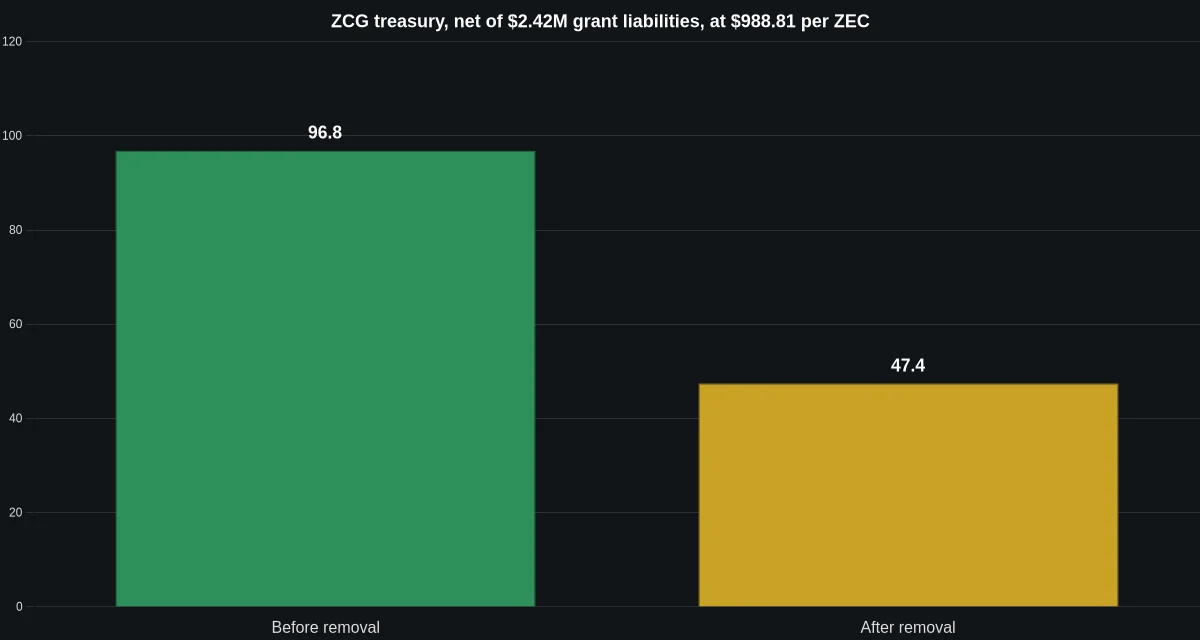
At the draft’s illustrative $1,300 per ZEC, the 8% stream is 144 ZEC a day, 52,560 ZEC a year, or about $68.3 million, which the authors describe as more than seven times ZCG’s spending. The same table puts the treasury at $125.3 million net of liabilities before the removal, equal to 13.3 years at 2026 spending rates, and $60.3 million after it, equal to 6.4 years.
Re-running those figures at today’s quote changes the totals but not the direction. At $991.17, 50,000 ZEC is $49.6 million, and the remaining 41,452.98 ZEC plus cash less liabilities comes to about $47.5 million, or roughly five years of spending at the annualised 2026 rate, against about $97.0 million and 10.3 years before the transfer. The 8% stream alone is worth about $52.1 million a year at the same price, 5.5 times that spending rate.
Two ratios are worth holding next to each other. The 50,000 ZEC equals 347 days of the 8% stream at 144 ZEC a day, so the transfer roughly buys back a year of the funding it ends. And $49.6 million is about 5% of ZEC’s $0.94 billion of 24-hour volume on CoinGecko, which is large for a treasury transfer but small against the market’s daily turnover.
Why the 12% coinholder stream is left alone
The asymmetry is the sharpest criticism of the draft. Under ZIP 1016, 8% of the block subsidy goes to ZCG and 12% to the Coinholder-Controlled Fund. The ZIP ends the first stream early and leaves the second running to 2028. At today’s price, the 12% stream is 216 ZEC a day, or 78,840 ZEC a year, worth about $78.0 million, half again as much as the ZCG stream it replaces with a lockbox.
Vaspholdings, a perennial ZCG candidate who has declared an intention to stand for a ZCG seat in December, argued in a November 7 forum post that the draft answers the price argument on only one side. “If a higher price makes 8% too much, it makes 12% too much as well,” the post reads. It also disputes the wording of the transfer obligation: “A donation required by rule is not a donation,” it states, because the ZIP says the ZCG Committee SHALL make it. And it reduces the lockbox itself to a holding pen: “A lockbox is not a grants programme.”
The draft’s authors do not address that comparison in the ZIP text. Their motivation section argues that a higher ZEC price inflated the dollar value of a treasury built for a much cheaper coin, and that removing coins from circulation reduces the pressure that comes with holding them. Both claims can be checked against the dashboard; neither settles whether the coinholder stream deserves the same treatment.
Three rival drafts and one withdrawn plan
The ballot is not a binary. Four governance proposals have circulated since late October. Draft 1414 sent the 8% stream straight to the NSM. Draft 1423 winds ZCG down. The Zcash Adoption Pool, filed by ZIP editor Daira-Emma Hopwood, keeps the 8% and the treasury but narrows grant criteria toward adoption. The Future Dev and Legal Defense Fund lockbox is the compromise that reached the repository, and it is the only one that pairs a lockbox with the 50,000 ZEC removal.
Behind the ballot sits a procedural problem that the poll cannot fix. In the same November 7 post, Vaspholdings wrote that ZIP editors had told authors that governance ZIPs belong in a body that does not yet exist, leaving the drafts without a settled route to Active status. The merged pull request puts the lockbox text in the repository at Draft, not Active, which is where every ZIP starts.
The immediate history matters too. ZCG proposed redirecting about 98,000 ZEC from its assets and future income toward mining rewards, and dropped that plan on November 3 after criticism. Before that, a draft from Sean Bowe proposed sending the 8% stream straight to the NSM , the version that drew the widest attention to the idea of ending ZCG’s automatic funding. A Dev Fund Soft Landing draft, which tapered the 20% of subsidy going to both funds at each halving, was withdrawn on October 30 by its author in favour of the lockbox approach.
How 50,000 ZEC would leave circulation
The ZIP prefers the protocol’s own removal tool. ZIP 233 lets a v7 transaction carry an explicit removal amount, which ZIP 237 credits to the NSM value balance when the transaction is mined. Where that path is available, the draft adds no consensus rules of its own and no address.
The fallback is blunter: a P2SH address,
t3QZUHYkaEQEuWosAc9HgMPKiQRdvuBPCQZ
, whose redeem script is the single opcode OP_RETURN, so nothing sent to it can be spent. The ZIP permits that route only if ZIP 233 will not be active at activation, and states that the expected deployment activates ZIPs 233 and 248 in the same upgrade, which means the address should not be used. Software that accepts payment destinations is told to recognise the address and present a payment to it as an irreversible removal, not an ordinary transfer.
Execution sits with people, not code. Because ZCG’s funds are held by the Financial Privacy Foundation, the committee fulfils the obligation by directing FPF to build the transactions, exactly as it directs grant payments under ZIP 1015. The ZIP requires the committee to publish each transaction identifier promptly after it is mined, and amends ZIP 1015 to say the removal is not a grant.
What still has to happen before any coin moves
The sequence has five gates. Polls run November 16 to 30. Organisers publish results and judge rough consensus. Engineering teams and miners agree a target date for NU 7.1. A deployment ZIP sets the activation height, which must fall before block 6,132,390 for the lockbox rules to bite. Then the committee has 30 days to remove the 50,000 ZEC.
Several things are explicitly undecided, and readers should treat them as open rather than pending. There is no disbursement mechanism for the lockbox and therefore no answer to who spends it. There is no reference implementation. There is no published threshold for what counts as rough consensus. And the polls are advisory, so a losing proposal does not die by arithmetic; it dies when organisers conclude the community will not adopt it.
What the market has priced
ZEC traded at $991.17 at 09:55 UTC on November 12, up 2.3% over 24 hours and down 25.0% over seven days, with a market capitalisation of $16.89 billion and $0.94 billion of daily volume on CoinGecko. Bitcoin fell 8.4% over the same week, so the drawdown is not Zcash-specific, and nothing in the price data establishes that the governance calendar caused it.
What the price does change is the size of the decision. At $1,300 the draft’s own table described a $125.3 million treasury; at today’s quote the same coins and cash net to about $97.0 million. Every month the vote slips, the dollar value of the 8% stream and of the 50,000 ZEC moves with the coin, which is why the draft expresses the transfer in ZEC and the runway in years rather than dollars.
Data: CoinGecko , zcash/zips pull request 1428 , ZIP 1016 , Zcash Community Forum polling timeline .
Frequently Asked Questions
Coinholder and community panel polling opens on November 16, 2026 and closes on Monday, November 30 at 23:59 UTC. Results are published shortly afterwards and assessed for rough consensus.
50,000 ZEC, about 54.7% of the 91,452.98 ZEC in the October dashboard snapshot cited by the draft. At $991.17 that is roughly $49.6 million, credited to the Network Sustainability Mechanism rather than sold.
No. The polls are advisory. The ZIP becomes consensus only if it is deployed in a network upgrade, planned as NU 7.1, and adopted by nodes, miners and wallet providers. No activation height has been set.
At activation it stops flowing to Zcash Community Grants and the same 8% accrues to the Future Dev and Legal Defense Fund lockbox until the third halving. No rule yet exists for spending from that lockbox.
Not as a lump sum. They are credited to the NSM value balance and return to circulation slowly through future block subsidies to miners. The OP_RETURN fallback address, used only if ZIP 233 is unavailable, cannot be spent at all.
This article is not intended as financial advice. Educational purposes only. Prices cited are CoinGecko quotes taken at 09:55 UTC on November 12, 2026 and will change.