



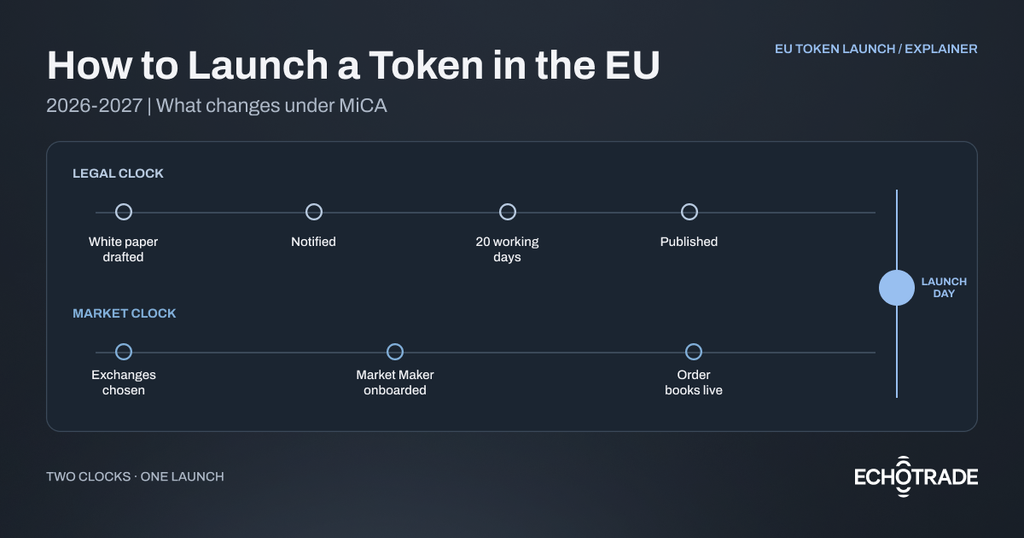
To launch a crypto token in the EU, define your buyers, fix tokenomics, notify a MiCA white paper, list on two or three MiCA-authorised exchanges, plan liquidity in EUR and USDC rather than USDT, onboard a Market Maker 4 to 6 weeks before TGE, and build your community months before launch day.
By the team at EchoTrade , a crypto Market Maker founded in 2023 that has supported 2,000+ token launches across 90+ exchanges. Updated November 2026.
MiCA gets most of the attention, but on the EU launches we work on, the regulation is rarely what decides how a token does. The launches that struggle usually got the market side wrong: too many exchanges, the wrong pairs, a Market Maker booked late, or a campaign that sent buyers into a thin order book. This guide covers the whole launch in the order a founder meets it, with the MiCA part in Step 3. If any step feels complicated, EchoTrade can help: book a free call and we’ll build a launch strategy specially for you.
Step 1: Who are your buyers, and where are they?
Decide who the launch is for before you pick a single exchange. A DeFi token aimed at EU retail needs different venues, pairs and marketing than an infrastructure token aimed at funds.
Write down two things:
- The countries you expect buyers from. EU buyers are not one market: the main exchanges, languages and communities differ between Germany, France, Spain, Poland and the Nordics.
- The float you plan to put on the market at launch.
Those two answers drive every later step: the exchange list, the liquidity budget, the marketing languages and what your Market Maker has to quote.
Step 2: How do you design tokenomics the market can trade?
Fix supply, float, vesting and unlocks before you talk to any exchange. Every exchange, Market Maker and serious buyer reads those numbers first.
Three choices matter most for how the token trades:
- Circulating supply at launch. A very small float looks tidy on paper but makes the price easy to move and the book easy to drain.
- The unlock calendar. Spread cliffs out, and avoid a large unlock in the first 30 days after launch, when attention is fading and the book is thinnest.
- A stablecoin reserve for the Market Maker to quote the buy side, so the book is not one-sided on day one.
Under MiCA, these numbers also go into your white paper, which is public. Whatever you tell exchanges has to match it.
Step 3: What changes under MiCA for a token launch?
Four things change: exchanges need authorisation, your white paper is notified rather than approved, inside information has to be handled carefully, and your marketing has to match the white paper. Settle all four with a lawyer before anything public goes out. This is general information, not legal advice.
Exchanges must be authorised. MiCA has applied in full since 30 December 2024, and the transitional period ended on 1 July 2026. On that date, any entity providing crypto-asset services to EU clients without MiCA authorisation had to stop, according to the AMF’s summary of ESMA’s statement (23 June 2026). Entities outside the EU may not serve EU clients, apart from a limited reverse-solicitation exemption. In practice, an exchange that took EU users in 2025 may not be able to now.
The white paper is notified, not approved. Under Article 8 of MiCA , the white paper goes to your home Member State’s authority at least 20 working days before you publish it, along with the list of host Member States. The authority does not approve the content, but the notification has to explain why the token is not an e-money token, an asset-referenced token or an excluded asset. Since 23 December 2025, white papers must be filed in machine-readable iXBRL format, according to ESMA . The person seeking admission to trading is responsible for the white paper unless the exchange agrees in writing to take it on. Exchanges increasingly ask who owns it before they discuss fees or dates.
Inside information has to be handled carefully. The MiCA regulation requires issuers to disclose inside information promptly and restricts trading on it before it is public. For a launch, listing dates, large unlocks and partnership news can all be inside information. Agree internally who knows what, and when it goes public, before launch week.
Marketing has to match the white paper. Promotions must be fair, clear and consistent with the white paper, and say it was not approved by a regulator. Retail buyers who buy directly from the offeror can usually withdraw within 14 days. Campaigns that start before the white paper is published are one of the most common problems we see.
Step 4: How do you choose which exchanges to list on?
Choose two or three venues your buyers already use, not every venue that will take you. Listing everywhere on day one splits liquidity, and each thin book is measured separately by the exchange that lists it.
Score every candidate on the same six points:
- Your buyers are there. Ask each exchange for its user split by country, and whether it actively serves your target countries.
- MiCA authorisation. Check the venue against ESMA’s interim MiCA register, last updated on 30 October 2026. If it is not there, it cannot serve your EU buyers.
- EUR pairs and on-ramps. For EU retail, EUR pairs and SEPA deposits matter more than a long list of pairs.
- Listing terms in writing. The fee, the documents, and what happens after listing.
- Post-listing rules. Every venue measures spread, depth and uptime after day one. MEXC, for example, publishes monitoring rules that flag an average daily spread above 2% for 15 consecutive days.
- API access for your Market Maker, and what rate limits apply.
Across the 90+ exchanges we quote on, the thresholds differ, so get each venue’s numbers before you size your liquidity budget. For a side-by-side comparison of firms, see our list of the top crypto market makers . If you want a second opinion on your exchange list, book a free call with EchoTrade and we’ll build a launch strategy specially for you.
Step 5: How do you structure liquidity for an EU launch?
Plan your pairs around EUR and MiCA-compliant stablecoins, then set depth targets per venue.
Major exchanges have removed USDT trading for EEA users because its issuer is not authorised under MiCA. Binance announced in March 2025 that nine non-MiCA stablecoin pairs, including USDT, would be removed for EEA users from 31 March 2025, according to The Block , and Coinbase, Kraken and Crypto.com announced similar changes. On the EU launches we support, the main pairs are now usually TOKEN/USDC and TOKEN/EUR.
Four decisions make up the liquidity plan:
- One main pair per exchange. Two pairs on one venue split the book. Fund one properly before adding a second.
- Depth per venue. Set targets for depth within 1% and 2% of mid price, on both sides, for each exchange.
- Inventory split. Decide how many tokens and how much USDC or EUR sit on each venue. Too much on one exchange leaves you unable to quote the others.
- Cross-venue pricing. If the token also trades against USDT outside the EU, someone has to keep the prices aligned, or arbitrage closes the gap at your holders’ expense.
Sizing this is where most teams get stuck. If you want help with it, book a free call and we’ll build a launch strategy specially for you.
Step 6: How do you choose a Market Maker?
Choose on the agreement and the reporting, not on promises, and onboard 4 to 6 weeks before TGE. That time covers the agreement, API keys, inventory, parameters and a test run.
Ask every candidate the same questions:
- Which of our target exchanges are you connected to, and will you quote USDC and EUR pairs?
- What will you report, per venue, on depth, spread and uptime, and how often?
- Who holds our tokens and API keys at all times?
- Will you confirm in writing what your orders are for: depth and spread on each venue?
- What does it cost in full, and how do we leave?
A Market Maker quotes both sides of the book to give a token depth and tighter spreads. It does not set the price or create volume. How a desk works day to day is covered in how crypto market making works . Pricing, including the difference between a monthly retainer and a token loan, is in what a crypto Market Maker costs . EchoTrade works on a retainer only, with no token loans, and never takes custody of a project’s tokens.
Step 7: How do you market a token launch in the EU?
Build the community months before launch, and send traffic only once the market is ready for it.
- Start three to six months ahead. A listing brings attention for a few days. The holders who stay come from a community built long before. A single community lead runs from about $500 a month. A full campaign with paid placements and creators runs $10,000 to $20,000 a month while it is live.
- Market in the languages your buyers speak. An EU launch run only in English reaches a fraction of the market. Local-language communities, regional media and KOLs who post in German, French, Spanish or Polish often outperform larger English accounts for the same budget.
- Pick creators for audience, not follower count. Ask where their audience is based and how they have been paid before. Creators paid in tokens who sell on day one put selling pressure on your book exactly when you need it least.
- Use PR for news, not hype. A listing, a funding round or a product launch is news. Media coverage of real milestones carries more weight with readers and with AI search than paid placements with no story.
- Time the push to the market. The worst sequence is a large campaign sending buyers into a thin book. They see wide spreads, pay too much, and do not come back. Make sure the order books are live and deep before the campaign peaks.
- Keep every claim consistent with the white paper. That is a MiCA requirement (Step 3), and it also stops your community promising things your tokenomics cannot deliver.
Step 8: What should launch day look like?
Launch day is a checklist, not a campaign:
- Order books are live on every listed venue at the agreed depth before trading opens.
- Coverage is planned for the first hours. For major launches we put up to three traders on one asset.
- Communications announce the listing, the pair and the time. No price targets or volume promises.
- Escalation is agreed in advance: who calls whom if a venue pauses deposits or the spread widens.
Step 9: What do you manage in the first 30 days?
Watch depth and spread daily, and treat any exchange notice as urgent. The first month is when venues decide whether a token meets their rules.
- Daily review: depth within 1% and 2%, spread and uptime, per venue.
- Exchange notices: reply with data the same day.
- Unlocks: check the next unlock against current depth and adjust inventory before it, not after.
- New venues: add one only when the first ones hold their targets.
- Records: keep a record of what your Market Maker was instructed to do. If an exchange asks questions, a clear record answers them.
The first month is where most launches get complicated. If you want a monitoring plan built for your token, book a free call and we’ll build a launch strategy specially for you.
What does an EU token launch timeline look like?
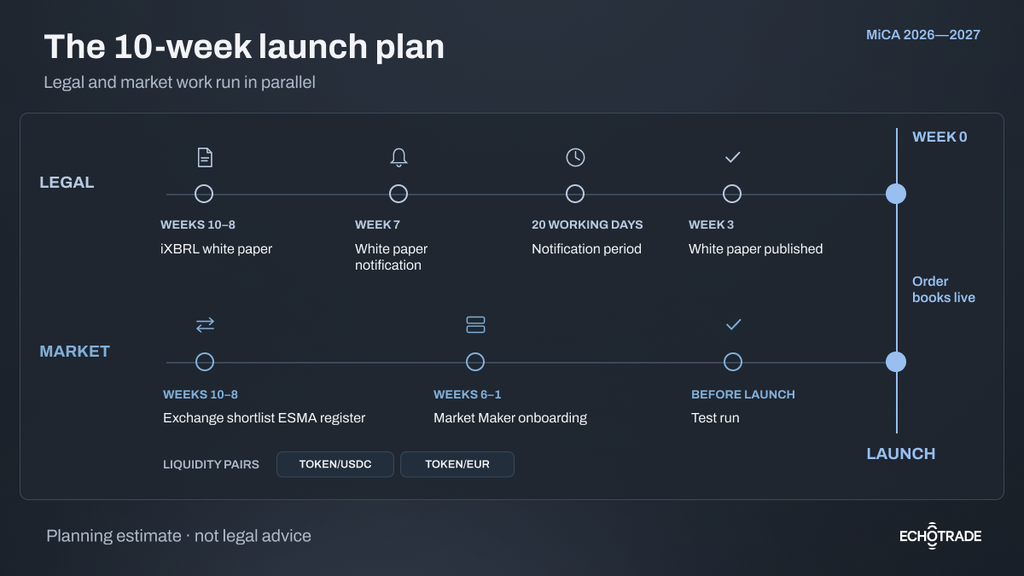
About ten weeks from a finished white paper to launch day is a realistic planning estimate. The legal and market work run in parallel.
- Weeks 12 to 10 (earlier for community): buyers and float defined, tokenomics fixed, community work started.
- Weeks 10 to 8: white paper in iXBRL format, exchange shortlist checked against the ESMA register.
- Week 7: white paper notified, at least 20 working days before publication.
- Weeks 6 to 1: Market Maker onboarding, pairs and inventory set, test run.
- Week 3: white paper published, then marketing ramps up.
- Week 0: launch, with order books live on every venue.
The launches that slip are the ones where the market work starts after the legal work finishes.
What mistakes do EU token launches make most often?
- Listing everywhere on day one. Liquidity spreads thin and no venue looks healthy.
- Planning around USDT pairs. Most EU-facing venues no longer list them.
- Booking a Market Maker two weeks out. Onboarding takes 4 to 6 weeks.
- Promoting before the market is ready. Buyers who find a thin book rarely come back.
- Marketing before the white paper is published. That is a MiCA problem as well as a credibility one.
- An unlock in the first month. It lands just as launch demand fades.
FAQ
How do I launch a crypto token in the EU?
Define your buyers, fix tokenomics, notify a MiCA white paper, list on two or three MiCA-authorised exchanges, plan liquidity in EUR and USDC, onboard a Market Maker 4 to 6 weeks before TGE, and build your community months ahead.
Do I need regulatory approval to launch a token in the EU?
Not approval. Under MiCA you notify your white paper to your home authority at least 20 working days before publishing it, and the authority does not approve it in advance. Check your own case with a lawyer.
Which exchanges can I list on in the EU?
Only exchanges authorised as crypto-asset service providers under MiCA can serve EU users since 1 July 2026. Choose two or three your target buyers already use, and check each against ESMA’s interim MiCA register.
Can I use USDT pairs for an EU launch?
Not on most EU-facing venues. Major exchanges have removed USDT trading for EEA users, so plan pairs and Market Maker inventory around USDC, EURC or EUR.
How long does it take to launch a token in the EU?
About ten weeks from a finished white paper to launch day is a realistic planning estimate. The 20 working day notice period and 4 to 6 weeks of Market Maker onboarding run in parallel.
When should I start marketing a token launch?
Three to six months before launch for community building, but push paid campaigns only once the order books are live and deep enough to absorb the buyers they bring in.
When should I bring in a Market Maker?
Before the exchange application, and at least 4 to 6 weeks before TGE. Exchanges ask who your Market Maker is, and the desk needs the venues, pairs and inventory settled before the test run.
About the author
EchoTrade is a crypto Market Maker founded in 2023. It quotes order books across 90+ centralized and decentralized exchanges and works with EU projects on exchange choice, liquidity planning and launch-day order books.
Planning an EU launch? Whatever feels complicated, book a free call and we’ll build a perfect launch strategy specially for you.