



MARA Holdings sold 13,597 bitcoin at an average price of roughly $81,039 after its third quarter closed, raising about $1.1 billion and spending $750 million of the proceeds to fully repay its bitcoin-collateralized term loans. The Q3 2026 shareholder letter , released on November 9 alongside the company’s results announcement , says the repayment returned 17,477 bitcoin that had been pledged as collateral and left less than 5% of MARA’s coins loaned or pledged.
That single paragraph carries three numbers that do not sit comfortably together. The company sold 40% of the bitcoin it reported holding at September 30. It sold at a price 8.5% above where bitcoin trades now. And it did so in a quarter reported as strongly profitable, on the back of accounting gains rather than mining margins.
Bitcoin was at $74,720 at 05:31 UTC on November 10, according to CoinGecko data, down 40.7% from its all-time high of $126,080 and 0.3% higher over 24 hours. MARA’s post-quarter sale, disclosed as an average of approximately $81,039, cleared spot by $6,319 a coin.
The loan retired at a 53% collateral ratio
The disclosure is unusually specific for a collateral release, which makes the arithmetic possible. MARA repaid $750 million and got back 17,477 bitcoin. At the $81,039 average sale price, that collateral was worth about $1.42 billion when it came off the books. Dividing the loan by the collateral value gives a loan-to-value ratio of roughly 53% at the moment of repayment.
That is a conservative structure for a bitcoin-backed facility, and it explains why the company was able to retire the loan without a forced-sale discount. MARA did not sell at the bottom of a liquidation cascade; it sold into a market where the coin was still worth more than $80,000, then handed the proceeds to lenders and took the collateral back.
The company frames the move as risk reduction, not distress. “While markets have declined, bitcoin has remained resilient, and our balance sheet gives us the flexibility to act on those opportunities when they arise,” the letter states, referring to capital deployment broadly. Earlier in the same document, management writes that it manages “cash, bitcoin, debt, and access to capital as parts of one balance sheet,” and that total debt has fallen $1.4 billion, or 37%, since the start of the year.
Work backwards from that percentage and MARA carried about $3.78 billion of debt entering 2026. The $1.4 billion reduction leaves roughly $2.38 billion outstanding, before any further repayment in the current quarter. The 13,597 coins sold generated $1.102 billion, which means about $352 million of the proceeds stayed inside the company after the $750 million repayment.
A record profit built on two marks
The headline number is net income of $632.1 million, or $1.28 per diluted share, against $123.1 million in the same quarter last year. Revenue went the other way: $164.2 million, down 35% from $252.4 million. Those two lines moving in opposite directions is the whole story of the quarter.
The income statement explains it. MARA booked a $421.9 million gain inside “change in fair value of digital assets,” which sits in the cost section as a negative expense, and another $463.5 million gain on “change in fair value of digital assets – receivable, net” in other income. Together those two marks add $885.3 million, which is the figure the company itself flags in its highlights. Strip both out and the quarter’s pre-tax result flips to a loss of about $254 million.
The nine-month picture is less flattering still: a net loss of $1.24 billion and an operating loss of $1.41 billion. The third quarter’s profit is real under fair-value accounting, and it is the reason the balance sheet shows what it shows. It is not evidence that mining bitcoin at $74,000 pays for a company with $150.9 million of quarterly depreciation, $75.8 million of general and administrative expense, and $71.5 million of third-party hosting costs.
Adjusted EBITDA of $857.7 million, up from $395.6 million, inherits the same issue. The company’s own reconciliation starts from GAAP net income and adds back interest, taxes, depreciation and a list of non-cash or non-recurring items. The digital-asset revaluations are not on that add-back list, so they flow straight through the adjusted figure. Investors reading $857.7 million as operating cash generation are reading it wrong.
Diluted earnings carry the convertibles
The per-share figures expose a second balance-sheet fact. Basic net income per share was $1.64 on 385.7 million weighted average shares. Diluted came to $1.28 on 496.4 million, a 22% haircut. The 110.7 million share gap is the convertible overhang, and it is the same instrument stack whose puts management says become exercisable next year.
A $500 million repurchase authorization has to be sized against that gap. Every $10 of share price turns $500 million into 50 million shares, about 13% of the basic count and less than half the convertible overhang. The buyback is better read as a signal about how management values the equity than as a fix for the capital structure. MARA does not disclose a price at which it would buy, and the letter states the program “does not obligate us to repurchase any particular amount.”
Cheaper per coin, worse per dollar
MARA mined 2,247 bitcoin in the quarter, up 5% from 2,144 a year earlier, and won 644 blocks for a 5.4% share of available miner rewards. Energized hashrate reached 71.2 EH/s, an 18% increase. Cost per petahash per day improved 2% to $30.8, and purchased energy cost $0.04 per kilowatt-hour at owned sites.
Purchased energy cost per bitcoin mined came to $39,674, against $39,235 a year earlier. Set that against the $75,300 average price MARA realized on the 3,891 coins it sold during the quarter, and the gross spread was $35,626 a coin, or 47%. On the mining line alone, the business still works.
What broke is revenue per coin. Dividing $164.2 million of quarterly revenue by 2,247 bitcoin mined gives $73,075 per coin, against $117,724 in the year-earlier quarter on the same calculation. Part of that gap is bitcoin’s lower price across the period, which the letter cites as $71,688, and part is the mix: the company is carrying more hosting and infrastructure cost against a smaller mining revenue base.
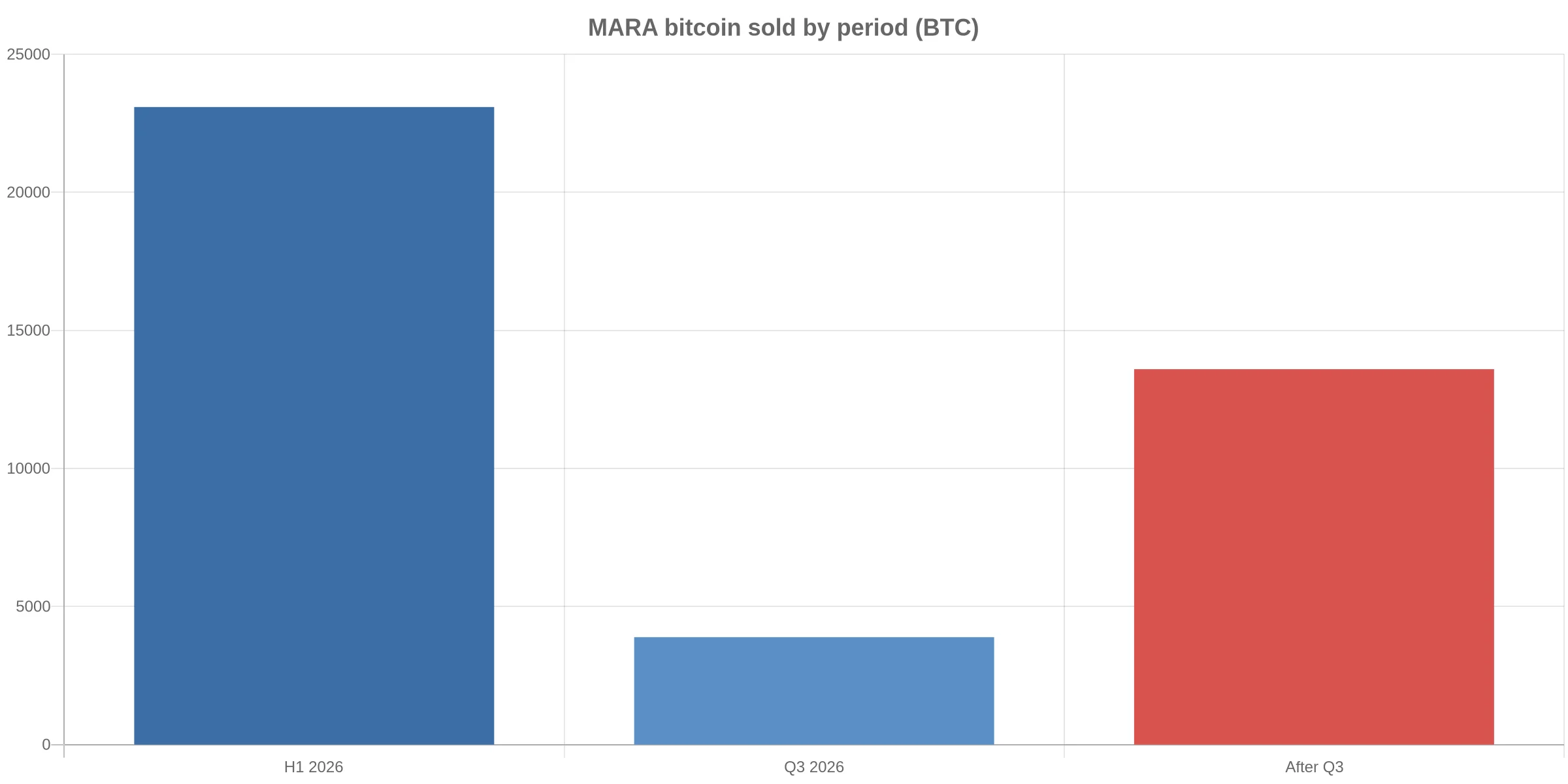
The treasury math is the part that compounds. MARA held 34,012 bitcoin at September 30, including digital assets receivable. It sold 3,891 during the quarter at $75,300 and another 13,597 after it closed at $81,039. Total 2026 disposals now stand at 40,581 bitcoin once the 23,093 coins sold in the first half, for $1.63 billion, are included, as BlockchainReporter reported in August .
The contrast with the largest corporate holder is instructive. Strategy’s 849,327 bitcoin sit 2.3% below its $75,451 average cost, a position BlockchainReporter detailed on November 9 , and that company has held rather than sold. MARA has now sold coins in every window this year, at $75,300 in the third quarter and $81,039 after it.
What the remaining coins are for
After the post-quarter sale, roughly 20,415 bitcoin remain on the September 30 count, before any fourth-quarter production or further sales. At $74,720 that is about $1.53 billion of market value, against combined unrestricted cash and bitcoin of $3.8 billion reported at quarter end.
Management is explicit about how it intends to use the asset. “We intend to continue using bitcoin to build cash for purposes such as AI infrastructure opportunities, to satisfy the puts on our convertible notes that become exercisable next year, and potential share repurchases,” the letter states. That sentence is the closest thing to guidance in the document, and it names three claims on the treasury that arrive before any new mining cash does.
The buyback is the newest. MARA’s board authorized up to $500 million of common stock repurchases after the quarter closed. The convertible puts fall due next year. The AI infrastructure spending is the largest and least defined: the company is targeting signed leases before year-end but concedes the timing “could slip into next year.”
The infrastructure pipeline is real but mostly uncontracted. Long Ridge has FERC approval, is authorized to sell 485 MW, and is expected to reach 505 MW of nameplate capacity in the first half of 2027, with roughly 70% of output under long-term contracts. A Matagorda County, Texas site of up to 2 GW has been classified as a studied load in ERCOT’s Batch Zero process, and MARA has obtained a $100 million letter of credit for the interconnection study deposit. Exaion signed a four-year, $79 million GPU-as-a-service contract on 100% take-or-pay terms, and the company cites a pipeline above $3 billion of total contract value, of which about $1 billion is targeted for delivery by the end of 2027. The letter labels that pipeline as indications of demand, not contracted or committed business.
Against that, MARA still runs 71.2 EH/s of mining, which the letter insists remains the foundation rather than a legacy business. “It is important to remember that this is not a pivot away from bitcoin,” it states. The company also launched Vertebrai, software that routes surplus power to on-site computing; at its Hansford County wind farm, MARA estimates the system cut curtailment from 46% of potential generation to 22% between April and September.
What the letter does not say
Three things are missing. There is no disclosure of the dates on which the 13,597 coins were sold, only that the sales happened after September 30, so the $81,039 average cannot be tied to a specific week of price action. There is no statement of the remaining collateral or covenant terms on the $2.38 billion of debt that was not repaid. And there is no quantification of how much of the AI/HPC pipeline has moved from indication to signed contract since the second quarter.
The letter also declines to repeat the claim, made by MARA’s chief executive in July, that AI compute is now far more profitable than bitcoin mining. What it says instead is more measured: “In our experience, waiting has improved the terms available to us.” That is a statement about negotiating leverage, not about returns already earned.
For readers tracking the treasury trade rather than the AI trade, the relevant test is simple. MARA sold 40% of its coins at a premium to today’s price to remove a secured lender from its capital structure. Whether that was prudent depends on where bitcoin trades when the convertible puts come due next year, and on whether the leases it is targeting actually get signed. Neither answer exists yet, and the letter does not pretend otherwise.
Disclosure: This article does not represent investment advice. The content and materials featured on this page are for educational purposes only.