




Bitcoin is the best crypto to buy now for a core position, while Ethereum is the higher-beta trade with a dated catalyst. BTC trades at $78,456 on October 30 after touching a six-week low of $76,500 overnight, ETH sits at $2,246 with its Glamsterdam scaling upgrade in final testnet, and XRP holds $1.26 after Ripple won a federal trust-bank charter for its RLUSD stablecoin. Three large-cap assets, three live catalysts, and one broad selloff that has yet to find a floor.
The tape is risk-off across the board. Bitcoin is down 1.8% over 24 hours, Ether 2.8%, XRP 2.2%, and BNB 5.0% at the 06:45 UTC print on October 30, per CoinGecko . The declines come a day after Bitcoin fell from an $81,344 close on October 28 to $77,992 on October 29, and they leave the question a best-crypto list is built to answer: whether this dip is an entry or the start of something deeper.
Bitcoin’s Six-Week Low and the Level That Matters Now
Bitcoin’s daily chart shows the damage. The close fell from $81,344 on October 28 to $77,992 on October 29, then printed a $76,500 intraday low on October 30 before recovering to about $78,431. That $76,500 mark is the level that matters now: it is the session low and the deepest print of the current slide, sitting below the prior day’s $77,910 low.
The recovery attempt is thin. Bitcoin spent October 23 through October 28 trading between roughly $79,200 and $81,800, and that band is now overhead supply rather than support. A move back above $80,000 would have to absorb the sellers who bought that range, while a failure to reclaim it keeps the path of least resistance lower. The invalidation for the bearish read is simple: a daily close back above $81,800 would reopen the upper range.
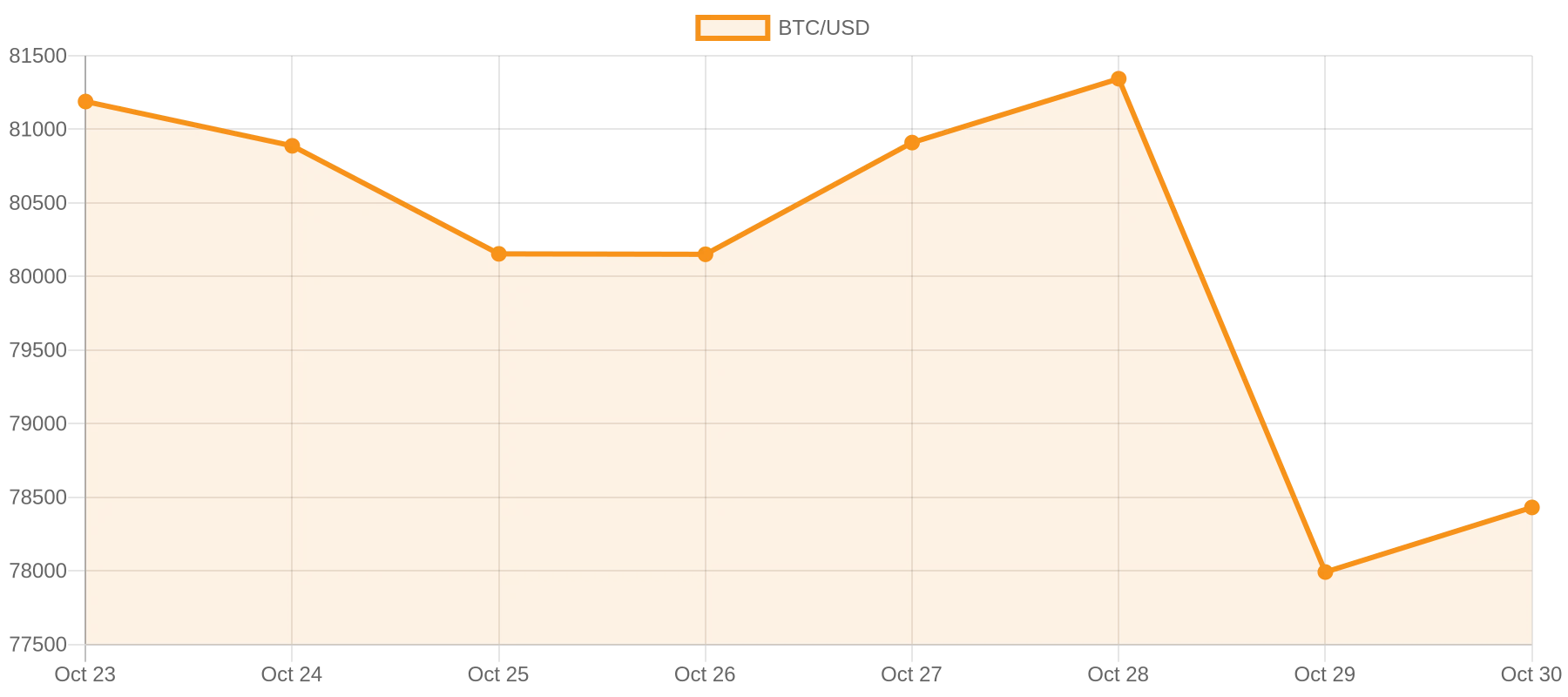
BlockchainReporter broke down the withdrawal halt that accompanied the move below $77,000 in its coverage of the six-week low , and the setup has not changed since. The decline has coincided with a broad risk-off tone rather than a single confirmed catalyst.
Glamsterdam: Ethereum’s Scaling Catalyst, In Final Testnet
Ethereum is the catalyst play on this list. Ether trades at $2,246, down 2.8% over 24 hours and 6.5% over the week, but the network is approaching Glamsterdam, the upgrade that brings enshrined proposer-builder separation and block-level access lists to the execution layer. “Glamsterdam combines the Amsterdam execution layer upgrade with the Gloas consensus layer upgrade,” the Ethereum Foundation explains . “Its headlining changes are enshrined proposer-builder separation (ePBS) and block-level access lists (BALs), which change how blocks are produced and validated to support greater L1 throughput.”
Those two changes matter because they are structural, not cosmetic. ePBS (EIP-7732) moves the proposer-builder split into the consensus protocol, and block-level access lists (EIP-7928) let clients read state from disk in parallel. “Together, ePBS and BALs provide a foundation for scaling execution capacity while keeping block validation practical for node operators,” the foundation wrote. The upgrade activated on the Sepolia testnet on October 6 and has since been running through the Hoodi testnet, with mainnet activation still to be scheduled by client teams.
The timing gap is the opportunity and the risk. A scaling upgrade that lands while Ether trades at $2,246 arrives on a low base. The math: Ethereum’s $274 billion market cap is about 17% of Bitcoin’s $1.58 trillion. For Ether to match just half of Bitcoin’s capitalization, it would need to reach roughly $6,450, a 2.9x from here. That is an arithmetic ceiling, not a forecast.
Ripple’s Trust Bank Makes RLUSD a Regulated Rail
XRP’s catalyst is regulatory rather than technical. On October 26, the Office of the Comptroller of the Currency granted Ripple final approval to charter Ripple National Trust Bank (RNTB), a federally supervised trust bank that will manage the segregated reserves behind RLUSD, act as collateral trustee for those reserves, and offer fiduciary digital-asset custody. “For years, we’ve said crypto and banks work better together. Final approval for Ripple National Trust Bank is what that looks like in practice,” said Brad Garlinghouse, CEO of Ripple . “A national trust charter gives us an even stronger foundation for RLUSD and the institutional products we’re building across payments, custody and capital markets.”
The approval is a specific application of the GENIUS Act, the federal stablecoin law the OCC is now turning into regulation. “We are providing a clear, practical framework for payment stablecoin innovation, with strong standards for reserve backing, redemption, and risk management,” Comptroller of the Currency Jonathan V. Gould said when the final rule was published October 21. The rule and the GENIUS Act take effect January 18, 2027.
RLUSD has grown to a $2.5 billion market cap since launching in December 2024, with BNY as its primary reserve custodian and monthly third-party attestations covering its reserves, according to Ripple. The trust bank does not change XRP’s token economics directly, but it deepens the regulated infrastructure Ripple can route institutional stablecoin volume through. Visa’s stablecoin settlement passing a $25 billion annualized run rate, which BlockchainReporter covered on October 29 , shows the scale of the demand that framework is competing for.
The Math Behind the Three Trades
Capital requirements differ sharply across the three assets. Bitcoin at $78,456 carries a $1.58 trillion market cap, so a 2x means adding about $1.58 trillion of new value. Ethereum at $2,246 carries $274 billion, and XRP at $1.26 carries about $80 billion. In dollar terms, $1,000 buys roughly 0.0127 BTC, 0.445 ETH, or 794 XRP. For that stake to double, Bitcoin needs to reach about $157,000, Ethereum $4,492, and XRP $2.52.
The smaller the capitalization, the less new capital a given multiple requires, and the higher the risk of getting there. Bitcoin’s double is a macro event that depends on a wave of new capital. Ethereum’s double depends on the scaling narrative holding through a mainnet date that has not been set. XRP’s double depends on the stablecoin rails the trust bank enables actually attracting institutional volume. These are arithmetic ceilings, not forecasts.
The Skeptical Case
The clearest risk is that none of these catalysts has a hard date attached. Glamsterdam’s mainnet activation has not been scheduled, and a testnet that finalizes is not a mainnet that ships. Ripple’s trust bank is approved but has not opened, and Ripple did not give a date for when it begins operating. The GENIUS Act framework takes effect January 18, 2027, meaning the stablecoin rails it enables are months away from full operation.
The second risk is the tape itself. Every major asset is red, and a six-week low in Bitcoin rarely marks a floor on the first touch. If the $76,500 level fails, the next observable support is well below the recent range, and a best-crypto list does not remove the downside. Position sizing should reflect that the catalysts are real but undated, and that the market has not yet confirmed a bottom.
Frequently Asked Questions
Bitcoin is the lower-risk core position at about $78,456 after a six-week low of $76,500, while Ethereum is the higher-beta trade with the Glamsterdam upgrade as its dated catalyst. XRP is the regulatory play after Ripple’s trust-bank approval. None is a certainty, and position size should match the gap in risk between them.
The broad market is in a risk-off move at the October 30 print: Bitcoin is down 1.8%, Ether 2.8%, XRP 2.2%, and BNB 5.0% over 24 hours, a day after Bitcoin fell from an $81,344 close on October 28 to $77,992 on October 29. No single confirmed catalyst has been tied to the move.
Glamsterdam activated on the Sepolia testnet on October 6, 2026, and has been running through the Hoodi testnet. Mainnet activation has not yet been scheduled; the Ethereum Foundation said Hoodi and mainnet times will be announced once client teams decide.
On October 26, 2026, the OCC granted Ripple final approval to charter Ripple National Trust Bank, which will manage the segregated reserves behind the RLUSD stablecoin, act as collateral trustee for those reserves, and provide fiduciary digital-asset custody.
The GENIUS Act is the U.S. federal stablecoin law signed in July 2025. The OCC published its final implementing rule on October 21, 2026, and both the rule and the Act take effect on January 18, 2027.
Disclosure: This article does not represent investment advice. The content and materials featured on this page are for educational purposes only.