




Ethereum is pinned near $2,352 on Oct. 27 — up 1.2% over the past 24 hours but down 13% since October began, per Binance market data. The coin scraped an intraday low of $2,297 before bids lifted it back above the $2,300 shelf that has caught every selloff since mid-month. That floor is holding for now, but the tape underneath it is thin.
Three forces are doing the selling. Spot ether exchange-traded funds lost another $88.6 million on Oct. 26, led by BlackRock’s iShares Ethereum Trust. A dormant ICO whale resurfaced after nine years to dump 1,500 ETH, according to Lookonchain’s Oct. 26 post . And CryptoQuant’s Net Unrealized Profit/Loss gauge has flattened to near zero, a sign that most of the market’s paper gains have already evaporated. The next catalyst is the Federal Reserve’s rate decision on Oct. 28.
Ether’s October Slide, in the Numbers
ETH opened the month at $2,706 and now trades near $2,352, a decline of 13%. Over the trailing 30 days the loss is 12.5%, and from the Oct. 2 swing high of $2,777 the coin is down 15%. The Oct. 27 session printed a $2,297 low before recovering — the third test of $2,300 this month.
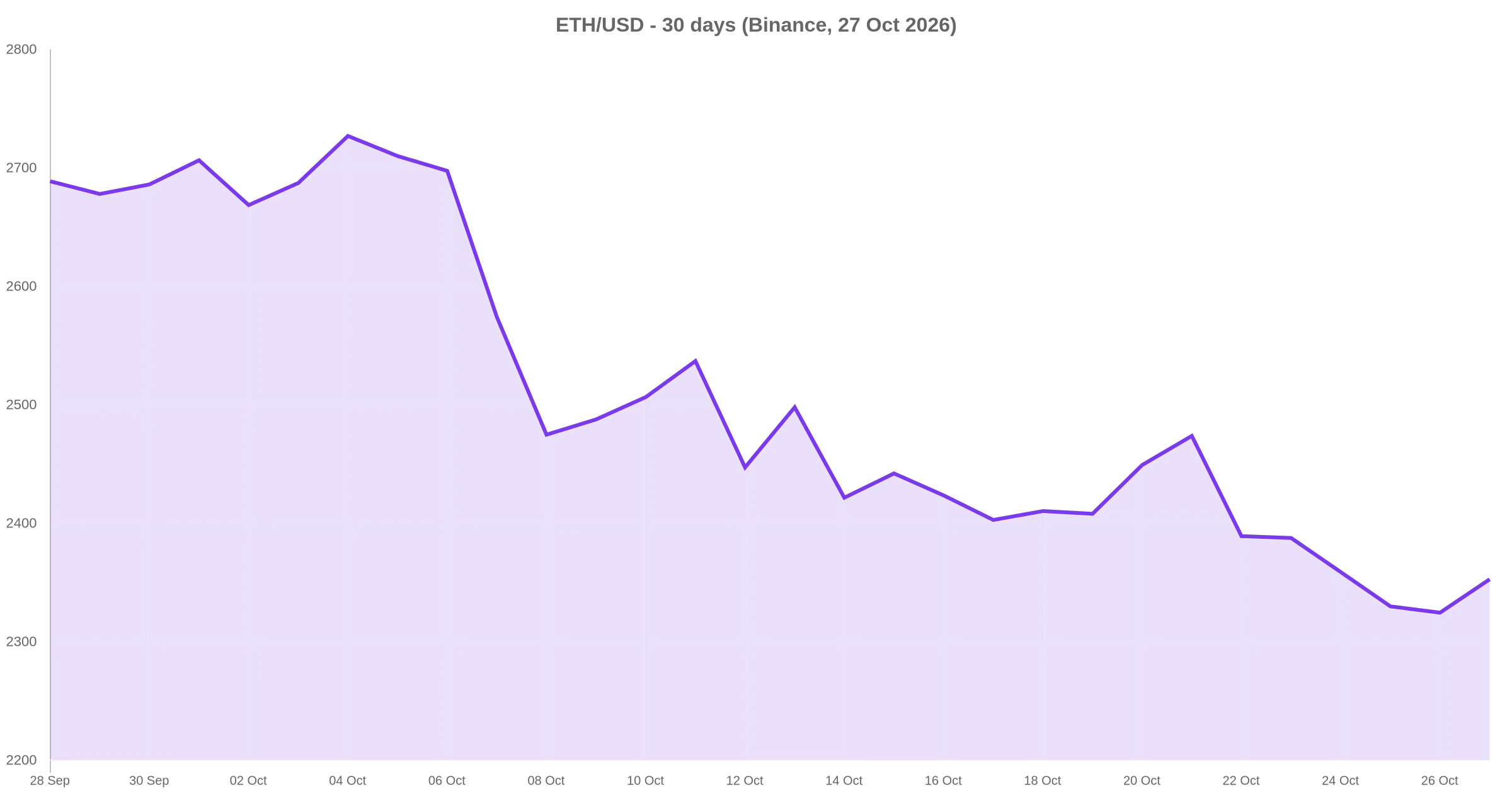
The $2,300 shelf matters because it has defined the bottom of the October range. Every flush toward it has been met with spot bids, but each recovery has also stalled below $2,500, where sellers keep reloading. That is the pattern of a market that is not liquidating longs so much as failing to attract new buyers — the tell of an asset grinding lower on absent demand rather than panic.
ETF Redemptions Keep the Bid Thin
U.S. spot ether funds shed $88.58 million on Oct. 26, according to SoSoValue . BlackRock’s ETHA did the bleeding, with $104.71 million in redemptions, while Fidelity’s FETH took in $16.13 million. Every other product printed a flat day. Cumulative net inflows now sit at $12.63 billion against total net assets of $14.07 billion — a gap that shows how much of the year’s gains have already been pulled back out.
The single-fund concentration is the story worth watching. One issuer accounted for more than the entire day’s net outflow, which means the redemptions are not a broad retreat across ether funds so much as a reallocation away from the largest product. That distinction matters for price: a one-fund unwind is usually a portfolio decision, not a verdict on the asset, and it can reverse as quickly as it appeared.
An ICO Whale Books a 7,400x Gain
On-chain trackers flagged the kind of seller that shows up only once a cycle. Lookonchain wrote: “Another #EthereumOG dumped 1,500 $ETH ($3.46M) after 9 years of inactivity. This OG bought 100,000 $ETH(cost $31K) at $0.31 through the ICO in 2015 and still holds 48,500 $ETH ($112.7M).”
The arithmetic puts the sale in perspective. The 1,500 ETH sold for $3.46 million had an acquisition cost of $465 — 1,500 times the $0.31 ICO price — so the seller booked roughly a 7,400x return on that tranche. The remaining 48,500 ETH, worth about $112.7 million, still dwarfs the position sold. The whale moved only about 3% of its remaining stack, which is profit-taking at the margin rather than a conviction exit.
For context, the same wallet class has been stirring all month. An Ethereum Foundation-linked address swapped 2,785 ETH for $6.42 million in USDS in late October, covered in our report on the Foundation’s stablecoin conversion . A separate leveraged whale sitting on a $214 million long is resting barely above its liquidation line, detailed in our look at the ether whale’s liquidation risk . The takeaway: several large holders are trimming or defending positions at the same time the ETF bid is absent.
On-Chain Profit Is Back to Zero
CryptoQuant’s NUPL metric — Net Unrealized Profit/Loss, which measures the aggregate paper gain across circulating supply — has fallen to roughly 0.0073, per the firm’s Oct. 27 analysis . A reading near zero means the market, in aggregate, is holding ether at about its average cost basis; the profit cushion that supported dip-buying through the summer is gone.
The same note flagged recurring negative netflows out of Binance through October, with several sessions posting unusually large withdrawals. Those flows are directionally ambiguous — coins leaving an exchange can mean self-custody or a move to another venue, not necessarily a sale — but they remove liquid supply from the order books that set spot prices. Thinner books make the same selling punch harder.
What Glamsterdam’s Delay Does — and Doesn’t — Mean
Technical news added a soft overhang. Ethereum core developers postponed the Glamsterdam upgrade on the Hoodi testnet. In the Ethereum Foundation’s Oct. 22 note : “Core developers decided on ACDE #248 to delay the previously scheduled Glamsterdam network upgrade on the Hoodi testnet to allow for further investigation of interactions of EIP-8037 with mainnet smart contracts.”
It is worth being precise about scope. The delay removes the Oct. 26 testnet activation, the Amsterdam execution-layer change and the Gloas consensus-layer change, plus a gas-limit schedule that would have raised Hoodi’s limit to 200 million. The Foundation was explicit: “This announcement concerns Hoodi. It does not set a Glamsterdam mainnet activation date, and no action is required from Ethereum mainnet users or ETH holders as a result of this update.”
So this is a testnet scheduling slip, not a mainnet problem. But it lands during a stretch when ether has no fresh positive catalyst of its own, and a postponed upgrade — even a testnet one — gives sellers one more reason to wait before adding risk.
Levels to Watch Into the Fed Decision
The Oct. 28 Federal Reserve announcement is the next real trigger, because it sets the macro backdrop against which the ETF flows and on-chain selling are judged. The setup is conditional, not a forecast.
Support sits at $2,297, the Oct. 27 low, reinforced by the $2,300 psychological shelf that has held three times this month. A daily close below $2,297 with volume would open the $2,240–$2,280 zone, the area where the mid-October range lows clustered. Resistance is $2,440–$2,500, where the last two recovery attempts stalled. The invalidation for the bearish read is a close back above $2,500 on spot volume, which would break the pattern of lower highs that has governed the month.
For a rate decision, the risk works both ways. A hold that markets read as hawkish could send ether back through $2,300 in a hurry. A hold that lands with dovish guidance would let the $2,300 defense stand, but the coin still needs the ETF bid to return before the $2,500 ceiling means anything. Watch the flow data the morning after the decision — if ETHA’s redemptions persist, the bounce is a dead cat; if they flip positive, the floor has a real bid under it.
Frequently Asked Questions
Ethereum is down 13% in October to near $2,352, pressured by spot-ETF redemptions, a dormant ICO whale selling 1,500 ETH, and on-chain profit metrics falling toward zero, ahead of the Fed’s Oct. 28 rate decision.
Lookonchain reported an ICO participant sold 1,500 ETH worth about $3.46 million on Oct. 26. The wallet bought 100,000 ETH at $0.31 in 2015 and still holds 48,500 ETH worth roughly $112.7 million.
The key support is the $2,300 zone, with the Oct. 27 low at $2,297. A daily close below $2,297 would open the $2,240–$2,280 range. Resistance sits at $2,440–$2,500.
That depends on the flow data. If spot ether ETFs return to net inflows and the $2,300 floor holds through the Fed decision, a recovery toward $2,500 becomes testable. Persistent ETHA redemptions would keep the bounce capped.
The Federal Reserve announces its rate decision Oct. 28. Markets are watching whether the statement and guidance read hawkish or dovish, which will set the macro backdrop for ether and the rest of crypto in the short term.
Disclosure: This article does not represent investment advice. The content and materials featured on this page are for educational purposes only.