Ether traded at $1,737.71 at 17:53 UTC on 23 November, up 1.38% in 24 hours and 7.3% above the $1,619.51 close it printed on 21 November, according to CoinGecko’s ether price data . The move came with a second disclosure that matters more for anyone deciding what to buy today: BitMine Immersion Technologies said its treasury now holds 6,085,564 ether, equal to 4.98% of the network’s 122.2 million supply, in its 23 November holdings release .
That is the largest corporate ether position in existence, and it is also the closest it has been to the ceiling the company wrote for itself. BitMine has said it would stop buying at 5% of supply. On its own numbers, 7,819 ether bought in the past week, the gap is about 24,436 ether, or three weeks of accumulation at the current pace. The question for the next month is not whether ether can bounce. It is what the spot bid looks like when the biggest weekly buyer in the market reaches a number it has promised not to cross.
What BitMine’s 23 November update actually says
The release is a holdings snapshot dated 3:00pm ET on 22 November, with ether marked at $1,713 per token using Coinbase pricing. BitMine reports 6,085,564 ether, 216 bitcoin, a $180 million stake in Beast Industries, $54 million of Eightco Holdings (NASDAQ: ORBS), other “moonshots” carried at $50 million of cost, and $384 million of cash and marketable securities. The company puts the total at $11.1 billion.
Staking is where the position turns into cash flow. BitMine reports 5,227,037 ether staked, about 86% of everything it holds, worth $9 billion at the release’s own mark. On the 2.74% seven-day yield it cites, that produces roughly $245 million of annualized staking revenue. Fully staked, the same math produces about $286 million.
The weekly purchase is the smallest number in the release and the one with the most consequence. Tom Lee, the company’s chairman, framed it as a track record: “Over the past week, we acquired 7,819 ETH. Bitmine’s track record of consistent buying of crypto is unmatched by any public company in the world. Bitmine has bought ETH each week since the inception of the ETH Treasury Strategy on June 30, 2025.”
The release also states, in its own highlights, that BitMine is “99% of the way to the ‘Alchemy of 5%’ in just 17 months.” That framing is the company’s. The arithmetic behind it is not: 4.98% of a 122.2 million supply is 6,085,560 ether, and 5% is 6,110,000.
The 5% ceiling is roughly three weeks of buying away
The size of the remaining gap depends on which supply figure you use, and the two are close enough that the range matters. On BitMine’s 122.2 million, 5% is 6,110,000 ether and the company is 24,436 ether short. On CoinGecko’s 122.24 million circulating figure, 5% is 6,112,000 and the gap is 26,436. At $1,737.71, that is between $42 million and $46 million of ether left to buy.
Pace converts the gap into a date. At 7,819 ether a week, BitMine needs 3.1 weeks to close the smaller gap and 3.4 weeks to close the larger one. Annualized, the same weekly rate is 406,588 ether, or 0.33% of supply per year. The company’s own commitment to stop at 5% is on the record in its October statement that it would halt accumulation at that threshold , which makes the next four weekly disclosures the ones to watch rather than any single price print.
Two things could change that schedule without a new price level. BitMine could raise the ceiling, which would require a fresh public statement and has not been announced. Or the weekly purchase could shrink as the gap narrows, which the release does not address. Neither is in the document. Both are possible, and neither should be assumed from the 17-month track record.
What stops when the buying stops
The honest scale of the bid is smaller than the headline position suggests. At $1,737.71, 7,819 ether is about $13.6 million of spot demand per week. Ether’s 24-hour volume across venues was $13.20 billion at the same timestamp on CoinGecko. The weekly BitMine purchase is roughly 0.1% of a single day’s turnover.
That does not make it irrelevant. Corporate treasuries buy on a schedule regardless of price, which is a different order flow from momentum traders, and 406,588 ether a year is real absorption against an issuance rate BitMine itself puts at 0.90% annualized. It does mean the removal of that bid is unlikely to reprice ether on its own. The larger variable is the mark-to-market on 6.09 million tokens, which moves $106 million for every $17.38 change in the ether price.
Staking revenue is the more durable part of the story. At the release’s $1,713 mark, $245 million of annualized revenue works out to $46.87 per staked ether, which is 2.74% of the marked value. Priced at the live $1,737.71, the same dollar revenue is 2.70% of market value. The revenue line does not depend on the 5% cap. The accumulation line does.
Lee’s supply argument runs in a different direction from the flow argument. He compares inflation rates rather than demand: “By contrast, annualized supply growth for SOL has been +7.6%, XRP +5.4% and ADA +2.9%. These others have been far more inflationary.” The release puts ether’s own supply growth since 30 June 2025 at 0.90% annualized, or 1.26% in total, against 0.82% for bitcoin. That is a statement about scarcity, and it is the company’s interpretation, not an established fact about price.
Ether’s rebound has a supply zone at $1,823 and a floor at $1,619
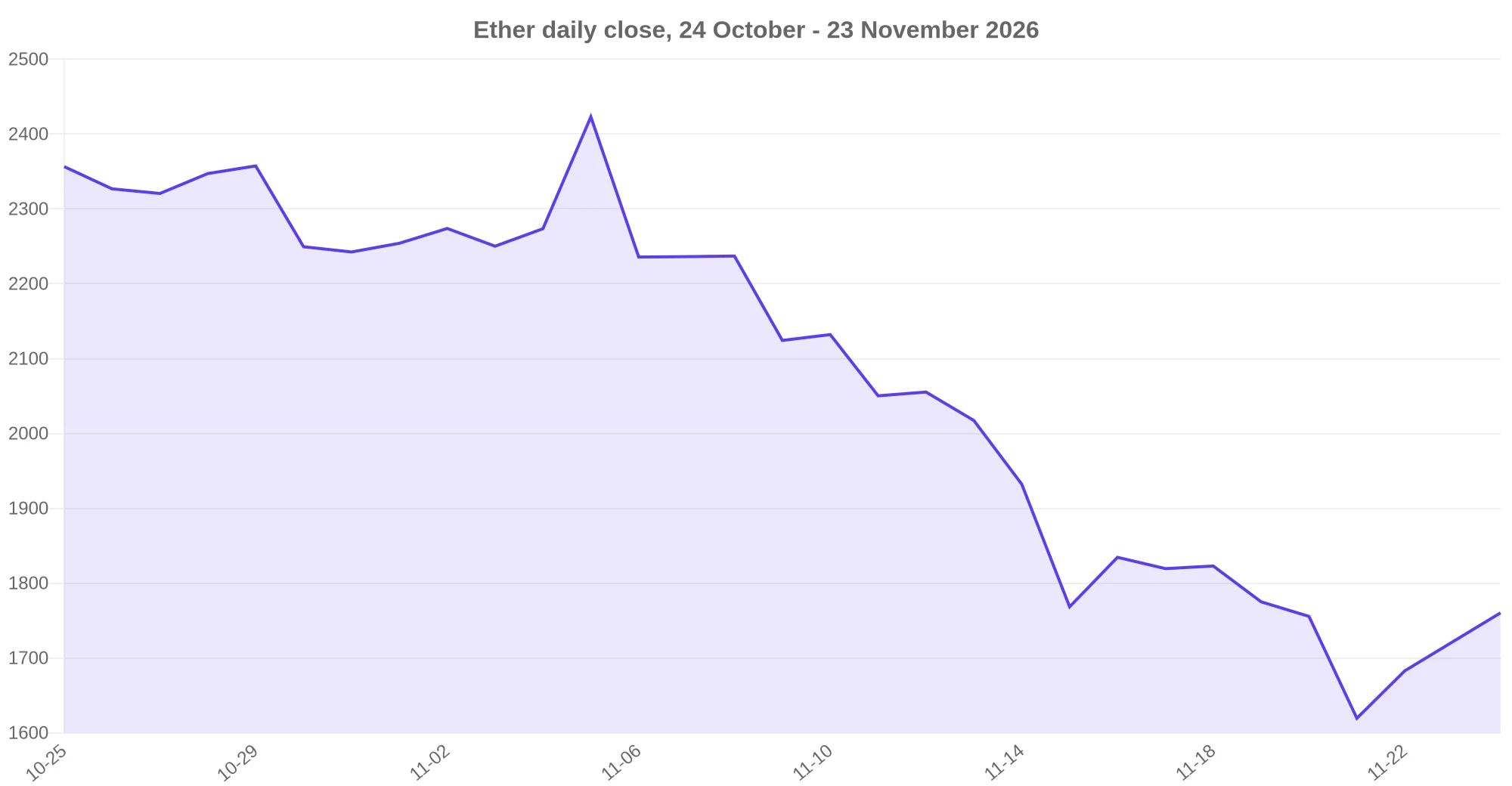
On daily closes from CoinGecko, the 30-session range runs from $1,619.51 on 21 November to $2,423.08 on 5 November. The rebound has taken ether back above the 22 November close of $1,682.85 but not above $1,822.96, the 18 November close and the highest close of the past seven sessions. That $1,823 area is the first level where the bounce stops being a bounce, with the 14 November close of $1,932.28 behind it. A daily close above $1,823 would put the 50-day average of $2,227.25 back in play as a target rather than a ceiling.
Below, $1,682.85 is the first support, and $1,619.51 is the invalidation level for the rebound thesis. A close under that low would leave the 200-day average at $2,119.85 untouched overhead and would put ether at its lowest daily close of the past 90 sessions. These are observed closes, not projections: the levels come from the same CoinGecko series used in the chart above, and they carry no claim about what happens if they break.
One context point deserves care. Ether is still 4.91% lower over seven days and 64.9% below its $4,946.05 all-time high. The 7.3% move off the low recovered part of a November decline that took the price from $2,423 to $1,619, not a reversal of it. Nothing in the BitMine release establishes that the treasury’s buying caused the bounce, and the timing is the only link between the two.
What $1,000 buys across the four majors today
At the 17:53 UTC prices, $1,000 buys 0.0162 bitcoin, 0.5755 ether, 13.60 solana or 1,045 XRP. The more useful comparison is what each asset needs to return to its all-time high, because that is the number the market-cap math has to support.
| Asset | Price | 24h | 7d | Market cap | From all-time high |
| Bitcoin | $61,566 | +1.29% | -5.09% | $1.238T | -51.2% |
| Ether | $1,737.71 | +1.38% | -4.91% | $212.3B | -64.9% |
| Solana | $73.50 | +4.44% | +3.01% | $43.5B | -74.9% |
| XRP | $0.957 | +3.21% | -0.32% | $60.8B | -73.8% |
Bitcoin needs to roughly double to reach $126,080. Ether needs 2.85 times its current price to reach $4,946.05, which would put its market cap near $605 billion from $212.3 billion today. Solana needs 3.99 times to reach $293.31, or about $173.6 billion of market value at a 592 million circulating supply. XRP needs 3.81 times to reach $3.65, near $231.8 billion.
The ranking of that math is the point. Solana and XRP have outperformed over both windows measured here, and both need more multiple expansion than ether to recover their highs. Ether carries the only large, disclosed, schedule-driven corporate buyer of the four, and that buyer is three weeks from a self-imposed stop. Those two facts point in opposite directions, which is why the cap matters more than the bounce.
What would prove this reading wrong
Three things would change the picture. First, a BitMine statement raising or removing the 5% ceiling would turn the three-week clock into an open-ended bid, and the release does not hint at one. Second, a weekly purchase materially above 7,819 ether would shorten the runway and move the cap into the current week. Third, a sustained ether close above $1,823 would suggest the market is pricing something other than the treasury schedule, in which case the cap arithmetic explains less of the tape.
The comparisons inside the release also carry the company’s own framing. BitMine cites Strategy Inc. as holding 849,327 bitcoin valued at roughly $69 billion in the same document; that figure is BitMine’s description of a third party, not a Strategy disclosure, and it should be read that way. The ether supply figure of 122.2 million is likewise the company’s, though it sits within 40,000 tokens of CoinGecko’s 122.24 million circulating count, which is a reasonable independent check.
The mark is another moving part. The release values ether at $1,713, and the live price at 17:53 UTC was $1,737.71. That 1.4% difference lifts the value of the ether stack from $10.42 billion to $10.57 billion, a swing of about $150 million on a position whose reported total is $11.1 billion. Anyone reading the $11.1 billion headline should know which price produced it, and that BitMine’s carrying marks have run well above spot before .
Frequently Asked Questions
BitMine reported 6,085,564 ether as of 3:00pm ET on 22 November 2026, equal to 4.98% of the 122.2 million supply the company cites. Of that, 5,227,037 ether, about 86%, was staked.
The company said in October 2026 that it would halt accumulation at 5% of ether’s supply and has described itself as 99% of the way to that target. At 7,819 ether a week, the remaining gap is about three weeks, unless BitMine raises the ceiling in a new statement.
Ether was $1,737.71 at 17:53 UTC on 23 November 2026, up 1.38% in 24 hours and 7.3% from the 21 November close of $1,619.51, according to CoinGecko. It remains 64.9% below its all-time high of $4,946.05.
The weekly purchase is about $13.6 million at current prices, roughly 0.1% of ether’s $13.20 billion daily volume. That is scheduled demand rather than dominant flow, and no evidence links the 23 November rebound to the treasury’s buying.
On daily CoinGecko closes, $1,822.96 is the first resistance and $1,619.51 the invalidation level for the rebound. Above $1,823, the 50-day average at $2,227.25 becomes the reference; below $1,619.51, ether would sit at its lowest close in 90 sessions.
Data: CoinMarketCap . Prices cross-checked against CoinGecko at 17:53 UTC; holdings, staking and supply figures come from BitMine’s 23 November release.
Read BitMine’s own disclosure on the company’s investor relations page .
This article reports on company disclosures and live market data. It is not investment advice and does not recommend any asset or position.
The post Best Crypto to Buy Now: Ether Rebounds From $1,619 Low While BitMine Nears 5% of Supply appeared first on BlockchainReporter .