


Bitcoin Cash (BCH) changes hands at $275.30 as of 16:47 UTC on October 25, up 1.6% over 24 hours and 1.9% over the week, according to CoinGecko . Its $5.53 billion market cap keeps it in 22nd place among crypto assets, but the more consequential shift this week happened away from the spot tape: on October 20, CME Group confirmed that FalconX and GSR had executed the first block trade in its new Bitcoin Cash futures , opening a regulated on-ramp into the payments-focused Bitcoin fork.
“With trading now underway in our Bitcoin Cash and Uniswap futures, we are providing clients with more versatility to manage cryptocurrency risk and exposure through our robust 24/7 marketplace,” said Giovanni Vicioso, Global Head of Cryptocurrency Products at CME Group, in the company’s first-trade announcement.
The market has not yet repriced BCH for that access. The token sits about 92.7% below its December 2017 all-time high of $3,785.82, and it has lost 45.7% over the past year even as Bitcoin holds near $80,000. Whether the CME listing — and a parallel push to convert Grayscale’s Bitcoin Cash Trust into a spot ETF — changes that gap is the question this article works through.
What the CME Listing Actually Changes for BCH
CME listed two Bitcoin Cash contracts on October 19: a standard contract sized at 250 BCH, and a Micro contract sized at 25 BCH. At the current spot price, one standard contract represents about $68,750 of notional exposure, while the Micro contract represents roughly $6,875 — small enough for a desk to hedge a modest book without committing to the full-size contract.
The first block trade, confirmed on October 20, is the more important detail than the contract specs. A block trade is a privately negotiated, bilaterally agreed transaction between large counterparties that is then submitted to the exchange for clearing. FalconX and GSR stepping in on day one tells you the market makers and prime brokers are treating BCH as a tradeable risk product, not a novelty.
“Institutional demand is moving beyond the largest digital assets toward tokens with distinct use cases, like Bitcoin Cash in payments and Uniswap in decentralized finance,” said Griffin Sears, Head of Derivatives at FalconX, in the same release.
The practical effect is a second, regulated way to take directional or hedging positions in BCH, alongside the spot market. Futures let a miner or a market maker short BCH to hedge inventory without borrowing the token, and let an asset manager gain exposure without custody. That does not, by itself, create buying pressure — a point worth holding onto — but it removes a structural reason institutions previously avoided the asset. CME’s broader crypto suite, which already spans Bitcoin, Ether, XRP, Solana, Cardano, Chainlink, Stellar, Avalanche and Sui, is the reference point: BCH now sits inside the same regulated wrapper as the majors. You can read the earlier launch details in BlockchainReporter’s coverage of CME’s Bitcoin Cash and Uniswap futures .
The Grayscale Conversion and the Supply Picture
Running in parallel is a second institutional track. On September 14, Grayscale filed to convert its existing Bitcoin Cash Trust (BCHG) into a spot Bitcoin Cash ETF, following the same playbook it used to convert its Bitcoin and Ethereum trusts. The conversion matters because BCHG today trades over the counter with a different, often less liquid structure; a spot ETF on a national exchange would give the fund a creation-and-redemption program and put BCH exposure inside ordinary brokerage accounts. BlockchainReporter covered the filing in full here .
The supply side is where BCH’s mechanics differ from most of the market. Bitcoin Cash shares Bitcoin’s 21 million coin cap and its four-year halving schedule. Of that cap, roughly 20.11 million BCH are already circulating — about 95.7% of the maximum supply has been mined. That leaves less than 900,000 BCH to be issued over the remaining decades. A small float relative to a fixed cap is the arithmetic that often gets cited for repricing, but it cuts both ways: with 95.7% already mined, there is little supply-side surprise left to price in.
Where BCH Sits on the Price Chart
Over the past 30 days BCH has traded in a band between roughly $265 and $343, and it is currently pinned toward the lower middle of that range at $275. The $265 area is the first support — the 30-day low, where October’s dips have so far found buyers. On the upside, $343 marks the top of the recent range.
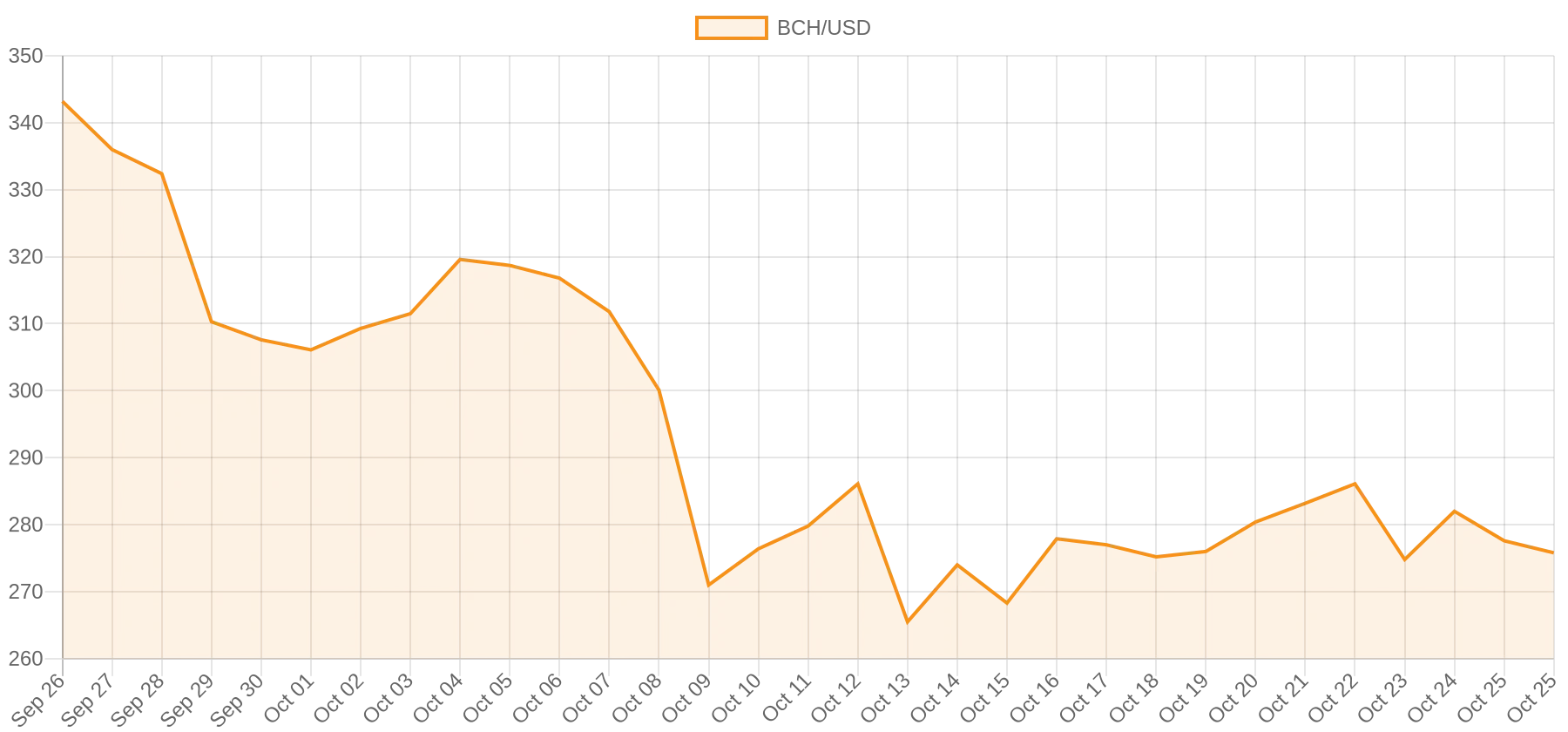
None of those levels are magic. They are simply where the last month of trading found equilibrium, and they are the honest basis for a conditional view: a daily close above $343 would break the October range and put the 2026 highs back in play, while a loss of $265 would open a retest of the lower end of the year’s range. The bearish signal to watch is a break of $265 on rising volume, which would invalidate the range-bound read and suggest the CME and ETF catalysts are not yet being paid for.
For context on the broader demand environment, CME reported its highest third-quarter revenue on record on October 21: $1.7 billion in revenue, $1.0 billion in net income, and average daily volume of 29.4 million contracts. “As uncertainty intensified in Q3, clients turned to CME Group in record numbers to manage risk and capitalize on opportunities,” said Terry Duffy, CME Group Chairman and CEO. The read-through for BCH is indirect but real — the venue institutions already use for crypto risk is the same one now clearing BCH futures.
The Money-Math: What a Repricing Would Have to Look Like
Any money-angle thesis on BCH has to survive the market-cap arithmetic. At $5.53 billion, BCH is small enough that a re-rating moves the price fast, but far enough from the majors that the multiples look extreme on paper. A 10x on BCH’s market cap would take it to roughly $55 billion — just behind Solana’s $59.7 billion and ahead of every other altcoin — implying a BCH price near $2,750. To match Bitcoin’s $1.6 trillion capitalization, BCH would need to rise about 292x from here, which is not a forecast anyone should treat as a base case.
A more grounded way to frame the same question is the BCH-to-BTC ratio. At $275.30 against Bitcoin’s $80,491, one BCH is worth about 0.34% of one BTC. Through most of Bitcoin Cash’s history that ratio sat between 1% and 10%, so the current reading is toward the bottom of the historical distribution. A return to even 1% — BCH near $805 with Bitcoin unchanged — would be a 2.9x from today’s price. That is the arithmetic that a futures listing plus an ETF conversion is theoretically capable of supporting, but it is a scenario, not a target: it requires the institutional rails to translate into sustained spot buying, and that translation is exactly what has not yet been demonstrated.
The Skeptical Case: Futures Are Not Demand
The cleanest argument against reading the CME listing as bullish is that derivatives are two-sided. Every BCH futures contract long has a short on the other side, and a venue that lets institutions short an asset can just as easily attract selling as buying. The listing is neutral plumbing; what matters is the net flow it eventually carries.
BCH’s own price history supplies the cautionary half. It is down 45.7% over the past year and 17.5% over the past 30 days, even as the network keeps functioning and the CME and Grayscale developments accumulated. A payments-focused fork of Bitcoin also competes against faster, cheaper layer-2 rails and stablecoin settlement, which is why BCH has struggled to convert its technology into sustained demand growth. If the ETF conversion stalls or the futures attract more hedging than speculative length, the $265 support, not the $343 ceiling, is the level that gets tested next.
Frequently Asked Questions
Bitcoin Cash trades near $275 as of October 25, 2026, up about 1.6% over 24 hours, with a market cap near $5.5 billion, according to CoinGecko.
CME Group launched Bitcoin Cash futures on October 19, and FalconX and GSR executed the first block trade on October 20. Grayscale has separately filed to convert its Bitcoin Cash Trust into a spot ETF.
CME lists a standard Bitcoin Cash contract of 250 BCH and a Micro contract of 25 BCH. At $275 per BCH, the standard contract represents about $68,750 of notional value.
That depends on your view of its adoption path. BCH sits 92.7% below its 2017 all-time high and is down 45.7% over the past year, so the case rests on the new institutional rails translating into sustained spot demand — which has not yet been shown.
Grayscale filed to convert its Bitcoin Cash Trust (BCHG) into a spot Bitcoin Cash ETF on September 14, 2026. The conversion is pending and has not yet been approved or made effective.
Disclosure: This article does not represent investment advice. The content and materials featured on this page are for educational purposes only.