

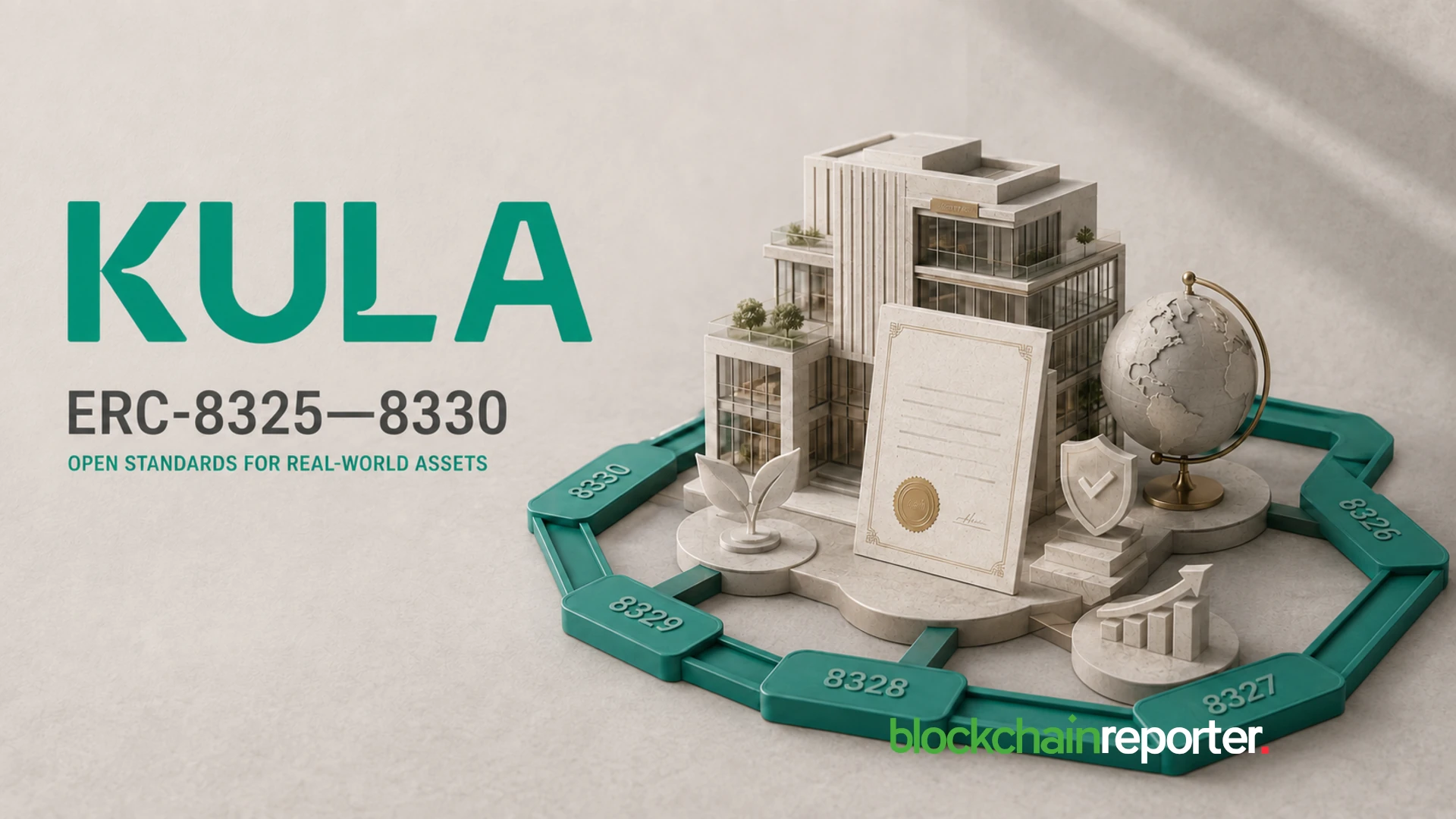
Kula , a compliant RWA tokenization entity, has recently proposed 6 exclusive Ethereum Request for Comment (ERC) benchmarks. With the proposal of ERC-8325–8330, Kula is addressing the compatibility gap, as several platforms are fragmented without the capability to develop on the work of each other.
As per Kula’s official press release, the proposal attempts to make RWA tokenization composable, just as ERC-20 redefined fungible tokens. Every proposed benchmark handles an exclusive challenge, including the verification of the asset connection to and the recording of diverse compliance events.
Kula Introduces ERC-8325–8330 Standards to Advance RWA Tokenization
Kula’s proposals for ERC-8325–8330 standards are currently in the last phase of review, underscoring a key point for the wider adoption of exclusive tokenized assets among institutions. These ERCs will reportedly extend the currently working frameworks instead of replacing them. Specifically, ERC-8325 offers a transparent registry-scoped connection between an anchor record denoting claims regarding off-chain assets and a token.
Apart from that, ERC-8326 guarantees that the obtained documents comprehensively correspond to diverse canonical commitments on-chain. Additionally, ERC-8327 enables jurisdiction-specific transaction compliance, a function that is not available for the existing standards.
Simultaneously, ERC-8328 develops a queryable and structured record of unique compliance events within the lifecycle of an asset. Moreover, ERC-8329 standardizes the recording and verifiability of the impact data. At the same time, ERC-8330 specifies a common interface in the case of the asset assessment reporting on-chain.
Eliminating RWA Tokenization Compatibility Challenges Across Borders for Wider Adoption
The fragmented compliant landscape highlights the requirement for the respective standards. In this respect, different jurisdictions are taking significant steps to meet these needs. While every jurisdiction possesses a live framework, none have compatibility with the others.
This forces new entities to reestablish validation stacks. Keeping this in view, Kula’s latest proposals attempt to remove such inefficiencies by developing a mutual infrastructure. Thus, Kula’s attention toward title tokenization separates it from diverse custodial models.
Kula’s Co-Founder, Chris Turner , said, “When we talk about institutional adoption of tokenised real-world assets, the question is never whether the technology can do it – it can.” As per him, the real issue is if 2 counterparties in diverse jurisdictions can trust and use the same asset without redeveloping the validation stack anew. So, he added, the latest standards are set to answer the respective question. Issued under Creative Commons Zero (CC0), these proposals guarantee their free usability and open-source nature.