



Crypto exchanges have been marketing themselves as “democratized financial platforms” where anyone with an internet connection can trade alongside institutions on equal footing. But according to Ouinex CEO and FX industry veteran Ilies Larbi that promise may be far more misleading than most retail traders realize.
“It’s like putting fish in a tank with sharks,” Larbi wrote in a March 2025 company post criticizing the central limit order book (CLOB) model used by most crypto exchanges. His argument is simple: retail traders using mobile phones are competing on the same infrastructure as high-frequency trading firms with vastly superior technology, execution speeds, and capital resources.
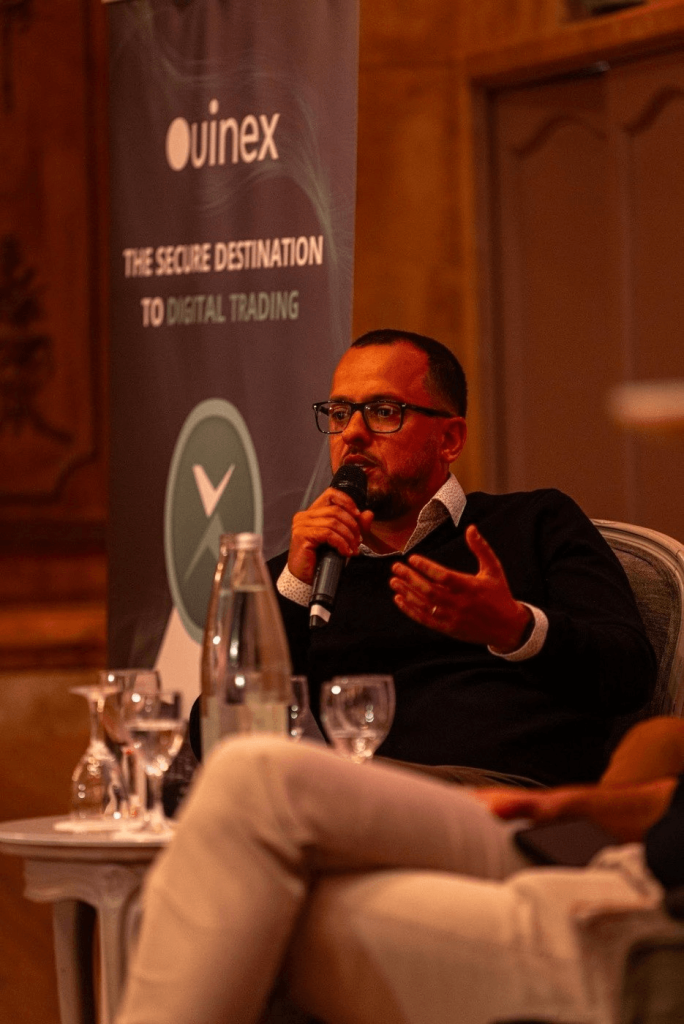
Ilies Larbi, Founder and CEO, Ouinex
That criticism is now gaining broader visibility following a Forbes feature this month titled “Fish In A Tank With Sharks – Ouinex Hits $9M To Kill The Order Book,” which examined the exchange’s unconventional approach to market structure and funding.
The article arrives shortly after Ouinex announced the completion of a $3.5 million equity round, bringing total funding for the platform to $9 million. Unlike most crypto exchanges, however, the company says none of that capital came from venture firms or institutional backers. Instead, the money was raised entirely from retail and professional traders using the platform.
According to Ouinex, more than 10,000 traders now hold equity in the company.
The model has drawn comparisons to decentralized exchange Hyperliquid, which also gained traction by prioritizing community participation over venture capital funding. But Ouinex is taking a different route. While Hyperliquid operates as a decentralized perpetuals exchange, Ouinex is building a fully regulated centralized platform with licenses across multiple jurisdictions and mandatory KYC requirements.
At the center of the debate is the exchange’s rejection of the traditional order book system used across both crypto and traditional electronic markets.
The Problem With Crypto’s Trading Infrastructure
In a LinkedIn post , Larbi argued that the rapid growth of “TradFi perps” – crypto-based perpetual products tied to traditional financial assets like forex and gold – may be exposing retail traders to deeply unfavorable market conditions. Drawing on more than two decades of experience in the FX and CFD industry, Larbi compared trading costs on major crypto platforms to traditional financial infrastructure and claimed the differences were dramatic.
Using EUR/USD perpetuals on Hyperliquid as an example, he argued that visible spreads combined with taker fees create an effective trading cost significantly higher than what traders typically experience in traditional forex markets.
He saw similar problems with gold products on Binance, arguing that while advertised spreads may appear attractive, the fee structures substantially increase real execution costs for retail users.
But for Larbi, the issue extends beyond fees.
He describes what he calls “CLOB asymmetry”, a market structure where retail participants compete directly against sophisticated trading firms with faster infrastructure, lower latency, and superior execution systems.
Larbi says, many retail traders mistakenly assume they are participating in efficient institutional-grade markets when, in reality, they are operating at a structural disadvantage.
“Liquidity is thinner, fees are massively above traditional market standards, and the other side sees more and reacts faster,” he states.
The criticism taps into a broader anxiety that has been growing across the crypto industry since the collapse of major platforms like FTX in 2022 and several high-profile security breaches and liquidation events that followed.
Ouinex’s Alternative: The “No-CLOB” Model
Rather than operating through a public order book, Ouinex says it uses a proprietary “No-CLOB” execution architecture inspired by systems commonly found in foreign exchange and CFD markets.
Under the model, market makers provide pricing to the platform but cannot see retail orders or directly trade against them. Ouinex aggregates those quotes, applies a markup, and displays a single executable price to the user.
Ouinex says this structure reduces opportunities for practices such as front-running, stop-hunting, and other forms of execution manipulation that critics associate with traditional order book environments.
Samuel Rondot, Ouinex’s Head of Trading and Strategy, described the system as an attempt to restore fairness to trading infrastructure.
“On most platforms, market makers can see the order book and position against retail traders,” Rondot said in the company’s recent announcement. “On ours, it stays hidden from them.”
The exchange’s broader pitch appears to focus on aligning the platform’s interests more closely with those of its users. Because the exchange itself is community-funded, Ouinex argues it has less incentive to prioritize institutional agendas or aggressive monetization strategies that could disadvantage traders.
That narrative has resonated with some participants in the trading industry.
Rodolphe Steffan, founder of InteractivTrading, publicly disclosed that he invested in the company, describing the model as something traders had been requesting “for years.”
A Wider Industry Shift?
Ouinex is not alone in trying to rethink exchange economics.
As Forbes noted, older exchanges like Bitfinex are also repositioning themselves by reducing or removing trading fees while emphasizing alternative revenue models rather than relying purely on transaction flow. Meanwhile, newer decentralized platforms continue experimenting with different ownership and liquidity structures.
At the same time, retail participation in crypto markets continues to grow, particularly around perpetual futures and tokenized traditional assets.
That growth raises a larger question for the industry: can crypto create trading infrastructure that genuinely serves retail users, or will the sector continue replicating the same institutional asymmetries found in traditional finance?
Ouinex is betting that traders are ready for a different model – one where exchanges are funded by their communities, market makers cannot see customer flow, and retail participants are no longer treated as liquidity for larger players.
Whether that vision can scale remains to be seen. But the conversation around fairness, transparency, and market structure in crypto trading is clearly getting traction.