
The post Iranians Increase Self-Custody Bitcoin Reserves Amid Iran-Israel War appeared first on Coinpedia Fintech News
Citizens of Iran are heavily purchasing Bitcoin (BTC) and directing it to self-custody wallets.
A 2026 report from blockchain analytics firm Chainalysis showed an uptick in Iran’s crypto system valuation from $7.4 billion in 2024 to $7.8 billion in 2025.
The report also highlighted that users withdrew roughly $10.3 million worth of cryptocurrencies from major Iranian exchanges to crypto wallets in the 48hours following the US-Israel’s preemptive strike on Iran. Within minutes of the hit, the country’s largest exchange, Nobitex, saw a staggering 700% spike in outflows.
This coincided with a steady uptrend in Bitcoin outflows before and after the January 8 government-imposed internet blackout.
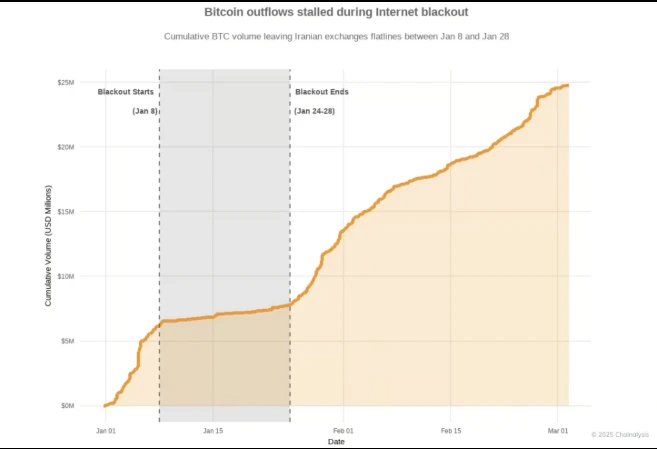
Source: Chainalysis
Bitcoin becomes the financial lifeboat for Iranian citizens
Bitcoin has primarily become a financial haven for Iranians since its long-term value acts as an inflationary hedge. Iran’s native currency, the Rial, has declined 90% in value since 2018. Inflation in the country has also escalated to 40-50%, the highest recorded since World War II.
Additionally, Bitcoin in self-custodial wallets is immune to state/exchange restrictions and security vulnerabilities. In mid-2025, Nobitex suffered a $90 million hack, while Tether continues to blacklist addresses and freeze USDT funds for alleged Iranian conspirators.
Meanwhile, the nation’s central bank (CBI) has suspended rial-crypto conversions several times to prevent further devaluation of the rial. The bank has recently become more accommodating of cryptocurrencies, but on the condition of real-time user surveillance.
Another reason for the migration is the January government-imposed internet blackout, which rendered cryptocurrencies on exchanges useless. Additionally, cryptocurrencies’ digital nature makes them highly portable for those anticipating fleeing the country.
Most importantly, cryptocurrencies allow cross-border remittances despite sanctions such as the SWIFT bank line of disconnects.
Researchers now estimate that 15 million Iranians (20% of the population) are involved with or using Bitcoin, among other cryptocurrencies.
Iran joins sanctioned countries in Bitcoin adoption
Iran, Russia , Venezuela, and North Korea are sanctioned countries that are increasingly pivoting towards cryptocurrencies to bypass international trade restrictions.
Crypto firms Binance and, ironically, the Trump-backed World Liberty Financial (WLFI) are now facing Senate probes related to Iran-linked flows.