
In the span of a couple of hours on Sunday evening, prominent cryptocurrencies, including Bitcoin, Ethereum, and others, experienced a significant decline, resulting in liquidations totalling hundreds of millions of dollars.
That nervousness continued into Monday, with top tokens falling deeply again.
At around $64,300, Bitcoin hit its lowest value since February 6, a 4.8% decrease. Ether, the second-largest digital asset, fell 5.2%.
Those deep losses came after US authorities told trading partners on Sunday that all current trade deals need to be preserved.
Recent macro shocks have rattled fragile markets and have been exacerbated by this development after the Supreme Court's ruling nullified President Trump's tariff emergency powers on Friday.
More economic uncertainty has been added to the mix by Trump's latest social media update, in which he increased global duties to 15% from the 10% announced a day earlier.
That creates a massive mix of uncertainty and imbalanced tariffs on countries that have already negotiated a trade deal.
While broadly, anti-tariffs ruling was expected to sweeten the path for Bitcoin and other cryptos, the Trump administration's response has made markets erratic.
The chaos comes after a deep rout in cryptos since hitting record highs in October.
All the gains that Bitcoin had made since Trump's re-election in November 2024 were reversed earlier this month.
Bitcoin hit a new all-time high of almost $126,000 in October of last year, just before a massive selloff that has wreaked havoc on the digital asset market ever since.
This was all due to hopes that Trump would take a more lenient approach to cryptocurrencies during his second term in office.
More than $2 trillion in value has been lost across the board in the cryptocurrency market, with smaller coins being hit the hardest.
The liquidation of several hundred million dollars in long positions intensified the decline that had been underway since Sunday. About $100 billion in long positions were liquidated, as indicated by CoinGecko's data-driven heatmap.
Deribit, a crypto derivatives platform, reports that protecting against losses around the $60,000 mark is a major priority.
Macro Risks
U.S. pending home sales fell 0.8% in January, hitting a record low of 70.9 since the data was first collected in 2001.
This pattern suggests that investors in the US market are becoming more worried about the economy.
The dollar and Wall Street futures have taken a nosedive due to the new uncertainty brought forth by Trump's latest 15% global import tax.
In the case of Bitcoin, there has been an unprecedented 59% weekly drop in spot volumes and five weeks running of ETF outflows. As a result, there was obviously not enough cash on hand to weather such a shock.
In a cautious market environment, bitcoin is the first to respond; this trend is not unique to crypto itself at the moment.
Speculation over a possible policy change towards further monetary tightening by the Bank of Japan has contributed to the recent rapid appreciation of the Japanese yen.
Funds were forced to lower their leverage due to the quick growth, which worsened the global collapse in risk assets.
Bearish Bets Return
Once it surpassed the $67,200 mark, the price of Bitcoin couldn't stay there. Once again, Bitcoin has fallen below the $66,500 support level, marking the beginning of a bearish trend.
The price slumped to lower than $65,000.
The BTC/USD pair fell below a bullish trend line, with $68,000 serving as support, on the hourly chart.
The most recent low was reached at $64,203, and the price is now experiencing a correction in order to recoup part of its losses.
Although the price has risen over $64,500, it is still well below the 23.6% Fibonacci retracement level of the most recent decline, which began at $68,653 and ended at $64,203.
Right now, the price of bitcoin is well below $66,500, which is also below the 100 hourly simple moving average.
If the price remains stable over $64,200, a fresh upward trend would be possible. The present level of resistance is about $65,250.
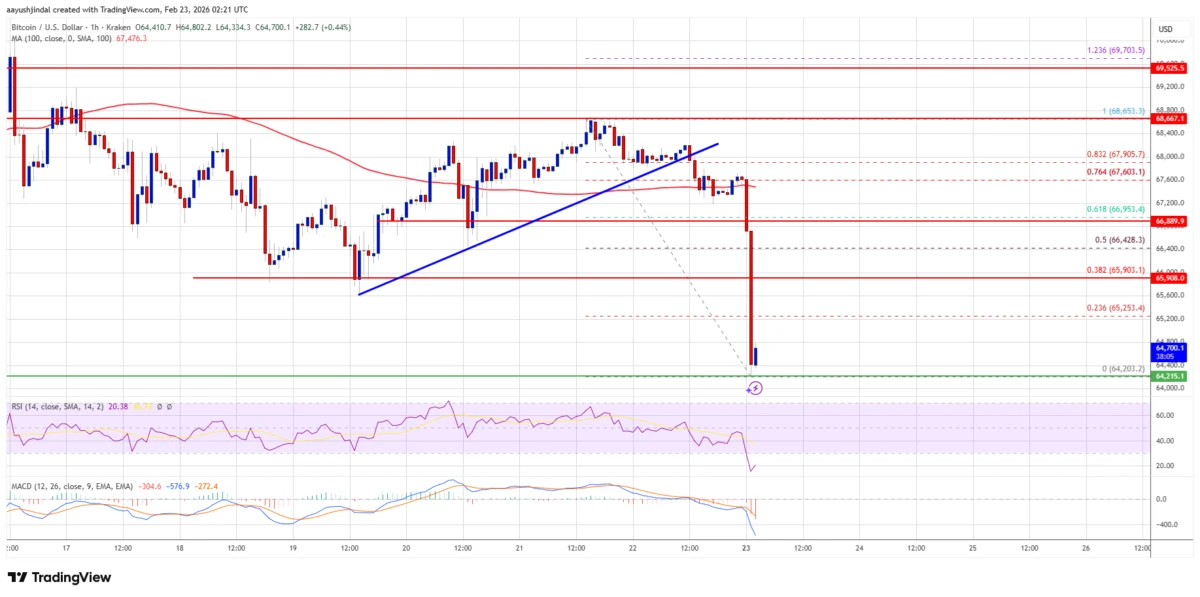
The current decline from the $68,653 peak to the $64,203 trough has a 50% Fibonacci retracement level at $66,400, which is the first major hurdle.
If the price can break past the $66,400 level of resistance, it might continue to rise. In this case, a price increase might push the market beyond the $67,000 psychological barrier. If prices continue to rise, they may reach $67,600.
Potentially approaching areas of resistance for the bulls are $68,000 and $68,500.
Bitcoin may start a downtrend if it can't break through the $66,000 level of resistance. Around $64,400, there is a considerable amount of support. One can find the first significant level of support at around $64,200.
The subsequent support level is at $63,500.
Support at $62,850 may be reached shortly if the price continues to fall. A quick recovery may be difficult if Bitcoin drops below $62,000, its present primary support level.
Blockcast – Licensed to Shill: How Energy & Geopolitics Are Building a Bitcoin-Driven World, ft. Bitcoin Arabia's Lara Eggimann & Jeff Gorman
The Middle East is poised to become a pivotal hub in the global cryptocurrency ecosystem. Countries within the region are increasingly recognizing the strategic importance of integrating blockchain technology into their economic frameworks, energy markets, and geopolitical strategies, according to Lara Eggimann and Jeff Gorman, co-founders of Bitcoin Arabia , a strategic Bitcoin advisory and ecosystem builder that connects the global Bitcoin industry with the Middle East’s most powerful stakeholders.
Thanks for tuning in! If you enjoyed this episode, please like and subscribe to Blockcast on your favorite podcast platforms like Spotify and Apple .
Be at the heart of TradFi–DeFi collaboration at Money20/20 Asia 2026 .
Are you looking to forge partnerships with banks and fintechs? To expand into new markets across Asia, or to secure funding from top-tier investors? This April, the world of digital assets, blockchain, and Web3 converges with the biggest players in APAC’s financial ecosystem at Money20/20 Asia 2026 and its brand new ‘Intersection’ zone, complete with a dedicated content stage, TradFi-Defi innovator showcase, and curated networking spaces. From traditional banking giants to decentralised innovators, private equity leaders, and cutting-edge fintech disruptors, this is where they meet to forge partnerships, spark dialogue, and shape the future of finance.